How to Structure Multi-Campaign Creator Agreements and Renewals
When you work with the same creator several times a year, a fresh contract every campaign is slow and inconsistent. How to split fixed terms into a master agreement and campaign-specific details into short campaign orders, handle pricing, rights and exclusivity across campaigns, and review the agreement at renewal.
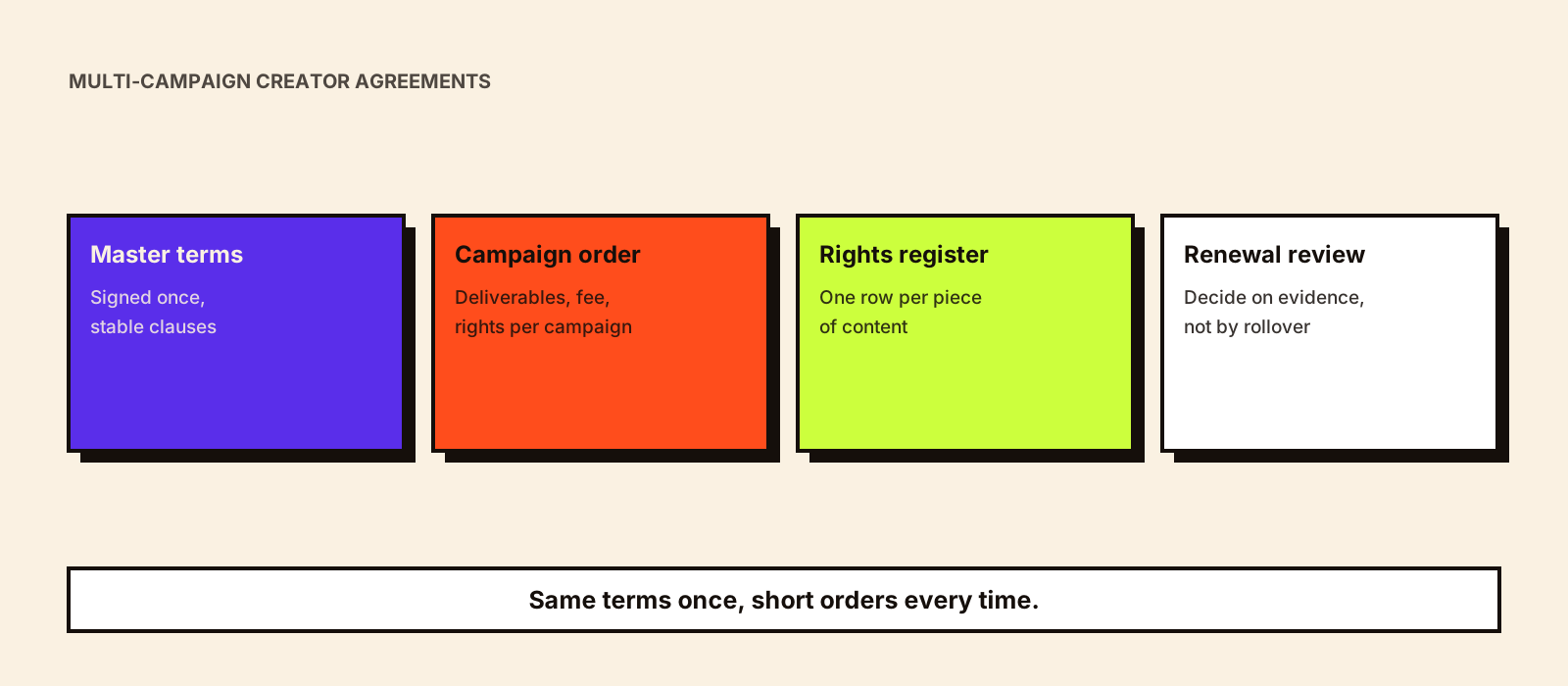
The third time you book the same creator, the contract starts to feel like the slowest part of the campaign. Legal re-reviews the same clauses, the rate is renegotiated from scratch, and nobody is sure whether the rights from the first campaign have expired. A multi-campaign agreement fixes that by deciding the stable terms once and keeping each campaign to a one- or two-page order.
Quick answer
Use a two-layer structure. A master agreement holds the terms that don't change between campaigns: disclosure, approvals, payment mechanics, general rights rules, conduct, confidentiality, liability and termination. Each campaign then gets a short campaign order (sometimes called a statement of work) with deliverables, dates, fee, usage rights, exclusivity and any special conditions. Lock rates for a defined period or volume, give every campaign its own rights and exclusivity window, and set a review date before the agreement renews so both sides can renegotiate on evidence. This is general guidance, not legal advice.
When a multi-campaign agreement makes sense
| Arrangement | Best for | Contract shape |
|---|---|---|
| One-off campaign | First collaboration or a single launch | One standalone contract |
| Multi-campaign agreement | A creator you expect to book two or more times in the next 6 to 12 months, with campaigns that differ | Master agreement plus a campaign order each time |
| Ambassador or retainer | A steady monthly commitment and a deeper role with the brand | One agreement with a fixed monthly scope, often with campaign orders for extras |
If you're still deciding whether to rebook a creator at all, start with repeat influencer collaborations. If the relationship is becoming a fixed monthly role, an ambassador programme is the better model. The clauses themselves are explained in influencer marketing contracts; this page is about how to organise them over time.
What goes in the master and what goes in each order
| Master agreement (signed once) | Campaign order (one per campaign) |
|---|---|
| Parties, term and how orders are created and accepted | Campaign name, objective and brief reference |
| Disclosure duties and compliance with ASCI and platform rules | Deliverables: platforms, formats, number of posts, duration |
| Approval process, revision rounds and response times | Draft, approval and go-live dates |
| Payment mechanics: invoicing, tax documents, payment days | Fee for this order and payment milestones |
| Rate card or price lock, and when it can change | Any agreed variation from the rate card |
| Default rights rules (what's included if an order says nothing) | Usage rights for this content: channels, duration, paid use, markets |
| Default exclusivity rules | Exclusivity for this campaign: category, period, markets |
| Conduct, morality, confidentiality, data handling | Product, gifting and return arrangements |
| Cancellation and termination of the whole agreement | Cancellation terms specific to this order, if different |
| Liability, governing law, dispute process | Special conditions (claims sheet, regulated-category review) |
The rule of thumb: if a term would be the same in every campaign, it belongs in the master. If it changes with the brief, it belongs in the order. And the master should say clearly that when an order conflicts with the master on a specific point, the order wins for that campaign only.
Pricing across several campaigns
Creators usually accept a lower per-campaign rate in exchange for predictable work, but only if the predictability is real. Decide which of these you're offering:
| Model | What the brand commits to | What the creator gives | Watch out for |
|---|---|---|---|
| Rate lock | Nothing beyond the orders you place | A fixed rate card for a period, such as 12 months | Creators often limit the lock to a period or a number of orders |
| Volume commitment | A minimum number of campaigns or spend | A lower rate per deliverable | You pay for the minimum even if plans change |
| Options | A right to book further campaigns at an agreed rate by a date | Holds availability and price | Options usually cost something if they're exclusive |
| Retainer | A fixed monthly fee for a fixed scope | Monthly deliverables and priority | Unused scope rarely rolls over unless agreed |
Whichever model you choose, write down when rates can be reviewed (for example, at renewal or if the creator's audience changes materially) and what happens to orders already placed. For fair payment terms across several orders, see influencer payment terms.
Rights: one register, one window per campaign
The most common mess in long relationships is rights. Content from campaign one is still running as an ad after its licence ended, or nobody knows whether paid use was ever included. Two habits prevent it. First, every campaign order states its own usage terms, even if it's 'as per master default'. Second, keep a rights register with one row per piece of content: creator, order number, channels, paid use, start and end dates. Influencer usage rights covers how to scope and price rights; the agreement's job is to make each campaign's rights unambiguous.
Exclusivity across campaigns
A year-long blanket exclusivity in a multi-campaign agreement is expensive and often unnecessary. A fairer pattern is exclusivity tied to each active campaign, for example from the go-live date to 30 days after the last post, within a narrowly defined category. If you genuinely need year-round exclusivity, pay for it separately and say so. Influencer exclusivity explains how to define the category and judge the cost.
Cancelling an order versus ending the agreement
- Order cancellation: what you pay if a single campaign is cancelled before or after content is produced. This can differ by order.
- Termination of the master: notice period, what happens to orders already accepted, and whether either side can walk away without cause.
- Termination for cause: disclosure failures, serious conduct issues, repeated missed deadlines, non-payment.
- Rights after termination: licences already granted for completed content usually continue for their stated term unless the agreement says otherwise. Decide this explicitly.
Cancellation in practice, including how to handle it with the creator, is covered in influencer campaign cancellation.
Campaign order no. [__] under Master Creator Agreement dated [__]
Campaign: [name]   Objective: [awareness / sales / content for ads]
Brief: [link, version]
Deliverables: [e.g. 1 Reel (45-60 s), 3 Stories with link, 1 collab post]
Dates: draft by [__]; brand feedback within [2] working days; go-live [__]
Fee: ₹[__] (rate card / agreed variation: [__])   Payment: [50% on approval, 50% within 30 days of go-live]
Usage rights: [organic brand channels, 6 months; paid use on Meta, 3 months; India only]
Exclusivity: [category], from go-live to [30] days after last post
Product and gifting: [details, returns]
Special conditions: [claims sheet attached; regulated review]
Signed: Brand ______  Creator ______  Date ______
Running the renewal review
Put a review date in the agreement, ideally 30 to 60 days before it renews or expires, so neither side is negotiating under deadline. The review should be a short, evidence-based conversation, not an automatic rollover.
- Results by campaign against each order's objective, compared with other creators of a similar type.
- Working relationship: draft quality, deadlines, revision rounds, responsiveness.
- Audience change since signing: size, location, engagement quality.
- Rights in use: which content is still running and whether licences need extending.
- Rate: whether the lock still reflects the market and the creator's value to you.
- Next year's plan: how many campaigns, which formats, whether exclusivity is still needed.
- The creator's view: what they'd change, and what would make them prioritise you.
| Review outcome | When | What changes |
|---|---|---|
| Renew as is | Results and working relationship both strong | Extend term; rate review if agreed |
| Renew with changes | Good partner, but scope, rate or formats no longer fit | Updated rate card, deliverable mix or rights defaults |
| Move to ambassador or retainer | You're booking them almost monthly | Fixed monthly scope replaces separate orders |
| Let it lapse | Results weak relative to alternatives, or fit has changed | End cleanly; confirm rights still running and their end dates |
An illustrative example
Hypothetical: a home-fragrance brand books a lifestyle creator for Diwali, a spring launch and an end-of-season sale. Instead of three contracts, it signs a 12-month master with a rate lock at ₹60,000 per Reel and ₹15,000 per Story set, and a review date in month 10. Each campaign gets a one-page order: Diwali includes three months of paid use; the launch includes six months of organic use only; the sale has no exclusivity. At the month-10 review, the launch content outperformed the brand's other creator ads, so the brand renews with paid use as the default and adds one extra campaign. The figures are illustrative, not benchmarks.
Common mistakes
- Copying the first campaign's contract and changing dates, so rights and exclusivity drift between campaigns.
- Putting deliverables in the master, then needing an amendment every time the brief changes.
- Blanket exclusivity for the full term without paying for it.
- No rights register, so expired content keeps running in ads.
- Letting the agreement renew automatically with no review.
- Locking a rate without saying when it can change.
This is general guidance, not legal advice. Have a lawyer draft or review your master agreement, particularly the rights, termination and liability sections.
Conclusion
A master agreement with short campaign orders turns repeat creator work from a legal project into a quick booking, while keeping each campaign's rights and exclusivity clear. Add a rights register and a proper renewal review, and the relationship can grow on evidence rather than habit. If you'd like help setting up long-term creator agreements, Kudozz's influencer outreach and management team handles contracting and renewals as part of managed programmes.