Copyright-Free Music for Instagram Reels and YouTube: What Creators Should Know
What copyright-free, royalty-free and Creative Commons really mean, where to find music for Reels and YouTube, how Content ID claims work, and music rules for brand deals.
You find the perfect track, post the Reel, and a day later the audio is muted or your YouTube video has a copyright claim. Most music problems come from misunderstanding three words: copyright-free, royalty-free and licensed. This guide explains what they mean, where creators in India can find music they are allowed to use, what happens when you get a claim, and how music changes once a brand is paying you.
Quick answer
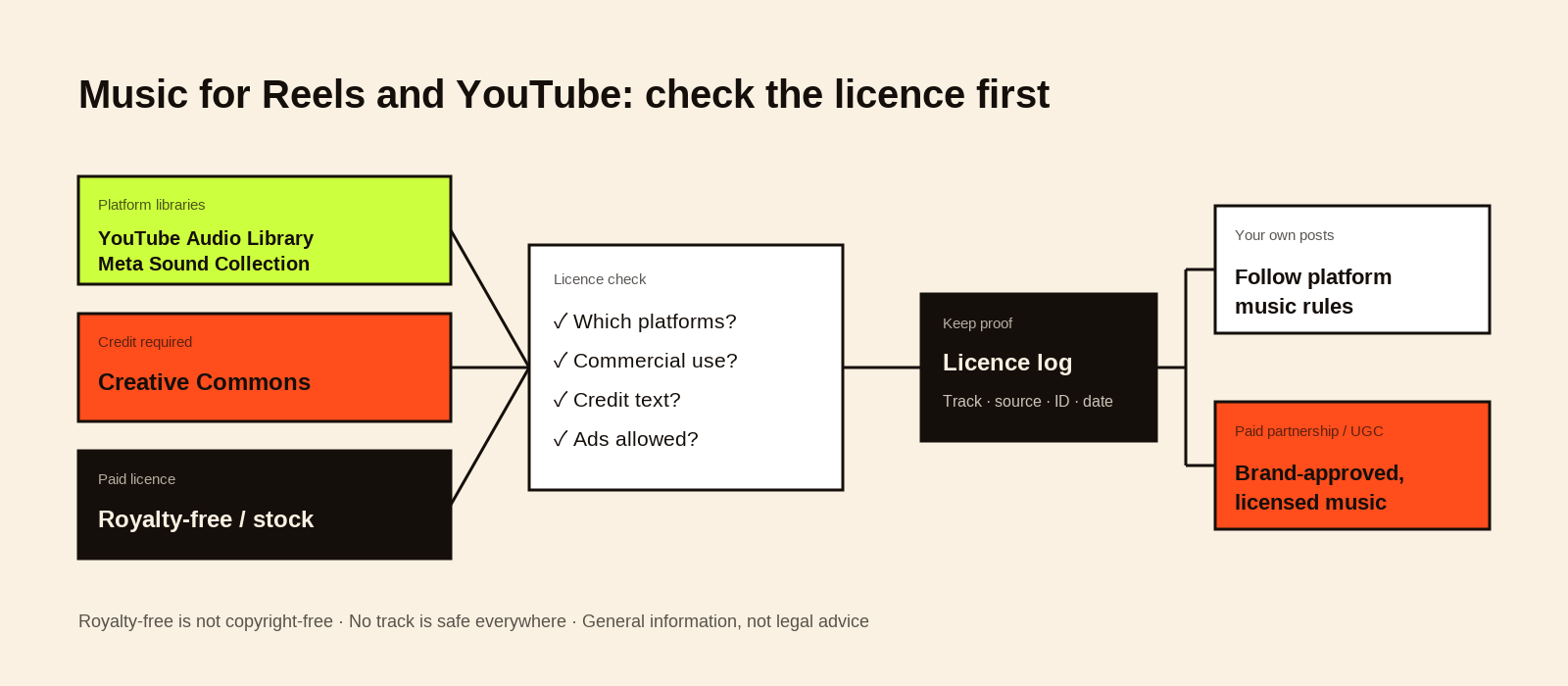
Almost all music is protected by copyright, so "copyright-free" usually means you have permission under certain conditions, not that anything goes. For YouTube, the Audio Library in YouTube Studio is the simplest source, with credit required for Creative Commons tracks. On Instagram, use the in-app music library for personal posts, or Meta's Sound Collection if your business account lacks the library. For paid partnerships and UGC, use music the brand has approved and licensed for that use. Keep a record of every licence.
This guide is general information, not legal advice. For a dispute or a high-value deal, speak to a lawyer who handles copyright.
Music terms, explained
"Copyright-free" is a search term, not a legal category. YouTube calls its own library "copyright-safe" instead. The Creative Commons FAQ is clear that "CC licenses are copyright licenses, and depend on the existence of copyright to work". Here is what each label usually means:
| Label | What it means | What you must do |
|---|---|---|
| Public domain | Copyright has expired or never applied | Confirm the specific recording is also public domain, not just the tune |
| CC0 | A public domain dedication by the creator; Creative Commons says it is not a licence | Usually nothing, but keep the source page as proof |
| Creative Commons (CC BY and others) | A copyright licence; every CC licence requires attribution | Credit as asked; NC bars commercial use, ND bars changes, SA requires sharing under the same terms |
| Royalty-free | No per-use royalty, but still copyrighted and licensed with conditions | Follow the licence: platforms, commercial use, credit |
| Licensed or stock subscription | You pay for a licence covering certain uses | Check whether brand and ad use is covered, and what happens if you cancel |
| Platform libraries | Music the platform has cleared for use on that platform | Use it inside the platform's rules; don't assume it works elsewhere |
The takeaway: royalty-free does not mean free of copyright. It means you don't pay each time, but the licence terms still apply.
Why an old song can still be protected in India
Under India's Copyright Act, 1957, a song usually contains separate copyrights: the music (composition), the lyrics, and the sound recording. Section 13(4) says copyright in a sound recording does not affect the separate copyright in the underlying work. They also last for different periods:
- Composition and lyrics (section 22): 60 years counted from the start of the year after the author dies. With several authors, it counts from the death of the last surviving one.
- Sound recording (section 27): 60 years counted from the start of the year after the recording is published.
An illustrative example: a film song recorded and published in 1975 has its recording protected until the end of 2035. If its composer died in 2000, the composition is protected until the end of 2060. A new cover or remix creates a fresh recording with its own copyright too. So "it's an old song" is not a reason to assume you can use it. Our guide to creator copyright in India covers your own rights as a creator.
Music on YouTube
YouTube Audio Library
YouTube's Audio Library help page describes royalty-free music and sound effects it calls copyright-safe, available only inside YouTube Studio. Tracks under the standard YouTube Audio Library licence need no attribution. Creative Commons tracks require you to credit the artist in your description, and YouTube's automatic "Music in this video" section does not replace that credit. If you are in the YouTube Partner Program, you can monetise videos using library tracks, and downloaded tracks won't be Content ID claimed. YouTube also says it isn't responsible for "royalty-free" music from other libraries or channels.
Using Audio Library tracks outside YouTube, such as in an Instagram Reel, is not covered by that help page, and we could only see a snippet of the library terms. Check the current terms before you reuse a track on another platform.
Creator Music is not available in India
YouTube's Creator Music page says it "is now available to U.S. creators in the YouTube Partner Program" and that expansion outside the US is pending. As of November 2026, it is not an option for creators in India. Even where it is available, tracks are barred from content where the creator was paid mainly to promote a brand.
Content ID claim vs copyright strike
| Content ID claim | Copyright strike | |
|---|---|---|
| What triggers it | An automatic match against a rights owner's reference file | A legal removal request from the rights owner |
| What happens | Owner's policy: track, monetise (sometimes with revenue sharing) or block, which can vary by country | The video is removed and a strike is added to your channel |
| Account risk | YouTube says a claim typically doesn't result in a strike | 3 strikes in 90 days and the channel is subject to termination |
| Your options | Dispute if you have the rights, an exception applies, or it's a misidentification | Wait for expiry, ask for a retraction, or file a counter notification |
YouTube's Content ID page notes that claimants usually choose to track or monetise videos rather than block them. Its dispute page sets out the timeline: the claimant has 30 days to respond to a dispute, after which the claim expires. If they reject it, you can appeal, and they then have 7 days. Crediting the artist, owning a copy of the song, or not monetising your video are not valid dispute reasons. Disputes cannot be cancelled once submitted, and a claimant can file a removal request during a dispute, which can lead to a strike. So only dispute when you genuinely hold the rights.
According to YouTube's copyright strike page, a strike expires after 90 days if you complete Copyright School and have fewer than 3 strikes. Scheduled removals give you 7 days to delete the video yourself and avoid the strike. Claims also affect money: Shorts over 1 minute with claimed content can't be monetised, and each music track in a Short reduces the creator pool portion of that Short's revenue. Our YouTube monetization guide explains how revenue sharing works more broadly.
Music on Instagram
If you switched to a business account and lost most of the music library, that is expected. Instagram's music help page says certain business accounts and certain types of posts do not have access to the library, broadly to keep licensed music from being used commercially. It says those accounts may be able to use Meta's Sound Collection, described as 14,000+ royalty-free songs and sounds for Reels and Stories, including commercial uses such as ads. A search snippet of the Sound Collection terms suggests use is limited to Meta's own products, so check the terms before using those tracks on YouTube or elsewhere.
Instagram's 2020 music guidelines also say that the more full-length recorded tracks a video contains, the more likely it may be limited, and that recorded audio should not be the primary purpose of the video. Live performances are allowed. Videos that break these rules may be muted or blocked, whatever your account type.
Music in brand deals and UGC
This is where creators get into the most trouble. Instagram restricts the music library on some business accounts precisely to keep licensed music out of commercial use. A paid partnership is commercial content, so adding a trending licensed song to a sponsored Reel is risky for you and the brand, even if the app lets you pick it. Instead:
- Agree the music in the brief: library track, a track the brand has licensed, or original audio.
- Get written confirmation from the brand that the chosen track is cleared for this post, on these platforms, for this period.
- If the brand plans to boost the post or run it as an ad through whitelisting, confirm the licence covers paid ads too.
- Keep a version without music, or with a voiceover-only mix, so the brand can add its own licensed track.
UGC needs extra care. If you are delivering videos for a brand to run as ads, the brand needs a commercial licence for any music in them, and your platform library permission does not transfer to the brand. Many brands prefer music-free files. Our guide on how to become a UGC creator in India covers delivery formats, and our guide to creator usage rights explains how ad rights and duration are agreed. For how brands put your content into ads, see whitelisting for creators.
Keep a licence record
If a claim arrives a year later, you need to prove where the track came from. Keep one row per track, plus a screenshot or PDF of the licence page on the day you downloaded it, in the same folder system you use for project files.
Track title | Artist | Source (library / site / brand) | Licence type (YouTube Audio Library, CC BY, Sound Collection, paid stock, brand-supplied) | Attribution required? (exact credit text) | Commercial / ad use allowed? | Platforms covered | Licence or download ID | Date downloaded | Proof saved (file name) | Used in (video link, date) | Brand approval (email date, if sponsored)
What to do if your video is claimed or muted
- Read the claim or notice first: which track, which timestamp, and what the owner's policy is (track, monetise or block).
- Check your licence log. If you have a valid licence, dispute with the evidence and reference the licence ID.
- If you don't have the rights, don't dispute. Check the editing options YouTube Studio offers on the claim, or replace the audio; on Instagram, swap in a Sound Collection track or reupload without it.
- For a strike, don't upload more risky content while it is active. Complete Copyright School and review your music sources.
- For a sponsored post, tell the brand immediately and agree on a fix together.
If a claim involves a large sum or a brand contract, that is the point to get advice from a lawyer rather than relying on platform tools. The steps in protecting your videos from reuploads also apply when someone wrongly claims your own audio.
Conclusion
No track is safe everywhere. What matters is whether you have permission for this platform, this use and, for brand work, commercial use. Use YouTube's Audio Library and credit Creative Commons artists, use Instagram's library for personal posts and the Sound Collection where the library isn't available, and agree music in writing for every paid collaboration. A simple licence log turns a scary claim into a five-minute dispute.