Influencer Marketing for Baby and Parenting Brands: How to Choose the Right Creators
How Indian baby and parenting brands can build trust through creators responsibly, without making unsupported claims about child health, safety, or development.
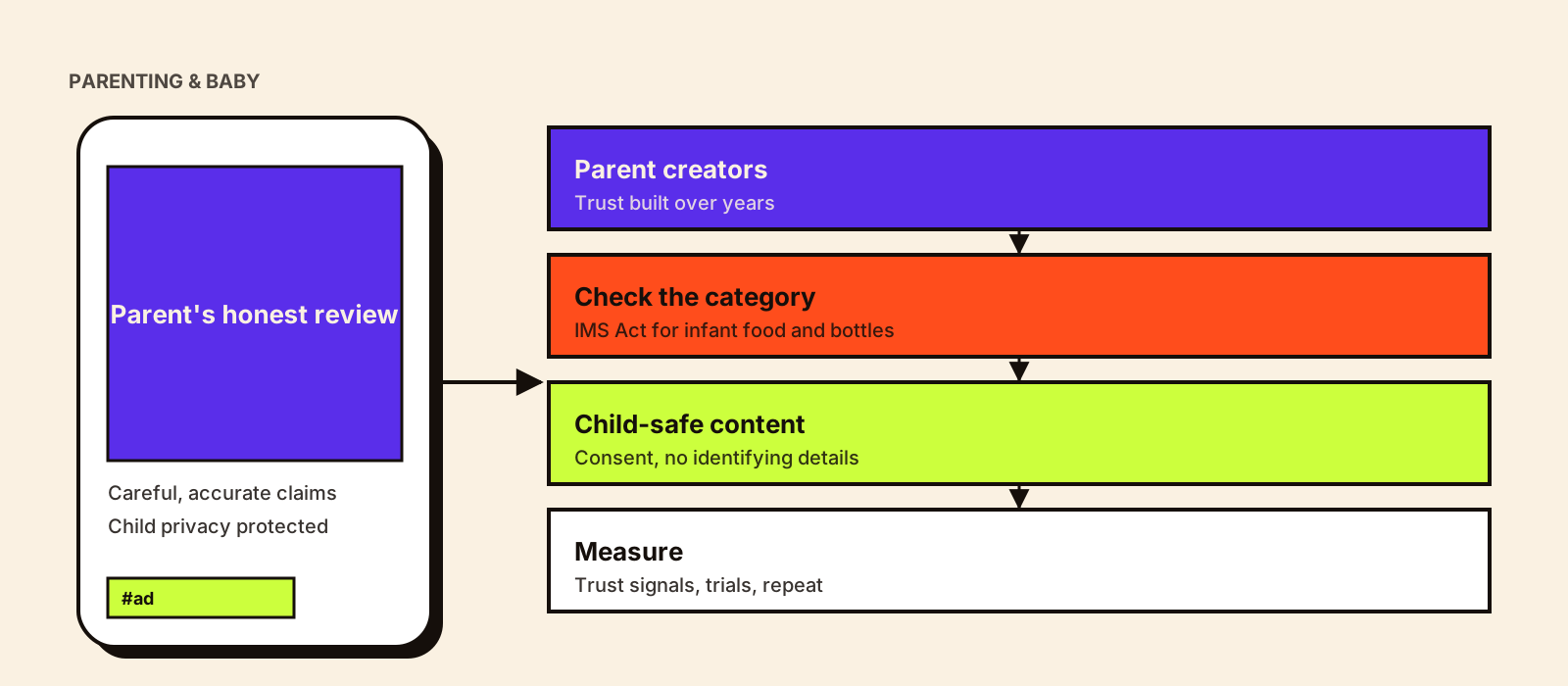
Parents researching a baby or child product are usually more cautious and more skeptical of marketing than in almost any other consumer category, since the decision affects a child, not just themselves. Creator content that respects that caution, honest, specific, non-alarmist, tends to build more trust than content that leans on urgency or exaggerated claims.
Quick answer
Baby and parenting brands in India should work with parenting creators whose audiences trust their honest, specific experience, and keep every health, safety and development claim accurate. Some categories can't be promoted at all: the IMS Act, 1992 prohibits promoting infant milk substitutes, feeding bottles and infant foods, including through influencers. Take care with children on camera and their data.
Why trust is especially important
A parent choosing a baby product is weighing safety and wellbeing alongside the usual considerations of price and quality, which raises the bar for what counts as credible content and lowers tolerance for anything that feels exaggerated or performative.
Parenting creators
Creators who share their own parenting experience build an audience specifically because that experience feels genuine, which makes authenticity, not production polish, the more important selection criterion for this category.
Family content creators
Broader family-focused creators can extend reach beyond a narrowly parenting-focused audience, useful for products relevant to the wider household rather than infant-specific needs alone.
Product demonstrations
Genuine demonstrations, how a product is actually used in a real daily routine, address a parent's practical questions more directly than styled product photography.
Educational content
Content that genuinely helps a parent, general guidance on a stage of development, a practical routine tip, alongside a relevant product mention tends to earn more trust than promotional content alone, provided any developmental or health-related information is accurate and appropriately caveated.
Parent-focused communities
Parenting communities, both online groups and creator-led audiences, are often where genuine product research and recommendations happen before a purchase, making community-embedded creators particularly valuable for this category.
Product safety communication
Any safety-related claim, materials, certifications, age-appropriateness, should be accurate and verifiable, and creators should never be asked to make a safety claim beyond what the brand can actually substantiate. Brands operating close to health-adjacent claims should also see influencer marketing for healthcare brands in India for the stricter compliance discipline that category requires.
Long-term creator relationships
Since parenting needs evolve as a child grows, an ongoing relationship with a creator can track a brand across multiple product stages in a way a single campaign can't, and tends to feel more genuine than a one-time sponsored mention.
Content authenticity
This category is particularly sensitive to content that feels staged or performative. Genuine reactions and honest mention of any downsides tend to build more credibility than uniformly positive coverage.
Measuring campaigns
Measure awareness and consideration content on engagement and comment quality, and conversion-focused content through trackable codes or links, with realistic expectations that baby and parenting purchases often involve more research time than lower-stakes categories.
Parenting Creator Selection Checklist
- Audience relevance: does the creator's audience genuinely match your target parent demographic and child age range?
- Content quality: is the content genuine and well-produced without feeling overly staged?
- Brand suitability: does the creator's values and tone align with your brand's positioning?
- Communication style: does the creator communicate clearly and responsibly, especially around any safety or health-adjacent topics?
- Transparency: has the creator disclosed past partnerships clearly and consistently?
Parents can tell within seconds whether a recommendation is genuine or a script. That instinct is sharper here than in almost any other category we work in.— Kudozz Strategy Team
A note on health and safety claims
This article provides general marketing guidance, not medical or child-safety advice. Any specific claim about a product's health, safety, or developmental benefit should be accurate, substantiated, and reviewed by qualified professionals or regulatory guidance as appropriate before it appears in creator content.
Categories that can't be promoted: infant food and feeding bottles
The Infant Milk Substitutes, Feeding Bottles and Infant Foods Act, 1992 prohibits the promotion of infant milk substitutes, feeding bottles and infant foods, and its definition of promotion is broad enough to cover influencer content, free samples and discount campaigns. State authorities have tightened enforcement, including on social media promotion. Brands in these categories should take legal advice before any creator activity; most will not be able to run promotional creator campaigns for these products at all.
Children on camera
- Parents decide whether their children appear; never make it a condition of the deal.
- Avoid showing identifying details (school uniforms, locations, full names).
- Keep sessions short and child-led; no scripted performances from young children.
- Don't show unsafe product use, even as a joke.
- Pediatric health advice should come from qualified professionals, stated upfront.
For toys, games and family entertainment, including what the advertising rules say about minors, see influencer marketing for toy and family brands.
Children's personal data
India's Digital Personal Data Protection Act, 2023 treats anyone under 18 as a child. Section 9 requires verifiable consent from a parent before a business processes a child's personal data, and says businesses must not track or behaviourally monitor children or direct targeted advertising at them, subject to exemptions the government may prescribe. Most of the Act's obligations take effect as the DPDP Rules, 2025 phase in.
- Contests, giveaways and sign-ups run through creators should collect entries from parents, not children.
- Target campaigns at parents, and don't build audiences of children from creator traffic.
- Don't ask creators for data about their children, or reuse children's images beyond what the parent agreed in writing.
- Take legal advice on consent flows before launching anything that collects data from families.
Planning your next campaign
Qualified health voices are covered in expert creator marketing, and trust-led product sampling in the influencer product seeding program guide.