Podcast Influencer Marketing: Complete Guide for Indian Brands
Podcast hosts build trust over hours of sustained listening, not a five-second scroll, which is exactly why a genuine host endorsement can move a purchase decision differently than most other creator formats.
A listener who's spent forty-five minutes with the same host, multiple times a week, for months, has a relationship with that voice that a five-second Reel view can't come close to. Podcast influencer marketing works because it borrows that relationship, carefully, rather than trying to replicate it from scratch.
Quick answer
Podcast influencer marketing means partnering with podcast hosts, across audio, video, or both, to reach their audience through host-read ads, sponsored episodes, product integrations, or guest appearances, leveraging the sustained trust listeners place in a host over many hours of listening. It differs from a visual, feed-based platform mainly in format, pacing, and the depth of the host-audience relationship. For Indian brands, this can mean access to genuinely engaged niche audiences in business, technology, and finance categories where podcast listening has become a meaningful part of how professionals consume information.
Why podcasts influence purchasing decisions
A podcast host's recommendation arrives inside a relationship the listener has chosen to maintain, voluntarily, over dozens of episodes, which is a fundamentally different trust context than an ad interrupting a feed. Long-form format also gives a host time to genuinely explain why a product matters, not just mention it, which suits considered purchases particularly well.
Podcast hosts vs. traditional influencers
| Podcast hosts | Traditional (visual/social) influencers | |
|---|---|---|
| Audience relationship | Deep, built over sustained listening across many episodes | Often broader, built through quick, frequent visual content |
| Content format | Long-form, conversational, often unscripted | Short-form, highly produced or trend-driven |
| Trust basis | Host expertise, consistency, and genuine voice | Aesthetic appeal, personality, and content frequency |
| Ad format | Host-read reads, integrations, sponsored episodes | Sponsored posts, Reels, Stories |
| Content lifespan | Long, episodes remain discoverable and downloadable for months or years | Shorter, feed-driven consumption window |
Niche audiences and host trust
Podcasts are unusually good at serving narrow, specific niches profitably, a show entirely about SaaS pricing strategy or personal finance for early-career professionals can sustain a genuinely engaged audience that a broader platform would struggle to concentrate this precisely. That narrowness is a feature for brands with a specific target customer, not a limitation.
Creator discovery and vetting
Discovery should start from the audience a brand needs to reach, not a download leaderboard. See how to find the right podcasts and podcast creators for your brand for the full discovery framework.
Podcast sponsorships and host-read ads
The most common commercial format is a sponsorship, typically a host-read ad placed pre-roll, mid-roll, or post-roll. See podcast sponsorships for the complete guide to how these are structured and priced.
Branded content, guest appearances, and product integrations
Beyond a standard ad, brands can pursue a founder or expert guest appearance, a natural product integration within an episode's actual content, or a fully sponsored, branded episode, each a genuinely different commercial format with its own approach to editorial independence and disclosure.
What podcast numbers actually measure
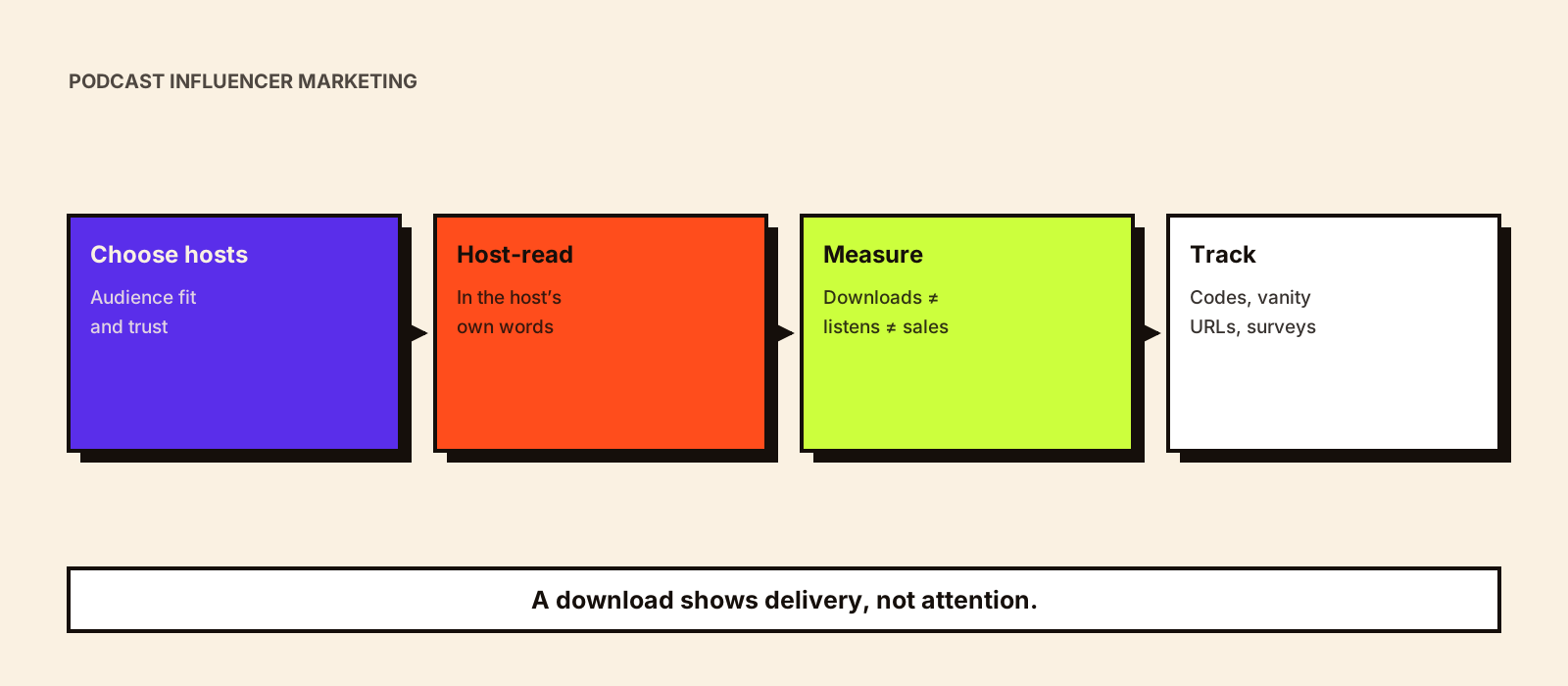
Podcast metrics are easy to misread because different numbers come from different places. IAB Tech Lab's podcast measurement guidelines (version 2.3, finalised on 29 September 2026) define a download as a unique episode request that delivers at least a minute of content to a listener's device, after filtering out bots and duplicate requests. A download shows that an episode was delivered, not that anyone heard the sponsored segment.
| Number | Where it comes from | What it tells you | What it doesn't |
|---|---|---|---|
| Downloads | The show's hosting provider, ideally IAB-certified | Episodes delivered to devices | Whether the ad segment was heard |
| Plays or listens | Individual apps' own dashboards | Listening within that app | Listening in other apps; definitions differ by app |
| Video podcast views | YouTube or other video platforms | Plays under that platform's view rules | Comparable figures to audio downloads |
| Code or vanity URL orders | Your store or analytics | Listeners who acted and remembered the offer | Listeners who bought later without it |
| Survey answers | Your checkout or onboarding | Influence that left no digital trail | Precise numbers; memory is imperfect |
- Ask the host for downloads per episode over the last 30 days from their hosting dashboard, and whether the provider follows the IAB guidelines.
- Agree how long after release you'll count results; podcast back catalogues keep getting listened to.
- Use a spoken code and a short vanity URL, and add the show as an option in a 'how did you hear about us?' question.
- Report audio and video podcast results separately; they're counted differently.
Campaign planning and measurement
See podcast influencer marketing strategy for the complete campaign framework, and how to measure podcast influencer marketing ROI for the measurement approach, including the attribution challenges specific to a passive, often-offline listening format.
Podcast influencer marketing for Indian brands
India's business, technology, startup, and personal finance podcast ecosystem has grown into a genuine destination for professional audiences, alongside a broad base of English-language and Hindi-language shows covering everything from comedy to true crime to career advice. Video podcasts distributed on YouTube have become an increasingly common format for Indian creators, often blurring the line between what counts as a podcast and what counts as a long-form YouTube interview show. Regional-language podcasting in India remains considerably less developed than regional-language content on Instagram or YouTube Shorts, so brands should verify a show's actual regional reach directly rather than assuming broad regional-language podcast availability in a given category.
Getting started
This guide covers the full picture; each stage has its own dedicated resource. For outreach, pricing, and campaign ideas, see podcast influencer outreach, podcast influencer marketing costs in India, and podcast influencer marketing campaign ideas.
How podcast strategy changes by industry
| Category | Shows that usually fit | What to plan for |
|---|---|---|
| B2B | Business, industry and interview shows | Host-reads plus expert or founder appearances over a long sales cycle; see the B2B guide linked below |
| SaaS and technology | Developer, product management and startup-technical shows | Technical credibility matters more than production polish |
| Startups and founders | Business and startup interview shows | Founder guest appearances before paid sponsorships |
| Fintech | Personal finance, investing and business shows | Claims review and disclosure for a regulated product |
| Healthcare and wellness | Health, fitness, mental wellness and nutrition shows | Accurate claims; hosts must not present opinion as medical advice |
| Education and EdTech | Parenting, career and skills, subject and student-life shows | Decide whether you are reaching parents or learners |
| D2C and e-commerce | Niche shows matched to the product | Promo codes and dedicated URLs, since podcasts have no in-platform shopping |
| Consumer electronics | Technology shows with hands-on hosts | Integrations and reviews that explain a considered purchase |
For business audiences in depth, see podcast influencer marketing for B2B brands.
Types of podcast creators
| Creator type | Source of authority | Fits campaigns that need |
|---|---|---|
| Interview hosts | Access to credible guests | Category credibility, founder visibility |
| Business and technology podcasters | Operator-level or technical experience | B2B and technical trust |
| Finance creators | Demonstrated financial expertise | Credibility in a regulated category |
| Lifestyle and entertainment creators | Personality and a loyal, engaged audience | Broad awareness |
| Education creators | Clear, useful instruction | Structured explanation of a product or skill |
| Video podcasters | Any of the above, plus YouTube distribution | Reach beyond audio, with clips for social |
Many shows now publish video on YouTube alongside the audio feed, and the two audiences can differ in size and behaviour. Ask for audio and video numbers separately before you price a sponsorship.
More podcast guides
Choosing shows and formats: how to choose the right podcast for your brand gives a scorecard for the shortlist, podcast audience analytics covers what to ask a host for, and pre-roll vs mid-roll vs post-roll ads compares the three positions. For deeper formats, see host-read podcast ads, sponsored podcast episodes, podcast product placement, branded podcast series and podcast guest marketing.
Running and judging the deal: the podcast sponsorship brief template sets out what to lock down, negotiating podcast sponsorships covers packages and rights, and the 15 podcast KPIs worth tracking group metrics by funnel stage. Before you commit, read the 20 podcast campaign mistakes, how podcast advertising differs from podcast influencer marketing, how podcasts compare with YouTube creators, and the podcast trends for 2026, which keeps confirmed changes separate from opinion.