How to Run a Pan-India Influencer Marketing Campaign
How to plan and run an influencer campaign across India: national vs regional creator layers, choosing cities and languages, finding regional creators for each market, localizing briefs without losing the core message, logistics, approvals in several languages, staggered rollouts and measuring by market.
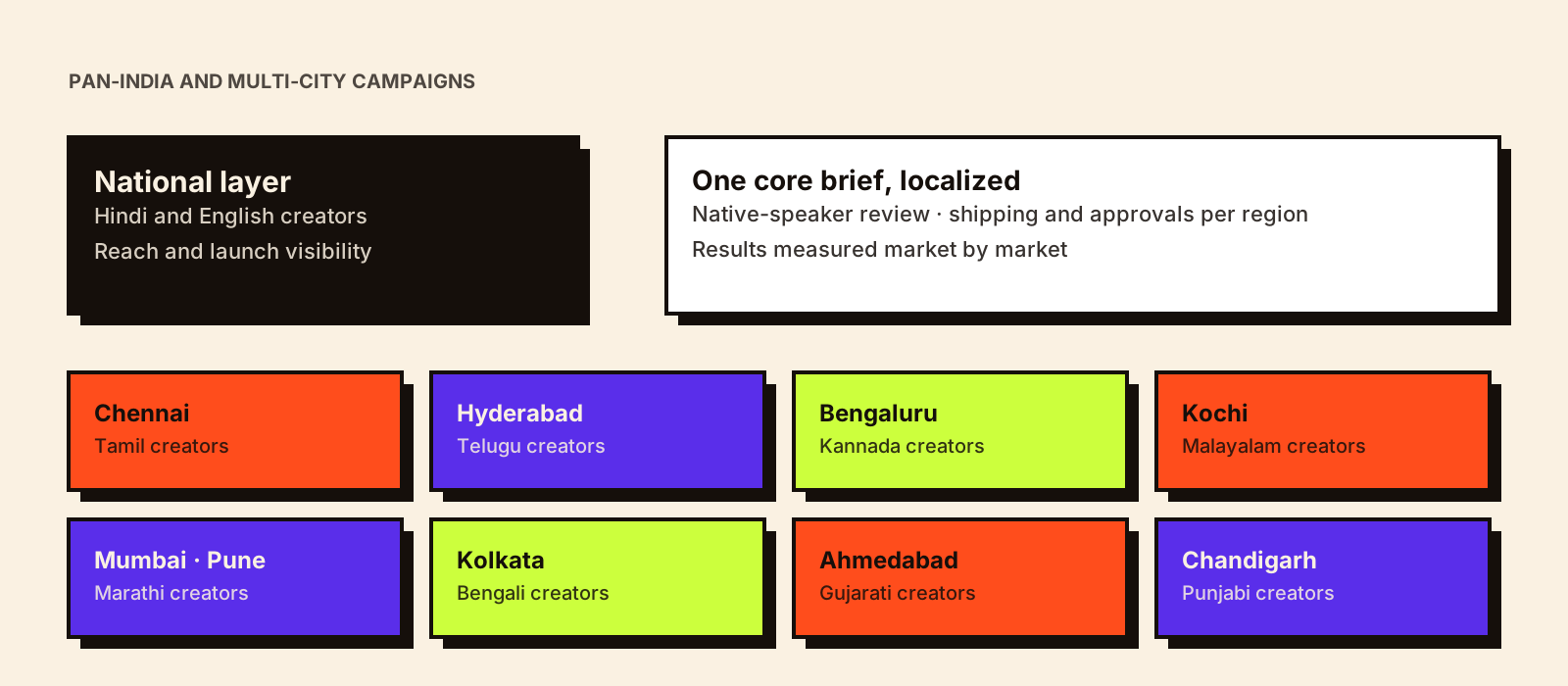
A campaign that works in Delhi can fall flat in Chennai, not because the product is wrong, but because the creators, language, references and even the festival calendar are. Pan-India campaigns succeed when they're planned as one national idea delivered through several local voices.
Quick answer
Run a pan-India influencer campaign in two layers: a national layer of creators with broad Hindi or English audiences for reach, and a regional layer of creators in each priority language and city for local trust. Choose markets from sales and distribution data, not a map; source regional creators per market; write one core brief with localized versions checked by native speakers; plan shipping and approvals per region; stagger the rollout if capacity or stock is limited; and measure each market separately.
National layer vs regional layer
| National layer | Regional layer | |
|---|---|---|
| Creators | Hindi and English creators with country-wide audiences | Creators in Tamil, Telugu, Kannada, Malayalam, Marathi, Bengali, Gujarati, Punjabi and other languages |
| Role | Reach, launch visibility, brand familiarity | Local trust, relevance, conversion in specific markets |
| Brief | Core message | Core message, localized references, language, examples |
| Measurement | Reach, search lift, overall sales | Market-level sales, leads or store visits |
Not every campaign needs both layers. A national awareness push may be mostly national; a regional launch may be entirely regional. Language and cultural relevance is covered in depth in regional and vernacular influencer marketing in India.
Choosing cities and languages
- Start from where you can sell: distribution, delivery coverage, store presence, service areas.
- Look at where current customers are, and where growth targets are.
- Group markets by language rather than by state boundary alone; Hindi covers many states, while Tamil Nadu, Kerala or West Bengal may need their own creators.
- Consider city tier: metro, tier 2 and tier 3 audiences may need different creators and formats.
- Prioritize: a few well-covered markets beat many thin ones.
Finding regional creators for each market
- Search in the local language and script, not only in English.
- Look for city-specific food, lifestyle, family and explainer creators.
- Check audience location and language data; a creator based in a city may have a national audience.
- Ask local teams, distributors or store staff which creators customers mention.
- Keep a market-by-market longlist; see how to build an influencer shortlist.
Shortlisting: how to build an influencer shortlist. Audience checks: influencer audience quality and fit.
One brief, localized properly
| Keep the same everywhere | Localize per market |
|---|---|
| Product facts and approved claims | Language, idioms and humor |
| Disclosure requirements | Cultural references and occasions |
| Brand safety rules | Examples, locations, use cases |
| Core message and CTA | Offers, if pricing or availability differs |
Have a native speaker check localized briefs and review regional content before approval. Machine translation of a Hindi brief into Tamil is a common source of awkward or wrong content. Disclosure should be in the language of the content or in English, per ASCI's guidelines.
Managing creators across languages
| Approach | What it means | Use when |
|---|---|---|
| Translation | Same script translated | Rarely; only for factual product information |
| Transcreation | Core message adapted to local idiom and references | Brand messages that must stay consistent |
| Native creation | Creators make original content in their language from a core brief | Most creator content |
| Workflow step | Multilingual practice |
|---|---|
| Brief | One master brief plus localized notes per language |
| Review | A native-speaker reviewer per language, with a back-translation summary for brand approvers |
| Approvals | Clear turnaround per language so one market doesn't hold up the rest |
| Consistency | Fixed product facts, claims and disclosure across all languages |
| Reporting | Results by language and market, compared fairly |
Logistics and approvals
- Ship product early; delivery times vary widely between metros and smaller towns.
- Plan approvers who can read each language, or a trusted reviewer per language.
- Stagger go-lives if stock, service capacity or customer support is limited in some markets.
- Use regional festival dates; Onam, Pongal, Durga Puja, Bihu, Gudi Padwa and Baisakhi fall on different days and matter differently by region.
- Track everything in one master tracker with a market column.
If the national layer is mainly about reach, the reach-planning levers are covered in influencer marketing for brand awareness.
Budget across markets
Allocate by market priority, not evenly. Regional creators may offer strong local trust for their fee, but each market adds coordination work. Reserve budget for translation, review and shipping. Allocation methods are in how to allocate your influencer marketing budget.
Deciding which smaller cities to add, and how audiences differ beyond metros, is covered in influencer marketing in tier 2 and tier 3 cities.
Measure by market
| Signal | How to split by market |
|---|---|
| Sales or orders | Pin code or city of orders during and after the campaign |
| Codes and links | Separate codes or UTM parameters per market or creator |
| Search interest | Region-level branded search trends |
| Leads and store visits | City field on forms; store-level footfall where tracked |
| Content performance | Creator-level reach and engagement by language |
Measurement methods are covered in how to measure influencer marketing ROI for Indian brands. Kudozz runs multi-city and regional creator campaigns; its campaign strategy service starts with the market and language plan.
Common mistakes
- Translating one Hindi campaign into other languages instead of localizing.
- Choosing markets without checking distribution or delivery.
- Creators based in a city but with national audiences, booked for local reach.
- Approvers who can't read the content they're approving.
- Measuring only national totals, hiding which markets worked.
Conclusion
Pan-India campaigns work as one idea in many voices: a national layer for reach where needed, regional creators for trust, markets chosen from where you can sell, briefs localized by native speakers, logistics planned per region, and results measured market by market so the next campaign puts money where it worked.