How International Brands Can Launch in India With Influencer Marketing
India isn't one market for creator campaigns: languages, cities, platforms, price expectations and the rules all differ from what most international brands are used to. A practical entry plan covering where to start, which creators to use first, localisation, compliance, paying Indian creators and measurement.
International brands often arrive in India with a creator playbook that worked in the UK, the US or the Gulf, and find that it doesn't transfer. The audience is larger and more varied, the platforms are different, buyers are price-aware, and the same campaign can land very differently in Mumbai, Lucknow and Kochi.
Quick answer
Start where you can actually sell and deliver, usually a few metros and one or two sales channels, rather than 'all of India'. Use Instagram and YouTube, the main creator platforms (TikTok has been blocked in India since 2020). Begin with credible category explainers and reviewers who can introduce the brand, then add micro and regional-language creators once the product is available and the message is proven. Localise the product story for Indian use and price expectations, follow ASCI's disclosure rules and India's consumer-protection guidelines, contract and pay creators in rupees with tax handled properly, and measure by channel: your own site, marketplaces and quick commerce each need a different method.
India is several markets
India's Constitution lists 22 scheduled languages, and many creators work in Hindi, Tamil, Telugu, Bengali, Marathi, Kannada, Malayalam and others, or mix English with a regional language. Buying behaviour, festivals and price sensitivity also differ by city size and region. Treat the first phase as entering a few markets inside India, not one country.
| Decision | Common starting point | Why |
|---|---|---|
| Cities | Two to four metros where delivery is reliable and your target customer is concentrated | Easier logistics, more English-language and premium-category creators |
| Language | English or Hinglish first, then the main language of each target region | Matches early-adopter audiences, then widens reach |
| Sales channel | One or two of: own site, Amazon or Flipkart, quick commerce, retail partners | Each channel changes the creator call to action and how you measure |
| Platforms | Instagram for discovery, YouTube for explanation and search | These carry most creator commerce in India |
When you're ready to widen beyond metros, see how to run a pan-India influencer marketing campaign and regional and vernacular influencer marketing in India. For platform choice, see the top social platforms for influencer marketing in India.
Build the creator mix in phases
| Phase | Creators | Job | What to measure |
|---|---|---|---|
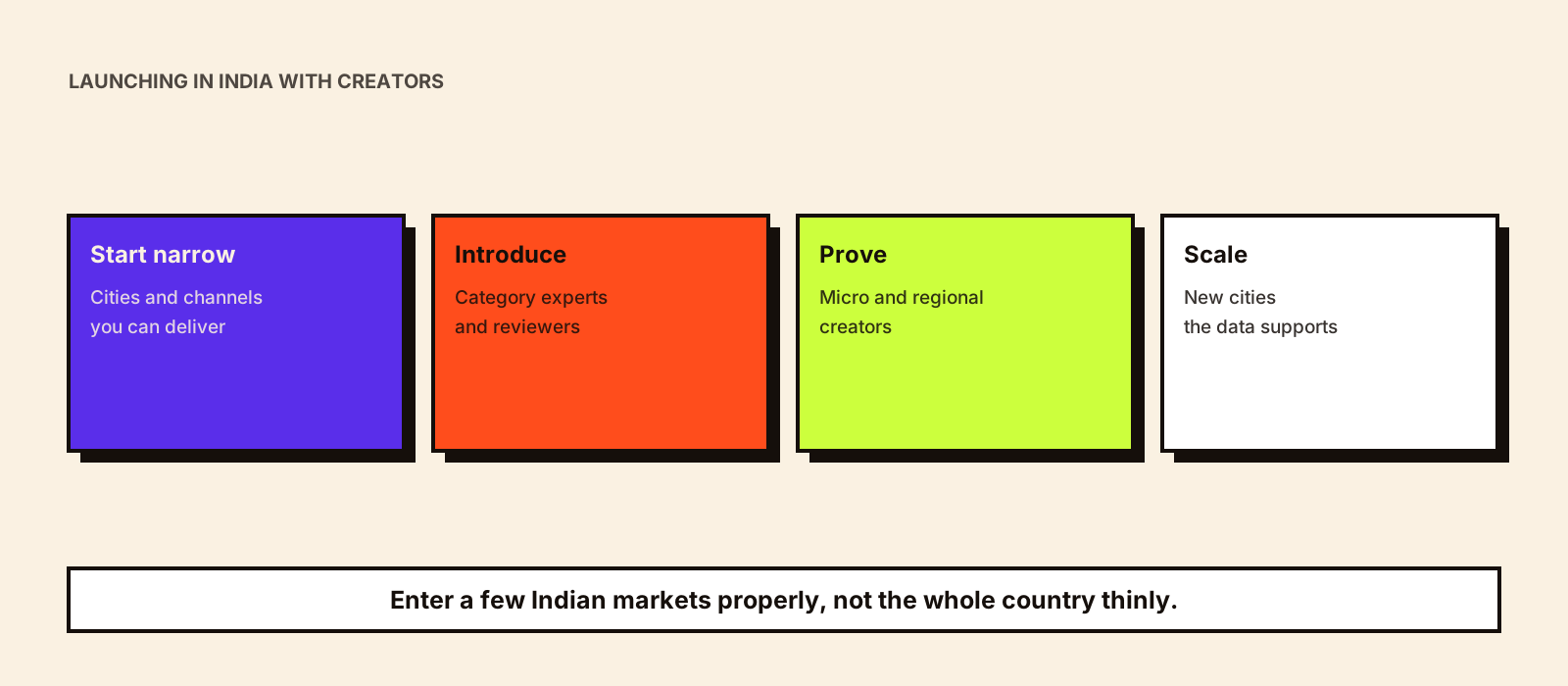
| 1. Introduce (weeks 1-6) | Category experts, reviewers and a few respected mid-tier creators | Explain who you are, why you're different and why the price is what it is | Reach in target cities, comments and questions, branded search |
| 2. Prove (weeks 6-12) | Micro-creators in your launch cities, some in regional languages | Show the product in Indian homes and routines; gather social proof | Cost per new customer, reviews, repeat purchase |
| 3. Scale (after week 12) | Wider micro and nano groups, affiliates, ambassadors | Extend to new cities and languages that the data supports | Incremental sales by city and channel |
Celebrity endorsement can create fast awareness in India, but it's expensive and rarely the most efficient first step for a brand that hasn't yet proven its product-market fit. A mix of credible mid-tier and micro creators usually teaches you more per rupee.
Localise the story, not just the language
- Show the product in Indian contexts: climate, homes, cooking, commutes, family use and festivals.
- Explain price and value plainly. If you're priced above local alternatives, let creators say why in their own words.
- Check product claims against Indian evidence and standards, not just your home market's approvals.
- Adapt to the calendar: festive periods such as Diwali shift demand and creator availability; see seasonal influencer marketing in India.
- Translate briefs properly and have native speakers review regional content; literal translation reads as foreign.
Festival timing and regional calendars are covered in seasonal influencer marketing in India.
Rules international brands should know
| Area | What applies | In practice |
|---|---|---|
| Disclosure | ASCI Code and influencer guidelines | A clear label such as 'Ad', 'Collaboration' or 'Free gift' at the start of the post, in the post's language |
| Misleading ads and endorsements | Consumer Protection Act, 2019 and the CCPA's 2022 guidelines | Claims must be truthful and substantiated; endorsers should have used the product |
| Health, finance and other regulated sectors | Sector rules, plus ASCI's requirement for qualified creators giving technical advice | Check before briefing; some products can't be advertised to the public at all |
| Packaged goods | Legal Metrology (Packaged Commodities) Rules for products sold in packaged form | Pack declarations such as MRP and importer details must be right before you sell, and creators shouldn't show non-compliant packs |
| Personal data | Digital Personal Data Protection Act, 2023 and its rules | Handle creator and customer data, including giveaway entries, lawfully |
A pre-launch checklist is in influencer campaign compliance in India, and how India compares with other markets is in influencer disclosure rules by country.
Contracting and paying Indian creators
Most Indian creators expect contracts and payment in rupees, with GST invoices where they're registered. Tax deduction at source, GST and cross-border payment rules depend on who contracts with the creator: an Indian subsidiary, a distributor, an agency or the overseas parent. Many international brands contract through a local entity or an agency to keep payments, TDS and invoicing straightforward. Take local tax advice before the first campaign; the basics are in the influencer payment process and TDS for influencers in India.
Measure by channel
| Channel | How creators drive sales | How to measure |
|---|---|---|
| Own website | Links and codes | Tagged links, codes, new-customer share; see tracking influencer sales |
| Amazon or Flipkart | Search for the brand or product on the marketplace | Marketplace sales and search data against a baseline |
| Quick commerce | Search in the app at the moment of need | City-level sales lift against comparison cities |
| Retail | Store visits and shelf recognition | Store sales by region, with a comparison region where possible |
Each channel has its own guide: influencer marketing for Amazon and Flipkart sellers and influencer marketing for quick-commerce brands.
A 90-day entry plan
| Weeks | Focus | Output |
|---|---|---|
| 1-3 | Market choice, channel set-up, compliance review, creator research in launch cities | Shortlist, brief, claims sheet, tracking in place |
| 4-6 | Phase 1 creators go live; seeding to a wider group | First reach and questions; product feedback |
| 7-10 | Phase 2 micro and regional creators in launch cities | Cost per new customer by city and channel |
| 11-13 | Review, keep the best creators, decide the next cities | Plan for the next quarter, based on results |
Common mistakes
- Launching 'nationally' before distribution can deliver nationally.
- Running the home-market creative with Indian creators instead of letting them adapt it.
- Leaning on one celebrity instead of building credibility with category creators.
- Ignoring regional languages until a competitor has claimed them.
- Measuring only coded sales while most buying happens on marketplaces or quick commerce.
Conclusion
International brands do well in India when they enter a few markets properly rather than the whole country thinly. Start where you can deliver, build credibility with category creators, localise the story, follow India's disclosure and claims rules, and measure each channel on its own terms. For running the same discipline across several countries, see the international influencer campaign playbook, or talk to Kudozz about an India entry plan through its campaign strategy service.