Social Media Management for Hair and Beauty Professionals: Building a Personal Brand That Attracts Clients
A guide for stylists, makeup artists, nail and lash technicians and freelancers: which account to use, what to agree with your salon, five content pillars, consent, safe demos and honest brand credits.
A colourist has worked at the same salon for five years. Clients ask for her by name, and some follow her personal Instagram, where her best work sits between holiday photos. Across town, a freelance makeup artist has the opposite problem: a polished portfolio, but enquiries asking 'how much for a party look?' that rarely turn into bookings. Both need a personal brand, and both have questions a salon's own account never has to answer.
Quick answer
Social media management for beauty professionals starts with deciding which account you post from and, if you're employed, agreeing the rules with your salon. Then build around five pillars: signature work, technique, client care, honest kit and your learning. Get written consent for every client photo, disclose gifted or paid products, frame demos with safety caveats, and make it obvious how and where to book you.
Which account, and whose clients?
Instagram offers personal accounts and two kinds of professional account. Its Help Centre describes business accounts as suited to local businesses and service providers, and creator accounts as suited to public figures, artists and content producers. Both give you insights and optional contact details, and you can switch type later. For most individual stylists and artists, a professional account is the practical choice.
| Your situation | Account | Booking route in your bio | Agree first |
|---|---|---|---|
| Salon employee | Your own professional account, crediting the salon | The salon's route, or yours only if your agreement allows | The salon's policy on staff accounts and client photos |
| Chair or booth renter | Your own professional account | Your own | Use of the salon's name, location and interiors |
| Freelancer (makeup, nails, lashes, hair) | Your own professional account | Your own WhatsApp or booking link | Venue rules when you work on location |
| Owner who also works on clients | The salon's account plus your own | The salon's account for bookings | Which posts belong where |
Points to agree with your salon
1. Can I post work I do at the salon on my own account? Which services?
2. Who asks clients for photo consent, and where is the signed form kept?
3. Should my bio and captions name the salon and its booking route?
4. Can I take bookings directly, or must every booking go through the salon?
5. Can I show the salon's products, interiors and branding? Is approval needed?
6. Can the salon reshare my content, and how will I be credited?
7. What happens to posts showing salon clients and the salon space if I leave?
8. Who handles complaints that arrive in my DMs?
Get the answers in writing. If your contract has clauses on social media or on contacting clients after you leave, ask a legal adviser to explain them before you rely on your own reading.
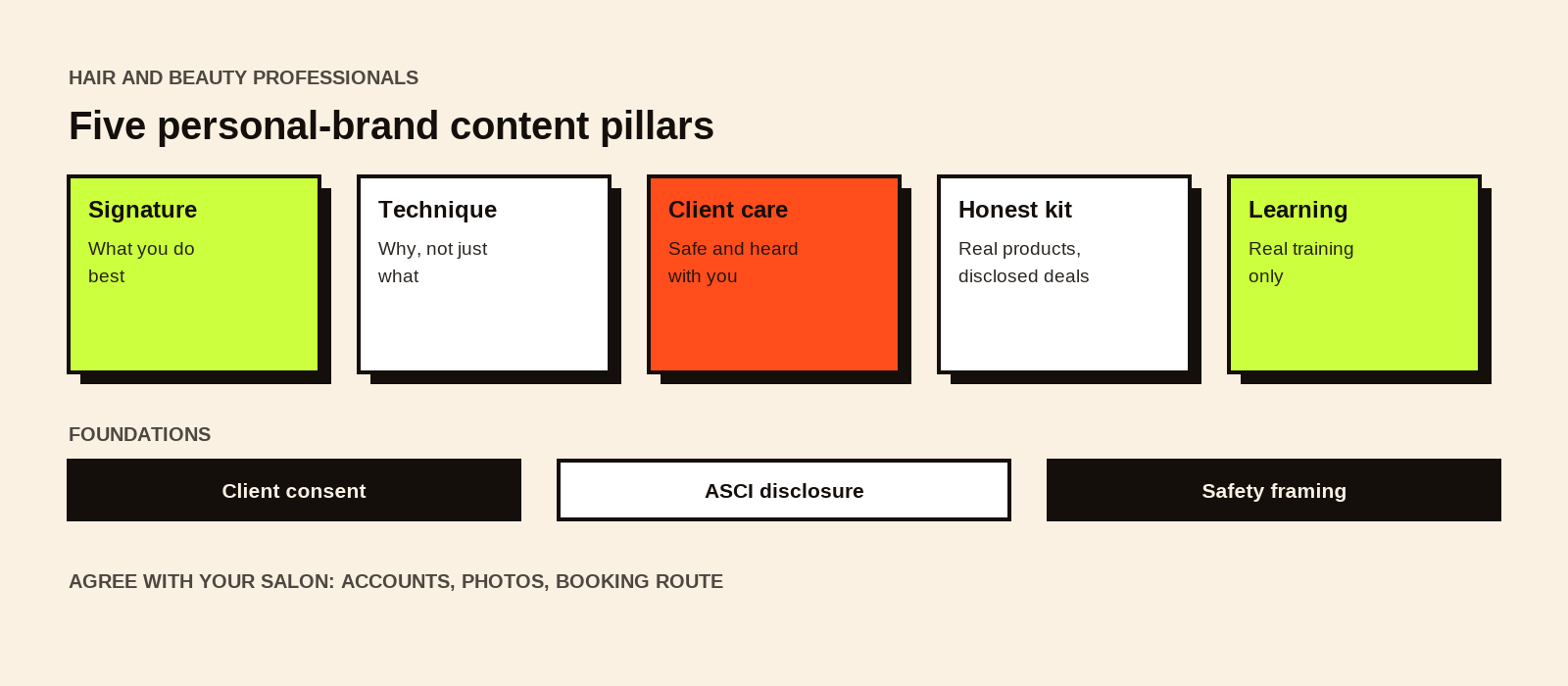
Five personal-brand content pillars
Pillars stop a personal account from becoming a random scroll of looks. Choose four or five and give each one a job.
| Pillar | What it proves | Post examples | Watch out for |
|---|---|---|---|
| Signature work | What you are best at | One look per post with the service named; a series on your speciality (curly cuts, bridal base, gel art) | Only your own work; no filters that change the result |
| Technique and process | That you know why, not just what | Sectioning, colour placement, brush choice, prep steps | Safety framing; not a DIY guide for risky services |
| Client care | That clients feel safe and heard with you | How you run a consultation, how you work with nervous first-timers, aftercare | No health advice; no client details without consent |
| Kit and products, honestly | What you use and why | Your real kit, products you buy and use, what you'd skip | Disclose gifts and paid deals; no claims beyond the label |
| You and your learning | Who you are and how you keep improving | Courses attended, competitions entered, a day in your working life | Only real qualifications; no 'certified' without the certificate |
A workable mix is to post mostly from signature work and technique, with client care and kit every week or two, and a personal post when there is something real to share. After a month, check which pillars brought the enquiries you want and shift the balance.
Your portfolio needs consent, not just good light
- Ask before the appointment ends, not after you've posted. Consent should say which images, where they'll be used and that the client can withdraw.
- Photos of identifiable clients are personal data. India's Digital Personal Data Protection Act, 2023 and the Rules notified in November 2025, with obligations being phased in, expect consent to be clear, informed and easy to withdraw. Check current obligations with an adviser.
- Crop or angle shots to show the work, not the face, when that's all the client has agreed to.
- No identifiable minors, such as a child's first haircut or a bridesmaid under 18, without a parent's or guardian's written consent.
- Edit honestly. ASCI's do's and don'ts for influencers warn against filters that mislead about benefits, such as making hair shinier. Hold your portfolio to the same standard, and say when a look includes extensions or a wig.
- If you leave a salon, follow what you agreed about posts showing its clients and space.
The DPDP Rules backgrounder from PIB and ASCI's do's and don'ts for influencers are short reads worth keeping to hand.
I, [client name], agree that [your name] may photograph or film my [hair / makeup / nails / lashes] on [date] and post it on [Instagram / Facebook / portfolio website].

[ ] My face may be shown      [ ] Work only, no face
[ ] My name or handle may be tagged      [ ] Please don't tag me

I can ask for the images to be removed at any time by messaging [number or handle].

Signature: ____________   Date: ________
If you also use a client's words alongside the images, our guide to customer testimonials and UGC covers permissions and keeping quotes accurate.
Technique demos with safety caveats
Technique content builds authority, but some viewers will try it at home. Frame demos so they inform without encouraging unsafe DIY.
- Colour, lightening, chemical straightening, perms, lash adhesives and nail chemicals: say on screen that these are professional services, and that the product maker's instructions, including any patch or strand test they specify, must be followed. Don't state test timings yourself.
- Heat tools: show heat protection and safe handling, and skip stunt-style hacks.
- Name products only if you actually used them, and don't add performance claims the maker doesn't make.
- Don't present yourself as able to treat scalp or skin conditions. If someone asks about hair loss, a rash or a reaction, tell them to see a doctor.
- Show the cleaning steps you actually follow, without 'safest' or 'most hygienic' claims.
Crediting brands and disclosing deals
Professionals often receive free products, brand education sessions or paid posts. ASCI's guidance treats gifts and product exchange as material connections, lists labels such as #Ad, #Sponsored, #Collaboration and #Free gift, and says not to hide the disclosure in your bio or bury it deep in the caption.
- Gifted product you post about: disclose, even if you would have bought it anyway.
- Paid post or ambassador deal: disclose up front, in the post itself.
- Product you bought and use: no label needed, but don't imply a partnership that doesn't exist.
- Brand-run training: say who ran it, and don't present a brand workshop as a formal qualification.
- Collab posts with your salon or a brand: Instagram adds the invited account as a co-author once it accepts, and the post is shared with its followers. Still disclose any paid or gifted relationship.
Instagram's Help Centre explains how collaborative posts work. If brand deals become a regular income, you're working as a creator too, and our creator disclosure guide covers the detail. Brands looking to hire beauty creators should read our guide to influencer marketing for beauty brands instead.
Turning followers into the right clients
A personal brand should attract people who want what you do best, at the rates you charge, in the place you work.
- Bio: your speciality, where you work (area, and the salon if employed), your working days and one booking route.
- Pinned posts: your signature service, how booking works, and your policies on deposits, cancellations and travel, stated as you actually apply them.
- Reply hours: set them, keep them, and move bookings to the agreed route.
- Freelance enquiries: ask for the date, location, number of people, the look wanted and reference photos, then quote from your published rates.
- Salon clients who follow you: book them through the salon unless your agreement says otherwise.
The salon-level journey, from profile to 'price?' replies, is covered in our guide to social media marketing for salons. The same reply discipline applies to an individual account.
A weekly routine you can keep
Most professionals post between appointments, so the routine has to fit a working week. The times below are suggestions, not targets.
| When | Task | Suggested time |
|---|---|---|
| During appointments (with consent) | Capture two or three clips or photos of finished work | A few minutes each |
| One quiet evening | Edit, write captions for three posts and schedule them | About an hour |
| Daily, at set times | Reply to DMs and comments | 15 minutes, twice a day |
| Through the week | Stories from your working day | As it happens |
| Monthly | Check which posts led to enquiries; update pinned posts and rates | 30 minutes |
What usually goes wrong: posting only when a brand sends product, mixing client work and personal life with no structure, taking salon clients privately against an agreement, and letting DMs pile up for days.
This week's set-up
Have the conversation with your salon, or write down your own freelance policies. Switch to a professional account, choose your pillars and print the consent form. Then post three pieces of signature work, with consent and clear booking instructions, and start the weekly routine.
Individual professionals usually run their own accounts. Salons that want staff and salon accounts planned together can look at our social media strategy work, which Kudozz scopes account by account for businesses in India.