Social Media Management for Wedding Photographers and Event Professionals: A Content Strategy That Wins Enquiries
How wedding photographers, filmmakers and event professionals can build a portfolio that answers couples' questions, handle consent and image rights, credit vendors, plan around wedding seasons and reply to enquiries well.
A wedding photography studio gets dozens of DMs a week in peak season, and most say 'price?' or 'available on the 12th?'. The feed is full of beautiful single frames from many weddings, but nothing shows how the team covers a three-day event, how many people come, or when the album arrives. Couples who book are mostly referrals. Everyone else goes quiet after the price reply.
Quick answer
Social media management for wedding photographers works when the feed answers what a couple needs before they enquire: your style across a complete event, how you work, what's included and how to check availability. Build the portfolio around full stories rather than single frames, agree image use with couples in the contract, take care with guests and children, credit vendors accurately, plan around your region's wedding seasons and reply to enquiries with clear questions about date, city and scope.
The enquiry portfolio framework
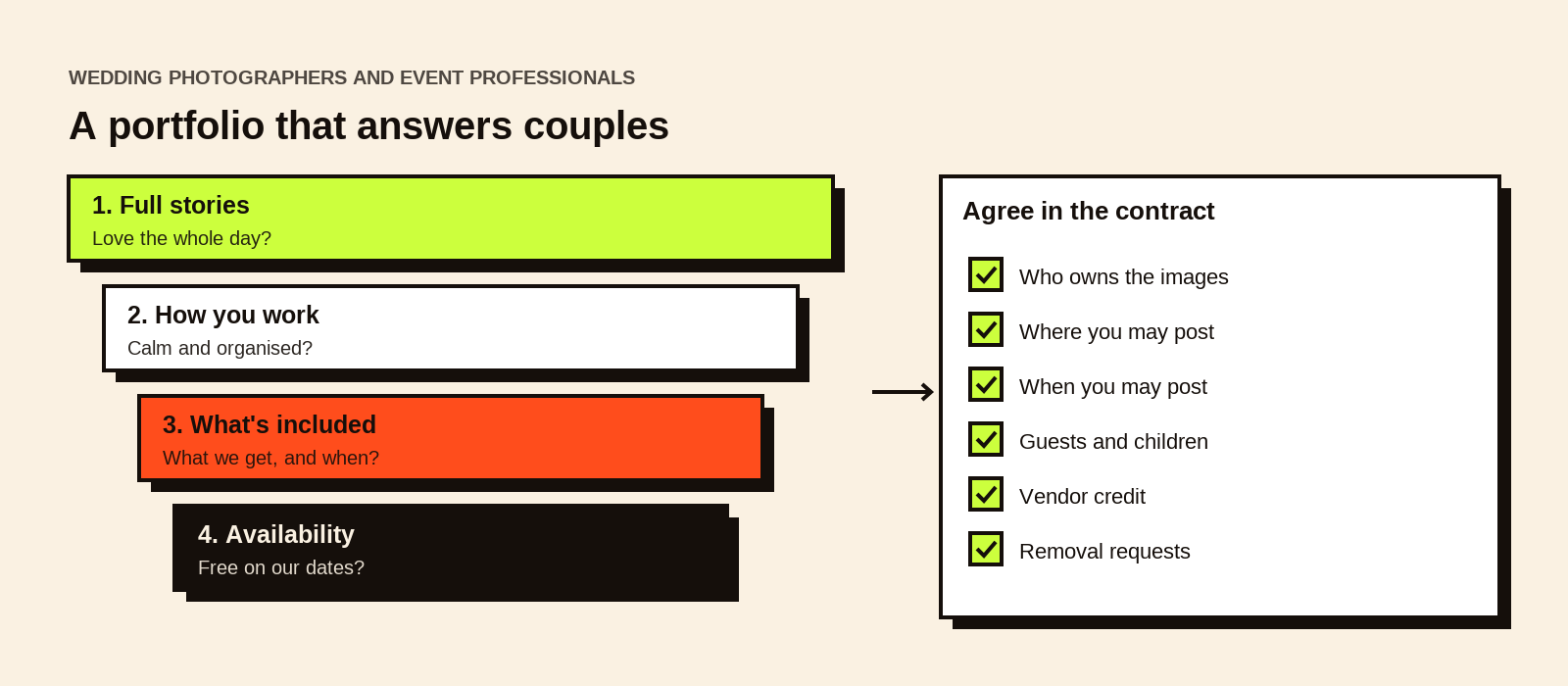
Couples scroll a photographer's grid to answer four questions in order. If your content answers each one, the enquiries you get are from people who already like your work and have a rough idea of what you offer. The same framework works for filmmakers, decorators, planners and makeup artists.
| Layer | The couple's question | Content that answers it | Where it lives |
|---|---|---|---|
| 1. Full stories | Do I love their work across a whole wedding, not just one shot? | Carousels and Reels covering one wedding from preparation to farewell | Feed, a Highlight per recent wedding |
| 2. How you work | Will they be calm, discreet and organised on the day? | Behind-the-scenes, team introductions, how you handle rituals and family portraits | Reels, Stories |
| 3. What's included | What do we get, and when? | Coverage options, team size, delivery timelines, album and film formats, payment terms | Pinned posts, Highlights, a price guide on request |
| 4. Availability and enquiry | Are they free on our dates, and how do we ask? | How to enquire, what to include, cities you travel to | Bio, pinned post, Stories |
Carousels carry full stories well; our guide to planning Instagram carousels covers sequencing. Many couples also collect ideas on Pinterest, which our guide to Pinterest marketing for businesses covers.
Consent, image rights and the contract
Who owns wedding photos is less obvious than many photographers assume. Section 17 of the Copyright Act, 1957 makes the author of a work its first owner, and the Act defines the author of a photograph as the person who takes it. But proviso (b) to section 17 says that when a photograph is taken for valuable consideration at the instance of another person, that person is the first owner of the copyright, in the absence of any agreement to the contrary. A paid wedding shoot may fall under that proviso. The point to take away is simple: agree ownership and usage in the contract, and have a lawyer draft or review it. This isn't legal advice.
Copyright and consent are separate questions. Even where you're entitled to use images, many couples don't want their wedding public, or want to wait until after the reception. Photos of identifiable people may also be personal data under the Digital Personal Data Protection Act, 2023, so check your obligations with a legal adviser.
- Who owns the copyright, and what each side may do with the images.
- Whether you may post on social media, your website, award entries, print ads or paid promotion, listed separately.
- When you may post (for example, after the couple's own announcement) and whether they approve the selection.
- What you'll never post: private rituals, getting-ready moments, children, guests who opt out.
- How the couple may use and share the images, and the credit they'll give you.
- How to ask you to remove a post later, and how fast you'll act.
- The same terms for second shooters, freelance editors and filmmakers you hire, in their contracts.
Guests and children in frame
Guests didn't sign your contract. Wide shots of a crowded mandap are part of wedding storytelling, but close portraits of guests, especially children, are different. Post identifiable children only with their parents' consent, remove any guest who asks, and avoid frames that reveal jewellery close-ups alongside a home address or live location. Delay posting until after the event for the couple's and guests' security.
Vendor collaborations and credit
Weddings are team work, and decorators, planners, makeup artists and venues share your audience. Credit every vendor accurately for the role they actually played, check their handles before posting, and send them the images they're allowed to use under your contract with the couple. If a vendor pays you, gifts you something or you have a commercial arrangement to promote them, label the post clearly; ASCI's guidelines on influencer advertising expect material connections to be disclosed. Our guide to influencer marketing for wedding businesses covers working with wedding creators, which is a separate programme from your own account.
Couple: [first names, only with their consent]
Venue: [@handle]
Planning: [@handle]
Decor: [@handle]
Makeup and hair: [@handle]
Outfits: [@handle, only if confirmed by the couple]
Film: [@handle]
Photography: [your handle and team]

Check: every handle verified, roles correct, any paid or gifted arrangement labelled, couple approved the post.
20 content concepts for wedding and event professionals
| # | Group | Concept |
|---|---|---|
| 1 | Full stories | One wedding in ten frames, preparation to farewell, as a carousel |
| 2 | Full stories | A 60-second film cut of a single ceremony, with the couple's approval |
| 3 | Full stories | The same couple across haldi, mehendi, wedding and reception, showing how your style holds across very different light |
| 4 | Full stories | Small or court wedding story, for couples planning something intimate |
| 5 | Full stories | Destination or travel wedding, with what changed in logistics |
| 6 | How we work | Our team on the day: who does what, filmed during setup |
| 7 | How we work | How we photograph rituals without getting in the way of the priest or family |
| 8 | How we work | Family portrait plan: how we organise a big group shot in minutes |
| 9 | How we work | Low-light reception shooting, explained without gear talk |
| 10 | How we work | From card to album: the editing and delivery timeline |
| 11 | Planning help | Questions to ask any wedding photographer before booking |
| 12 | Planning help | How to build a shot list with your family |
| 13 | Planning help | Photo-friendly timeline tips for a long wedding day |
| 14 | Planning help | What 'candid' and 'traditional' coverage mean in practice |
| 15 | Planning help | Pre-wedding shoot: what to wear, timing, location permissions to check |
| 16 | Team and vendors | Meet the second shooter or editor, with their consent |
| 17 | Team and vendors | A decorator's setup seen through your lens, credited |
| 18 | Team and vendors | Venue spotlight: where the light falls at different times |
| 19 | Team and vendors | A couple's own words about working with you, with written consent |
| 20 | Team and vendors | What's in our bag for a three-day wedding, and why we carry backups |
Planning around wedding seasons
Wedding demand rises and falls through the year, but the busy months differ by region and community, and auspicious dates change every year. Build your plan from your own bookings and the dates couples are asking about, not a national list. Most studios move through four phases.
- Off-season: shoot styled content, publish full stories from the last season, update your price guide and contracts.
- Booking window: lead with availability, how-we-work content and planning help, because couples are choosing now.
- Peak season: post less, mostly Stories and quick sneak peeks the couple has approved; keep enquiry replies fast.
- Delivery season: full stories, films and vendor credits as albums are delivered and couples approve.
A monthly calendar for the booking window
| Week | Feed post 1 | Feed post 2 | Reel | Stories |
|---|---|---|---|---|
| 1 | Full wedding story carousel (concept 1) | What's included and delivery timeline (concept 10) | Ceremony film cut (concept 2) | Dates you're still free, accurately; enquiry steps |
| 2 | Questions to ask before booking (concept 11) | Vendor-credited decor story (concept 17) | Team on the day (concept 6) | Question box: what are you unsure about? |
| 3 | Multi-event story (concept 3) | Couple's words with consent (concept 19) | Family portrait plan (concept 8) | Answers to the question box |
| 4 | Intimate wedding story (concept 4) | Shot list with your family (concept 12) | Rituals without getting in the way (concept 7) | Cities you're travelling to next season |
In peak months, cut to one feed post and daily Stories, and keep a backlog of approved stories to publish later.
Answering 'available?' and 'price?' enquiries
A one-line price reply invites a one-line comparison. Ask a few questions first so you can suggest the right coverage, and send your price guide with context. If dates are genuinely filling, say which ones; don't invent scarcity. The CCPA's dark patterns guidelines name false urgency among the practices they cover.
Hi [name], congratulations, and thank you for reaching out.

So I can check availability and suggest the right coverage:
1. Date(s) and which events (for example haldi, mehendi, wedding, reception)
2. City and venue, if decided
3. Approximate guest count
4. Photo, film or both?
5. Anything you've loved in our work so far?

[Our packages start from ₹__ and the full guide is here: link] (use only if you publish a guide)
We'll confirm availability within [__] hours. A date is held only once [your real booking terms].
Mistakes that lose enquiries
- A grid of single hero frames with no full stories.
- Posting a wedding before the couple has shared it, or without asking.
- Close-ups of guests' children without their parents' consent.
- Missing or wrong vendor credits, which cost you referrals.
- Replying 'DM for price' to a DM.
- Edits so heavy that couples can't recognise their skin tone or venue, which sets wrong expectations.
Before the next season
Update your contract's image-use clause with your lawyer, pin a 'how to enquire' post and a 'what's included' post, and pick three recent weddings to turn into full stories with the couples' approval. Then plan the booking-window month from the calendar above. Our guide to influencer marketing for photography and creative service businesses covers creator collaborations if you want to add them later.
If peak season leaves no time for posting, Kudozz's social media management for businesses can handle planning, captions, Reels edited from your footage and publishing within an agreed scope, while shoots, contracts and client approvals stay with your studio.