Influencer Marketing for AI Software and Copilot Products
How AI software, copilot and AI developer platform companies can work with creators: real-task demos, honest limits, claims and disclosure rules, creator types and measuring activation and retention.
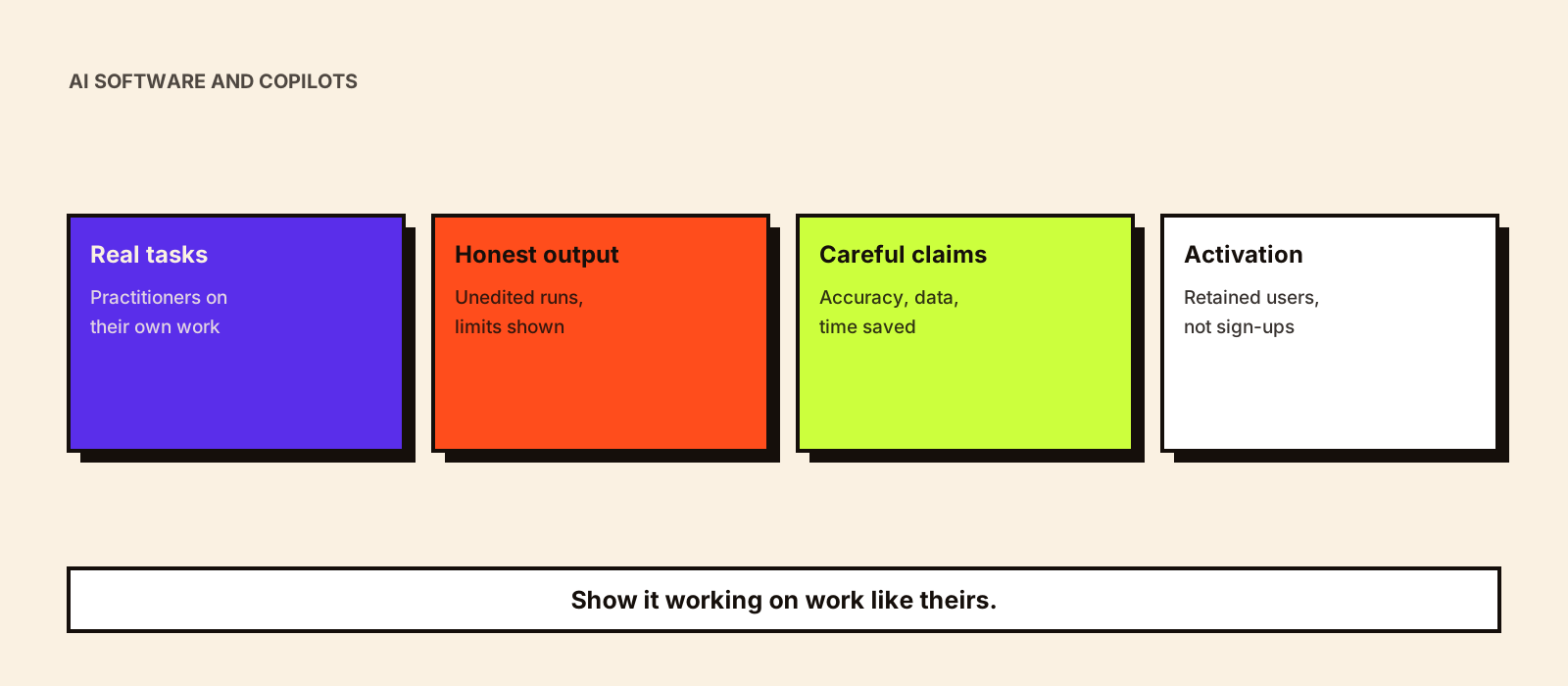
AI software companies have an unusual marketing problem. Viewers have seen hundreds of impressive AI demos, many of them cherry-picked, so another one rarely persuades anyone. What convinces buyers is seeing the product handle their kind of work, including where it falls short. Creators who use AI tools in real jobs can show that, which is why they matter more for AI products than for most software, and why the claims they make need more care.
Quick answer
To market AI software and copilot products with creators, work with practitioners who will use the product on real tasks from their own work, show complete unedited outputs including failures, and explain what the tool doesn't do. Keep capability, accuracy, time-saving and 'replaces your team' claims to what you can substantiate, be clear about how user data is handled, and disclose the partnership. Measure activated users and retained usage rather than sign-ups: AI tools attract many curious trial users who never return.
Why AI products need a different approach
| Challenge | What it means for creator content |
|---|---|
| Demo fatigue | Polished demos are discounted; real tasks with real inputs persuade |
| Output varies | The same prompt can give different results; show more than one run |
| Capabilities are easy to overstate | Claims about accuracy, autonomy or time saved need evidence |
| Data and privacy worries | Buyers want to know what happens to what they type or upload |
| Fast-changing products | Content goes out of date quickly; date it and plan updates |
| Different buyers | Individual users, team leads and IT or security reviewers need different answers |
Claims and rules to keep in view
There's no special exemption for AI in advertising law. In the US, the Federal Trade Commission launched 'Operation AI Comply' in September 2024 with enforcement actions against companies over false or unsubstantiated claims about AI products, according to law-firm summaries of the announcement. In India, misleading-advertisement rules under the Consumer Protection Act and the ASCI Code apply to AI products like any other, and ASCI published draft guidelines on AI in advertising in May 2026 for consultation; check whether a final version has been issued before planning AI-generated ad content. Separately, AI-generated or altered content in creator posts may need labelling; see AI disclosure for creators.
- Accuracy or 'never wrong' claims: avoid; show real outputs instead.
- Time-saved claims: state the task, the conditions and that results vary.
- 'Replaces a developer, writer or analyst': avoid; it's hard to substantiate and invites backlash.
- Security and privacy claims: only what your documentation and certifications support.
- Benchmarks: name the test, version and date, or don't cite them.
- 'Powered by AI': only if AI is genuinely central to the feature.
Which creators to work with
| Creator type | Best for | Watch for |
|---|---|---|
| Practitioners in the target job (marketers, analysts, designers, lawyers, teachers) | Showing the tool on real work | Confidential work in screenshots |
| AI tool reviewers and educators | Comparisons and walkthroughs | Hype-driven channels with low trust |
| Developers and ML practitioners | Developer platforms, APIs, model hosting | Unverified benchmark claims |
| Productivity and workflow creators | Everyday use, templates, integrations | Overstated time savings |
| Regional-language educators | Bringing AI tools to non-English users | Translation quality of outputs |
Campaign ideas
- A real task, start to finish: the creator uses the product on actual work and shows the unedited result, including edits they had to make.
- Three runs of the same prompt, to show consistency honestly.
- 'Where it fails': a creator explains the tasks the tool isn't good at; this builds more trust than another success.
- Before and after workflow: how a recurring task changed, with time measured.
- Prompt and template packs created by the creator for their audience.
- Security walkthrough: what data the product stores, where, and how to switch settings off, using your published documentation.
- Team rollout series: a creator's team adopting the tool over a few weeks.
- Live build or Q&A session where viewers suggest tasks.
AI developer platforms and model hosting
For APIs, model hosting and AI developer platforms, the audience is developers and ML engineers, and the content that works is technical: sample projects, latency and cost trade-offs with methodology stated, migration guides and honest notes on limits such as rate limits or context size. The approach in influencer marketing for B2B technology brands applies, including the technical accuracy review.
Measuring AI product campaigns
| Stage | What to measure |
|---|---|
| Interest | Views from the target job role, saves, comments asking how to do a task |
| Sign-up | Sign-ups by creator link or code |
| Activation | Users who complete a meaningful task, not just log in |
| Retention | Users still active after 30 days, by creator |
| Revenue | Paid conversions and seat expansion by creator source |
Conversion paths for trials and product-led sign-ups are covered in influencer marketing for SaaS brands, and fair side-by-side tests in how to brief creators for honest product comparisons.
Common mistakes
- Scripted demos with cherry-picked outputs.
- Claims about accuracy, autonomy or replacing jobs.
- Ignoring data and privacy questions in comments.
- Judging creators on sign-ups when most trial users never activate.
- Leaving outdated tutorials live after major model or feature changes.
Conclusion
AI software sells when buyers see it work on tasks like theirs, honestly. Work with practitioners, show real and repeatable outputs, admit limits, keep claims and data handling accurate, and measure activation and retention. Kudozz finds practitioner and technical creators for software brands through its creator discovery service.