Influencer Marketing for Australian E-commerce Brands
How Australian online brands can use creators to drive profitable sales: the commerce features available locally, links, codes and affiliate terms, landing pages, measuring net orders after returns, consumer guarantees, honest reviews, and how creator reviews may feed AI-assisted shopping, separated from verified facts.
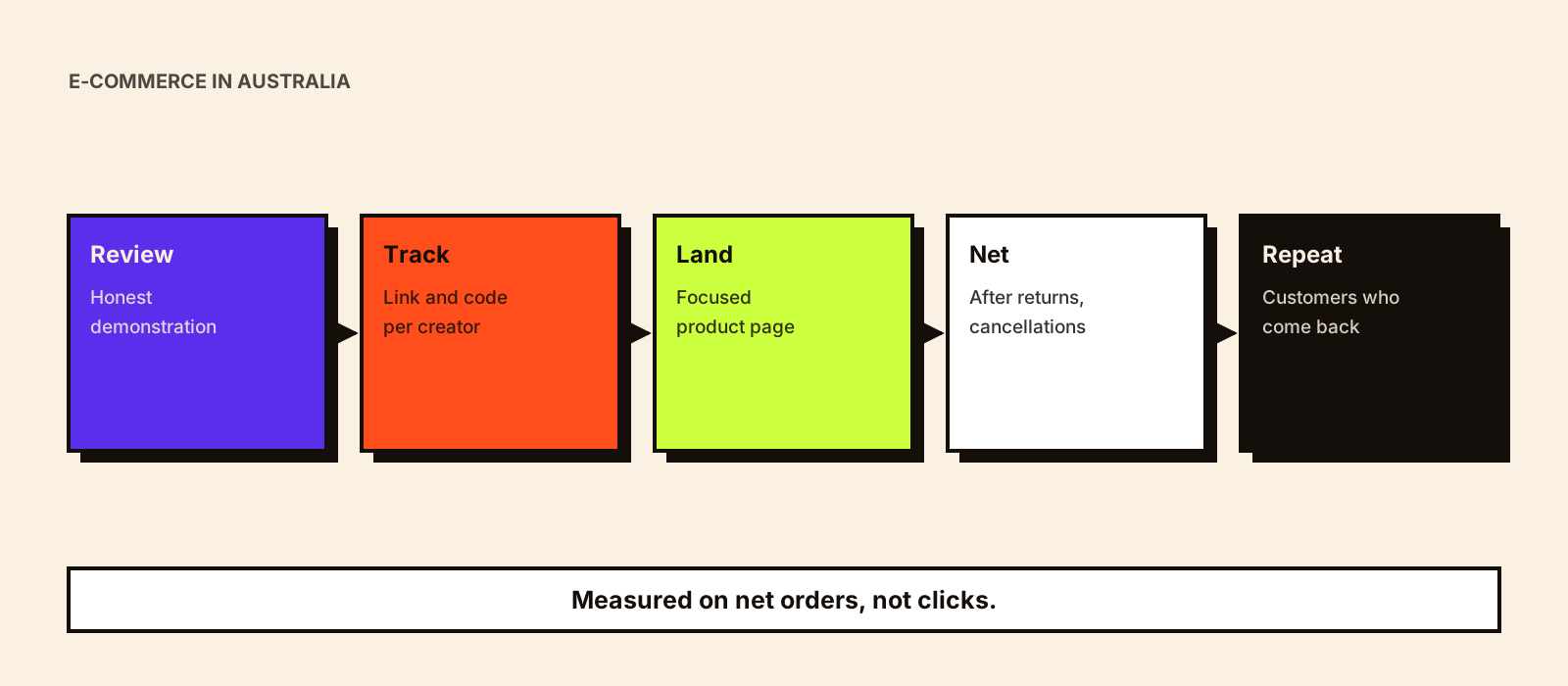
For Australian online brands, creators can drive traffic and sales, but the economics only work when campaigns are measured on profitable orders, not clicks. Local conditions matter too: some in-app shopping features available overseas aren't live here, consumer guarantees affect returns, and reviews must be honest. This guide is for e-commerce founders and growth teams.
Quick answer
Australian e-commerce brands get the best results from creators who demonstrate products honestly, with a tracked link and code per creator leading to a focused landing page. Measure net orders after returns and cancellations, cost per new customer and repeat purchases, not just clicks. Disclose every paid, gifted and affiliate relationship clearly, never edit or fake reviews, and plan conversion through your own store or retailers, because some platform shopping features aren't available in Australia.
Creator roles in the funnel
| Role | Content | Measure |
|---|---|---|
| Discovery | Short demos, first impressions | Reach in Australia, link clicks |
| Consideration | Reviews, comparisons, sizing and fit | Product page views, add to cart |
| Conversion | Codes, limited offers, bundles | Net orders by creator |
| Retention | Ambassadors, refills, new ranges | Repeat purchase by creator cohort |
Links, codes and affiliate terms
- One UTM-tagged link and one code per creator
- Commission on net sales after returns, with a clear attribution window
- Pay commission after the return period, so refunds don't create disputes
- Creators state clearly that they earn from links or codes
- Watch for code leakage to coupon sites; use expiring or single-creator codes
Program mechanics are covered in influencer affiliate programs.
Landing pages
- Send creator traffic to the product shown, not the homepage
- Show the code applied, delivery times and costs, returns and payment options upfront
- Design for mobile and in-app browsers
- Keep claims identical to what the creator said
Measuring profitable sales
| Metric | Calculation |
|---|---|
| Net orders | Orders − returns − cancellations, by creator |
| Cost per new customer | Creator costs ÷ first-time customers |
| Repeat rate | Customers who buy again within 90 days ÷ customers |
| Contribution | Net revenue − product, shipping, commission and creator costs |
Calculate break-even on revenue excluding GST. Hypothetical example: an A$110 order includes A$10 GST, so revenue is A$100. If product, shipping, payment fees and commission cost A$60, the contribution margin is 40%, and break-even ROAS is 1 ÷ 0.40 = 2.5 on GST-exclusive revenue (2.75 if your dashboard reports GST-inclusive revenue). The method is explained in how to calculate break-even ROAS for influencer campaigns.
Customer quality by creator is covered in how to measure customer quality from influencer campaigns.
Consumer law and reviews
Creator claims about your product must be accurate, and paid, gifted or affiliate relationships must be clear. The ACCC's guidance on online reviews says businesses must not write or arrange fake reviews, or edit reviews in ways that mislead, and in 2026 it penalised PhotobookShop over influencer reviews, including undisclosed edits. Returns and refunds are also shaped by the consumer guarantees in the Australian Consumer Law; don't let creator offers suggest customers have fewer rights than they do.
Creator reviews and AI-assisted shopping
Shoppers increasingly ask AI assistants for product recommendations. IAB Australia's Creator Connect Report 2026 says AI assistants are starting to draw on creator reviews, and surveyed consumers about what they want AI to draw on and how much source transparency they expect. What is verified: the research found the trend and consumers' expectations. What isn't: how any specific AI system selects or weights creator content, or whether your products will be recommended. No one can promise that.
IAB Australia's Commerce and Discovery Report 2026 (published July 2026, surveying 1,079 Australian online shoppers aged 18 to 70) adds context: shoppers move between search, retailer sites, reviews, social media and AI tools before buying; search remains the main discovery source; AI tools are used alongside existing research rather than replacing it; and creators' influence depends more on authenticity and expertise than audience size. The public summary doesn't give the detailed figures, so we haven't quoted any.
- Make reviews genuinely useful: specific use cases, sizing, pros and cons
- Keep facts consistent across creator content, product pages and retailer listings
- Publish clear product information on your own site (specifications, materials, care, returns)
- Keep disclosure clear; trustworthy sources are more useful to people and, plausibly, to AI systems
- Don't create fake or incentivised-but-undisclosed reviews to influence any channel
Choosing between Instagram, TikTok and YouTube for each stage is covered in Instagram, TikTok and YouTube influencer marketing in Australia.
Common mistakes
- Paying commission on orders that are later returned
- Planning around in-app shopping features that aren't live in Australia
- Editing creator reviews
- Judging creators on clicks
- Expecting AI visibility from volume rather than useful, consistent information
Conclusion
For Australian e-commerce, creators work best as honest demonstrators with tracked links, measured on net orders and repeat customers. Keep reviews genuine and product information consistent; it serves shoppers today and whatever discovery channels come next.