Influencer Marketing for Enterprise Brands: Managing Multiple Products and Business Units
How large companies with several brands or business units can run creator marketing without duplicated spend and exclusivity clashes: operating models, central vs unit responsibilities, a RACI, shared creator records and consolidated reporting.
In a large company, influencer marketing rarely belongs to one team. The personal care division books creators, so does the snacks division, a regional sales team runs its own local campaign, and HR works with employee creators. Each may be doing good work, but without coordination they pay different rates to the same creator, collide on exclusivity and report results nobody can add up.
Quick answer
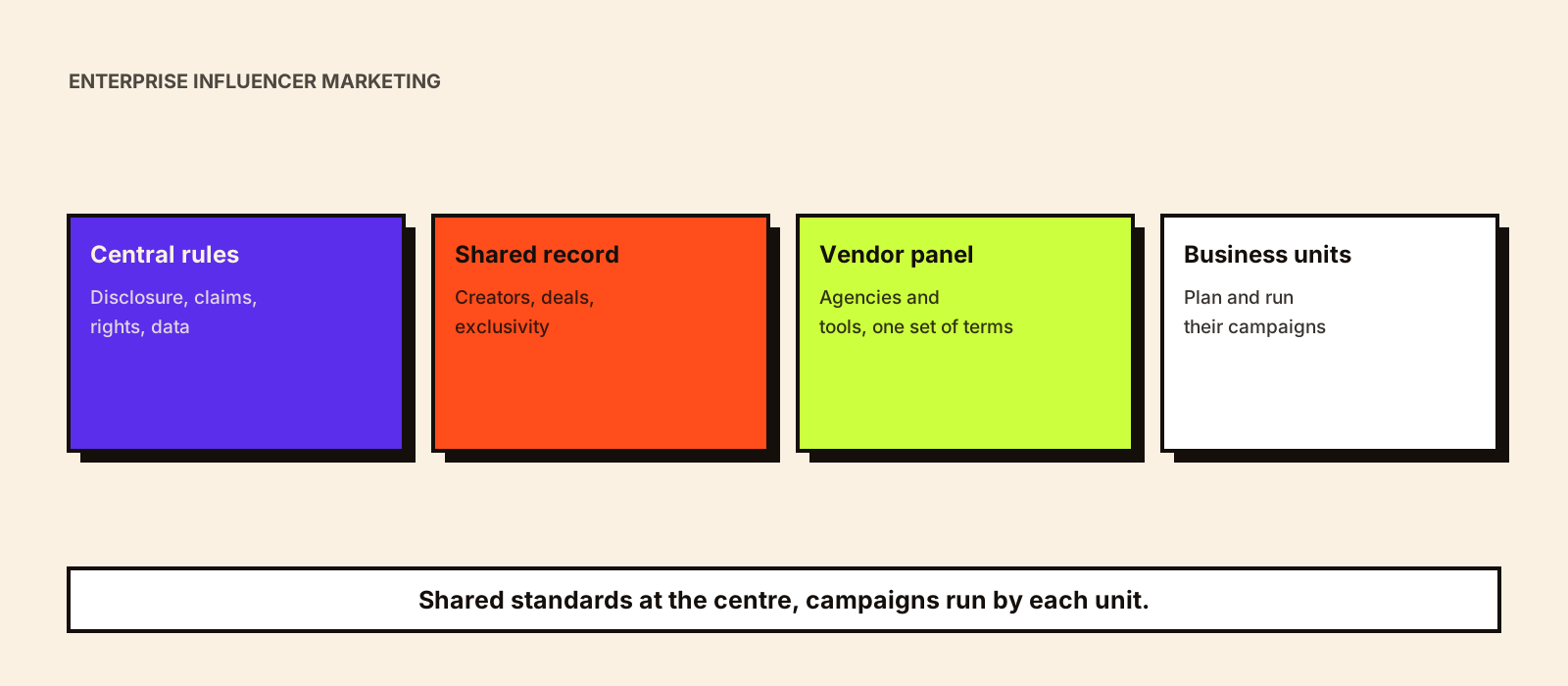
Enterprise brands with several business units get the best results from a hub-and-spoke model: a small central team sets the rules, contracts, tools and reporting standards, and each business unit plans and runs its own campaigns within them. Agree group-level policies for disclosure, claims, usage rights and exclusivity; keep one shared creator record so units can see existing deals; use a short list of approved agencies with common terms; and report every campaign against the same definitions so results can be compared and rolled up.
Three ways to organise it
| Model | How it works | Fits | Watch for |
|---|---|---|---|
| Centralised | One team plans and buys all creator work for every unit | Smaller groups, one dominant brand, tight brand control | Becomes a bottleneck; units feel the team doesn't know their customers |
| Decentralised | Each unit runs its own creator marketing | Very different businesses with separate audiences | Duplicated spend, inconsistent rules, no group view |
| Hub and spoke | A central team sets standards and shared services; units run campaigns | Most multi-brand and multi-category companies | Needs clear decision rights and light, enforced rules |
What the central team should own
- Policies: disclosure, claims approval, brand safety, AI use and data handling, applied to every unit.
- Contracts: one master template with standard usage, exclusivity and payment terms that units adapt rather than rewrite.
- Shared creator record: every creator, current deals, rates paid, exclusivity windows, performance and any issues, visible to all units.
- Vendor panel: a short list of approved agencies and tools with negotiated group terms.
- Measurement standards: the same definitions for reach, engagement rate, CPM, CPA and incrementality, so units' results add up.
- Training and a simple playbook so new teams start from the same base.
The individual policies are covered in influencer marketing governance, and a responsibility matrix in influencer marketing team structure.
What business units should own
- Their objectives, audiences and creator selection, because they know their customers.
- Briefs and day-to-day creator relationships.
- Approving content for their category's claims, using the group approval rules.
- Their budget, within any group rate guidelines.
Decision rights: a simple RACI
| Decision | Central team | Business unit | Legal or compliance | Finance |
|---|---|---|---|---|
| Group policies and templates | Responsible / accountable | Consulted | Consulted | Informed |
| Campaign plan and creator choice | Consulted | Responsible / accountable | Informed | Informed |
| Regulated claims (health, finance, children) | Informed | Responsible | Accountable | Informed |
| Exclusivity across brands | Accountable | Responsible | Consulted | Informed |
| Agency selection | Accountable (panel) | Responsible (within panel) | Consulted | Consulted |
| Reporting and roll-up | Accountable | Responsible | Informed | Informed |
Exclusivity and creator conflicts across units
The most common enterprise problem is one unit signing a creator to category exclusivity that blocks a sister brand, or two units booking the same creator in the same week. Define competitors per brand and category rather than for the whole group, check the shared creator record before any offer, and set a minimum gap between sister brands using the same creator. The detail is in the section on businesses with several brands in influencer exclusivity.
Consolidated reporting
Leadership will ask what the group spends on creators and what it gets back. Make that answerable from day one: every campaign reports the same core fields, and the central team rolls them up quarterly.
Business unit | Brand | Campaign | Market | Objective | Primary KPI and result
Creators (count, tiers) | Deliverables | Spend: creator fees, production, usage, management, paid amplification
Reach (unique where possible) | Engagement rate by reach | Cost per result (CPM / CPE / CPA)
Incremental result, if tested (method) | Content reused in ads (yes/no) | Creators to rebook | Issues logged
For presenting the roll-up to leadership, see the section on CEOs and finance teams in how to create an influencer marketing report, and for the investment case, influencer marketing business case.
Getting started without a big reorganisation
| Step | What to do | Output |
|---|---|---|
| 1. Map what's happening | Ask each unit for its creator spend, agencies and current deals | A one-page picture of who does what |
| 2. Agree five group rules | Disclosure, claims approval, usage rights, exclusivity checks, data handling | A short policy everyone signs off |
| 3. Start the shared record | A simple shared sheet or CRM with creators, deals and windows | No more double-booking |
| 4. Standardise reporting | Common fields and definitions | Comparable results |
| 5. Consolidate vendors | Review agencies and tools, agree a panel | Better terms, fewer contracts |
Common mistakes
- Centralising everything and slowing every campaign down.
- Letting each unit write its own contract terms.
- No shared view of creators, so units bid against each other.
- Comparing units' results that use different definitions of the same metric.
- Group exclusivity so broad it blocks sister brands.
Conclusion
Enterprise influencer marketing works when the centre makes it easier, not slower: shared rules, contracts, creator records and reporting, with units free to run their own campaigns. Start by mapping what's happening and agreeing a few group rules. Kudozz works with in-house teams on this kind of structure through its influencer campaign strategy service.