Influencer Outreach Email: How Brands Should Write Collaboration Emails
Practical, personalized outreach examples for different collaboration scenarios, plus what to include, what to leave out, and how to follow up without becoming the message a creator ignores.
An influencer outreach message gets replies when it shows the creator that a real person reviewed their actual content and has a specific, relevant reason to work with them, not when it follows a clever template. Personalization is the single biggest factor separating a message that gets answered from one that gets ignored. This article covers the message itself; for the full process before and after you hit send, sourcing, vetting, negotiating, and tracking, see influencer outreach strategy.
Quick answer
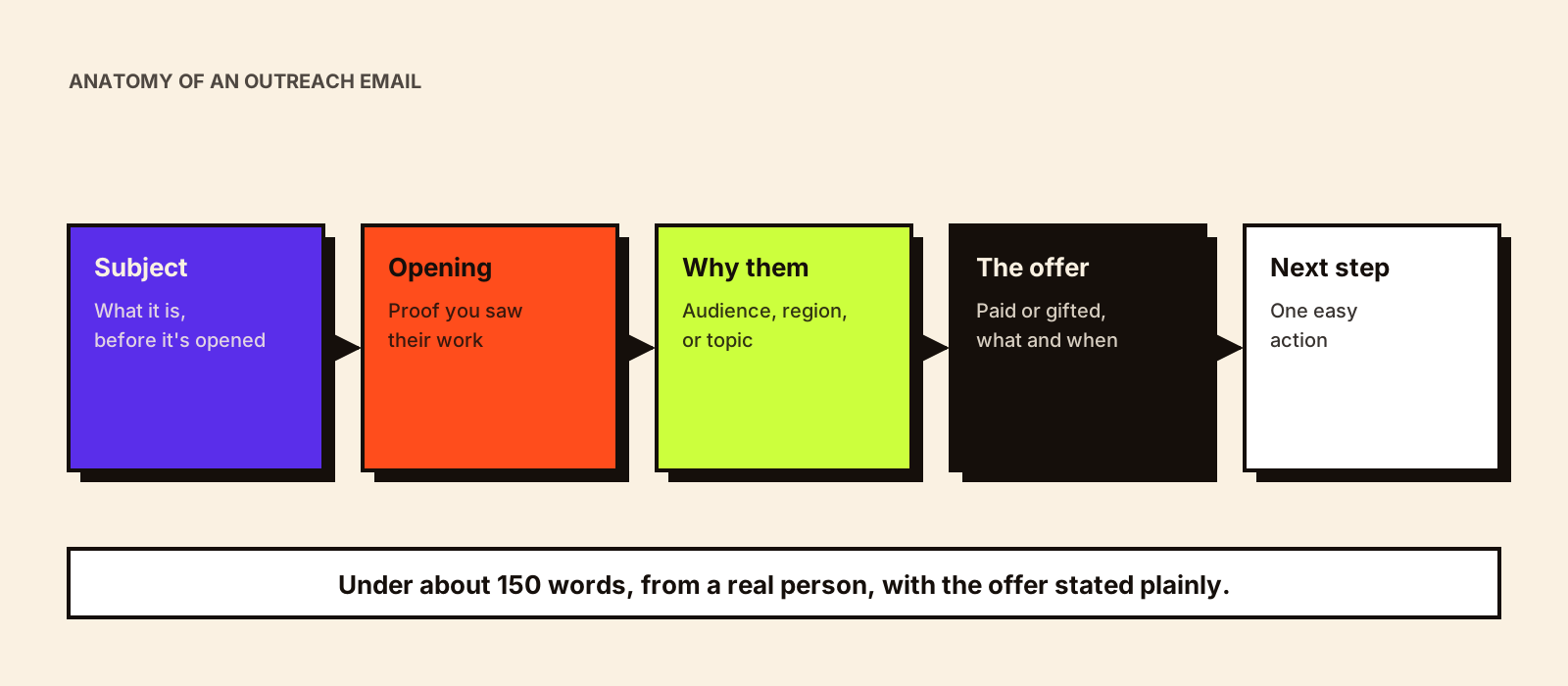
An influencer outreach email should have a specific subject line, a short opening that shows you know the creator's work, one or two sentences on why they fit, a brief description of the campaign or product, what you're asking for (deliverables and timing), whether it's paid, gifted or commission-based, and one clear next step. Keep it under about 150 words, send it from a real person on your brand domain and adapt it to the creator's language, tier and the type of offer.
Email, letter or DM: which to use
| Format | Use it when | Tone |
|---|---|---|
| Collaboration email | The creator lists a business email; most paid collaborations | Friendly, specific, under about 150 words |
| Formal letter or proposal (sent by email as a PDF or in the email body) | Celebrities, creators with talent managers, B2B experts, or when your company needs a formal offer on letterhead | Professional; includes company details, the full offer and a named contact |
| Instagram or YouTube message | Smaller creators with no business email, or a short 'may I email you?' first touch | Very short; move to email once they reply |
Subject: [Brand] x [Creator]: [paid / gifted] [format] for [month or campaign]

Hi [first name],

Your [specific video or post] is why I'm writing: [one sentence on what you noticed].

I'm [name], [role] at [brand]. We make [product, in one line] and we're working with a few [category] creators in [market] for [campaign or launch].

We'd love [deliverables], live around [dates]. This is a [paid collaboration / product-for-content collaboration / affiliate partnership]; [budget line, e.g. 'happy to work from your rates' or 'our budget is around ₹X'].

Would you be open to it? If so, could you share your rates or a good time to talk this week?

Thanks,
[name, role, phone, website]
Subject: Collaboration proposal from [Company] for [Creator]

Dear [name / manager's name],

[Company], the maker of [brand/product], would like to invite [Creator] to collaborate on [campaign name], planned for [dates] in [markets].

Why [Creator]: [one or two specific reasons tied to their content and audience].

Proposed scope: [deliverables, platforms, lengths, posting window].
Commercial terms: [fee or fee range, payment schedule, whether product is included].
Usage and exclusivity: [what we'd like to reuse, for how long; any category exclusivity].
Disclosure: all content will be labelled as a paid partnership in line with [ASCI / local] guidelines.

We'd be glad to adjust the scope to suit [Creator]'s usual formats. Please let us know if you'd like a call, or share your terms and we'll send a short agreement.

Kind regards,
[name, title, company, email, phone]
The anatomy of an outreach email
| Part | What it does | Example |
|---|---|---|
| Subject | Says what this is before it's opened | [Brand] x [Creator]: paid Reel for our October launch |
| Opening | Shows you've seen their work | Your 'small-kitchen Diwali clean-up' Reel is why I'm writing. |
| Why the creator | Connects their audience or style to the brief | Most of your audience is in Maharashtra, where we're launching. |
| Campaign or product | One or two lines, not a pitch deck | We make airtight steel storage for Indian kitchens. |
| Deliverables | What you'd like and when | One Reel and three Stories, live mid-October. |
| Compensation | Paid, gifted or commission, said plainly | This is a paid collaboration; happy to work with your rates. |
| Next step | One easy action | Could you share your rate card, or a time to talk this week? |
Not every email needs every part in the first message; a gifting message, for example, skips deliverables. But compensation type should always be clear.
Why personalized outreach matters
Creators, especially established ones, receive a high volume of outreach, much of it obviously copy-pasted. A message that references specific recent content signals the brand did real homework, which is itself a small but meaningful signal about what working together might be like.
How to research a creator before contacting them
Review their last several posts for content style, tone, and any existing brand partnerships, and check whether their audience genuinely overlaps with your target customer, not just their follower count. This is the same evaluation covered in how to find the right influencers for your brand.
What to include in an initial message
- A specific reference to a recent piece of their content and why it caught your attention
- A brief, clear introduction to the brand and product
- The general nature of the collaboration opportunity
- A rough sense of scope, without needing to finalize every deliverable upfront
- A clear, low-pressure next step, such as asking if they'd like to hear more
Writing an effective subject line
For email outreach specifically, the subject line decides whether the message gets opened at all. Skip generic lines like "Collaboration Opportunity" or "Partnership Inquiry," which read as mass-sent and often get ignored or filed as spam. A subject line that names your actual brand and states a concrete reason for reaching out, "Loved your [specific video] — a quick idea from [Brand]" or "[Brand] x you: a [product category] collaboration," performs better because it signals a real person wrote it about their specific content, not a template blasted to a list.
How to introduce your brand
Two or three sentences are usually enough — what the brand does and why it might be relevant to that creator's audience specifically, not a full company history.
How to explain the collaboration opportunity
State the general type of collaboration, such as a sponsored post, a product launch feature, or an ongoing partnership, without over-specifying deliverables before the creator has expressed interest. The full negotiation of details comes later.
What not to include in the first message
- A fully drafted contract or exhaustive list of legal terms
- A rigid script of exactly what the creator must say
- An unreasonably tight deadline with no room for discussion
- A lowball rate stated as non-negotiable before any conversation has happened
How to discuss compensation professionally
It's reasonable to ask what the creator's typical rate is for the type of content described, rather than opening with a number, especially in a first message. If proposing a number, base it on realistic market context rather than a flat internal budget figure.
Outreach example: initial collaboration inquiry
Hi [Name], I've been following your [platform] content for a while and really liked your recent post about [specific detail] — the way you [specific observation] stood out. I work with [Brand], a [one-line description], and think your audience could genuinely be interested in what we're building. Would you be open to hearing more about a possible collaboration? No pressure either way, just wanted to reach out directly.— Example outreach message, not a real exchange
Outreach example: Instagram DM
A DM should be shorter and more conversational than an email — nobody wants to read three paragraphs in their inbox on the app. Keep the same substance, who you are, why you're reaching out to them specifically, and a low-pressure next step, but compress it.
Hey [Name]! Been enjoying your content on [topic] for a while, especially [specific post]. I'm with [Brand] and think there could be a fun fit for a collaboration. Mind if I share a few more details?— Example Instagram DM, not a real exchange
Outreach example: paid collaboration
Hi [Name], I've been following your [content type] for a while and think there's a genuine fit with [Brand]. We'd like to put together a paid collaboration, specifically [Reel / video / post], with a budget in the [range] area depending on deliverables and usage. Happy to share the full brief if you're interested so you can see if it's a fit before we go further.— Example outreach message, not a real exchange
Outreach example: product gifting
Hi [Name], we'd love to send you [product] to try, no obligation to post about it. If you do end up loving it and want to share something organically, we'd genuinely appreciate it, but this is a gift either way, not a paid ask. Let me know if you'd like it sent over.— Example outreach message, not a real exchange
Outreach example: product launch collaboration
Hi [Name], we're launching [product] on [date] and I thought of you specifically because of [specific reason tied to their content]. We're looking for a small group of creators to get early access ahead of launch and share their honest first impressions. Would that be something you'd be interested in learning more about?— Example outreach message, not a real exchange
Outreach example: campaign invitation to a shortlist
Hi [Name], we're running a campaign for [Brand] across [platform] this [month/quarter] and you're on a shortlist of creators whose style and audience feel like a genuine fit. The campaign covers [one-line summary]. If it sounds interesting, I can send the full brief and rate expectations so you can decide if it's worth pursuing.— Example outreach message, not a real exchange
Outreach example: agency-to-creator
When an agency reaches out on a brand's behalf, naming the agency and the brand upfront avoids the message reading as a generic mass outreach from an unfamiliar sender.
Hi [Name], I'm reaching out from [Agency] on behalf of [Brand] for an upcoming campaign. We handle the outreach, briefing, and coordination on their side, so you'd be working directly with our team rather than juggling multiple brand contacts. If you're open to hearing more, I can share the campaign details and next steps.— Example outreach message, not a real exchange
Outreach example: long-term partnership inquiry
Hi [Name], we've loved working with you on [specific past collaboration] and the response from your audience was clearly genuine. We're exploring turning this into an ongoing partnership rather than a one-off, and wanted to see if that's something you'd be open to discussing.— Example outreach message, not a real exchange
Outreach example: follow-up message
Hi [Name], just wanted to gently follow up on my note from last week in case it got buried. Totally understand if this isn't the right fit right now — happy to share more details if useful, or leave it here if not.— Example outreach message, not a real exchange
What to change in each template, and why
Templates fail when they're sent unchanged. Before using any of the examples above, change these parts:
| Change | Why it matters |
|---|---|
| The specific line about their content | It's the only proof you looked; generic praise reads as spam |
| Why them (audience, region, topic) | Creators want to know their audience will care |
| The offer type and terms | Unclear pay is the most common reason for slow replies |
| Language and tone | A Tamil creator, a Hindi comedian and an English finance educator need different voices |
| The next step | One concrete action gets faster replies than 'let us know' |
Keep the structure, change the substance. For doing this across many creators, see personalized influencer outreach; for what to send once a creator is interested, see influencer collaboration proposal.
Choosing the right example
| Situation | Start from | Channel |
|---|---|---|
| First contact, paid | Paid collaboration example | Email or manager |
| Small creator, no email | Instagram DM example | DM or partnership inbox |
| Trying the product first | Product gifting example | DM or email, with permission |
| Launch with a fixed date | Product launch example | |
| Inviting a shortlist | Campaign invitation example | |
| Past partner | Long-term partnership example | Their preferred channel |
| No reply yet | Follow-up example (once or twice) | Same thread |
How to follow up without being intrusive
One follow-up after five to seven business days is reasonable; a second one after that is usually unnecessary. Keep the follow-up short, acknowledge they may be busy or uninterested, and avoid repeating the entire original pitch.
A note on volume and personalization
These examples are templates to adapt with genuine, specific detail for each creator, not scripts to send unmodified at scale. A message that's obviously mass-sent, even with a name filled in, tends to get ignored or reported as spam, and undermines the brand's credibility with exactly the audience it's trying to reach.
Influencer Outreach Checklist
- Creator's recent content reviewed and referenced specifically in the message
- Brand introduction kept to two or three relevant sentences
- Collaboration opportunity described clearly without over-specifying every deliverable
- No draft contract, rigid script, or non-negotiable rate included in the first message
- Compensation discussed as a conversation, not a flat opening demand
- A single, reasonably timed follow-up planned if there's no response
The outreach messages that get replies read like they were written for one specific person. The ones that get ignored read like they were written for a spreadsheet.— Kudozz Partnerships Team
What happens after a creator replies
Once a creator responds with interest, the conversation moves into negotiation and eventually a written agreement — see how to negotiate with influencers and how to work with influencers for what comes next, or how to build long-term influencer partnerships if the goal is an ongoing relationship rather than a single post.
Creators pitching brands rather than the other way round can use our 15 brand collaboration email templates for creators.
How Kudozz handles this: Influencer Outreach & Management.