Influencer Marketing for Manufacturing Brands: How Industrial Companies Can Work With Creators
How Indian manufacturing and industrial companies, an audience that hasn't traditionally considered influencer marketing, can use creator partnerships for credibility, education, and lead generation.
Most manufacturing companies have never run a creator campaign, and understandably so, the category doesn't resemble consumer marketing at all. But industrial buyers still research vendors, follow industry voices, and trust some sources more than others, which means the same underlying logic that makes B2B creator marketing work applies here too, just with a very different set of creators and content.
Quick answer
Manufacturing and industrial companies can work with creators, but the right ones are engineers, industry experts and B2B voices that buyers, distributors and engineers already follow, mostly on LinkedIn and YouTube. Use product demonstrations, factory and process stories, trade-event coverage and employer branding, and measure leads, distributor enquiries and recruitment rather than consumer-style reach.
Why manufacturing companies can benefit from creator partnerships
Industrial buying decisions involve real technical scrutiny and long evaluation cycles, and credible third-party voices, engineers, industry analysts, experienced operators, can move a buyer's confidence in ways a sales brochure or trade ad generally can't.
Industry experts
Recognized voices within a specific manufacturing sub-sector, materials, automation, industrial machinery, bring credibility that a generalist business creator simply doesn't have, since technical buyers can quickly tell whether someone genuinely understands the space.
Engineers and technical creators
A growing number of engineers and technical specialists create content explaining processes, standards, and equipment, and partnering with them for genuine technical demonstrations or explainers can reach exactly the audience a manufacturing brand needs: procurement teams, engineers, and technical decision-makers.
B2B thought leadership
Co-created content with a respected industry figure, an analysis of a sector trend, a technical comparison, a process explainer, lends a manufacturing brand credibility with an audience that's typically skeptical of direct marketing.
Trade audience education
Content that genuinely educates a trade audience, how a material performs under specific conditions, how a process improves efficiency, serves technical buyers directly and positions the brand as a knowledgeable source rather than just a vendor.
Product demonstrations
Demonstrations from a credible technical voice, showing equipment or materials performing under real conditions, carry more weight with an industrial buyer than a produced brand video, since technical audiences are specifically evaluating real-world performance.
Factory and process storytelling
Behind-the-scenes content showing how something is actually manufactured, quality control, process precision, scale, builds a kind of credibility and trust that a static product catalog can't, and increasingly resonates with both trade buyers and a broader audience interested in how things are made.
Employer branding
Manufacturing companies competing for skilled technical talent can use creator-style content, genuine employee voices, a look at working conditions and career paths, to reach candidates who don't respond to traditional recruitment marketing.
Trade events
Trade shows and industry events are natural moments for creator collaboration: live coverage, product demonstrations, and expert commentary distributed beyond the people physically in attendance.
Measuring B2B outcomes
Measure manufacturing creator campaigns on qualified leads, inquiry volume from the right buyer segment, and engagement from a genuinely relevant technical or trade audience, rather than broad reach or follower growth, which mean little in a market this specialized.
Manufacturing Influencer Marketing Strategy Framework
| Stage | Goal | Typical approach |
|---|---|---|
| Awareness | Introduce the company or a specific capability to a relevant trade audience | Industry expert commentary, trade event coverage |
| Industry credibility | Build trust with technical and procurement decision-makers | Thought leadership collaborations, technical demonstrations |
| Education | Help a trade audience understand a product, material, or process | Explainer content, process storytelling, engineer-led breakdowns |
| Lead generation | Convert interest into a qualified sales conversation | Gated technical content, webinar collaborations |
| Relationship building | Sustain credibility and visibility over time | Ongoing partnerships with the same trusted industry voices |
Making the case internally
For a manufacturing company considering this for the first time, the easiest starting point is usually a single technical thought-leadership collaboration or trade-event partnership, not a full creator program, since it lets a team see how a credible outside voice performs with their specific audience before committing to a larger, ongoing strategy.
Nobody outside the industry has ever discovered a manufacturing company through a viral post. But the right engineer explaining why your process actually matters can move a buyer that a brochure never will.— Kudozz Strategy Team
Reaching engineers, buyers and distributors
| Audience | Creators | Channel |
|---|---|---|
| Engineers and plant teams | Engineering educators, practitioners | YouTube, LinkedIn |
| Procurement and management | Industry leaders, consultants | LinkedIn, podcasts, newsletters |
| Distributors and dealers | Trade creators, association voices | WhatsApp communities, regional YouTube |
| Future hires | Employees and graduates | LinkedIn, Instagram |
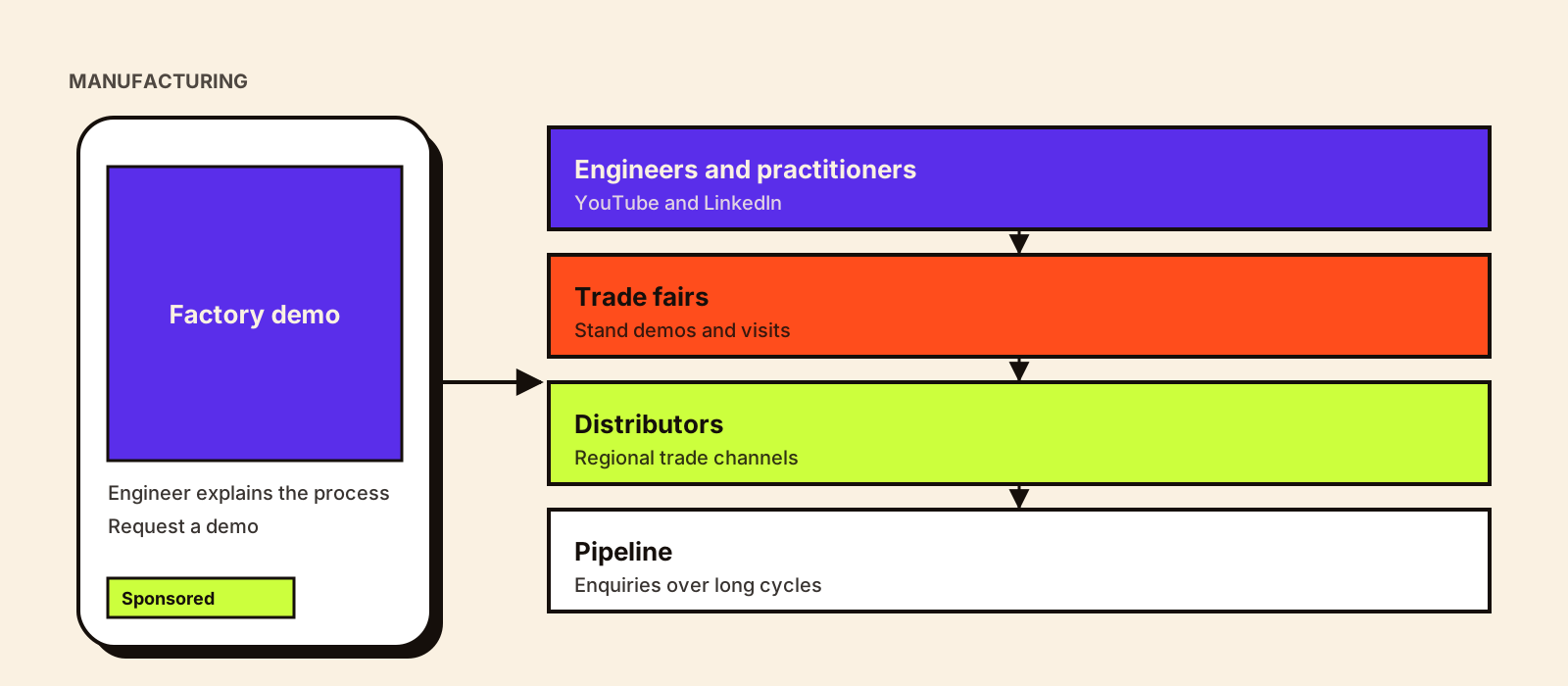
Trade fairs are natural creator moments: invite relevant creators to stand demos and factory visits around the event, and repurpose the footage for sales teams. Technology-heavy industrial products can borrow from influencer marketing for B2B technology brands, and building materials from influencer marketing for construction.
Industrial automation and laboratory equipment
Automation systems, instruments and laboratory equipment are bought by committees: engineers or scientists who evaluate, plant or lab managers who approve, and procurement teams who negotiate. The creators who matter are the practitioners those people already learn from: automation engineers, maintenance heads, lab technicians and scientists who post on YouTube and LinkedIn.
| Content | Who it's for | What to keep accurate |
|---|---|---|
| Application walkthroughs | Engineers and scientists evaluating fit | Specifications and test conditions as documented |
| Installation and integration | Plant and lab teams | Real time, tools and skills needed |
| Retrofit and upgrade stories | Maintenance and operations heads | Results stated as that site's experience, with permission |
| Methods and protocols | Lab users | Only validated methods; no shortcuts that affect accuracy |
| Total cost explainers | Approvers and procurement | Assumptions shown; consumables and service included |
| Trade show and demo-centre content | All roles | Show what's on site, not promises of future features |
- Give creators hands-on access and an application engineer to answer questions.
- Get written permission before filming any customer site, process or data.
- Treat performance, accuracy and safety claims as technical claims that need evidence and an engineering review.
- Measure RFQs, demo requests and application-note downloads by creator, and expect long cycles.
Long buying cycles are covered in influencer marketing for long sales cycles.
Planning your next campaign
Pipeline measurement for long B2B cycles is covered in creator-led B2B marketing.