Influencer Marketing for a New Product Category: How to Educate a Market That Doesn't Know It Needs You
When people don't yet know your category exists, creator campaigns that push the brand fall flat. How to sequence creator content from the problem to the category to the brand, which creators play which role, how to turn early customers into advocates and what to measure while demand is still forming.
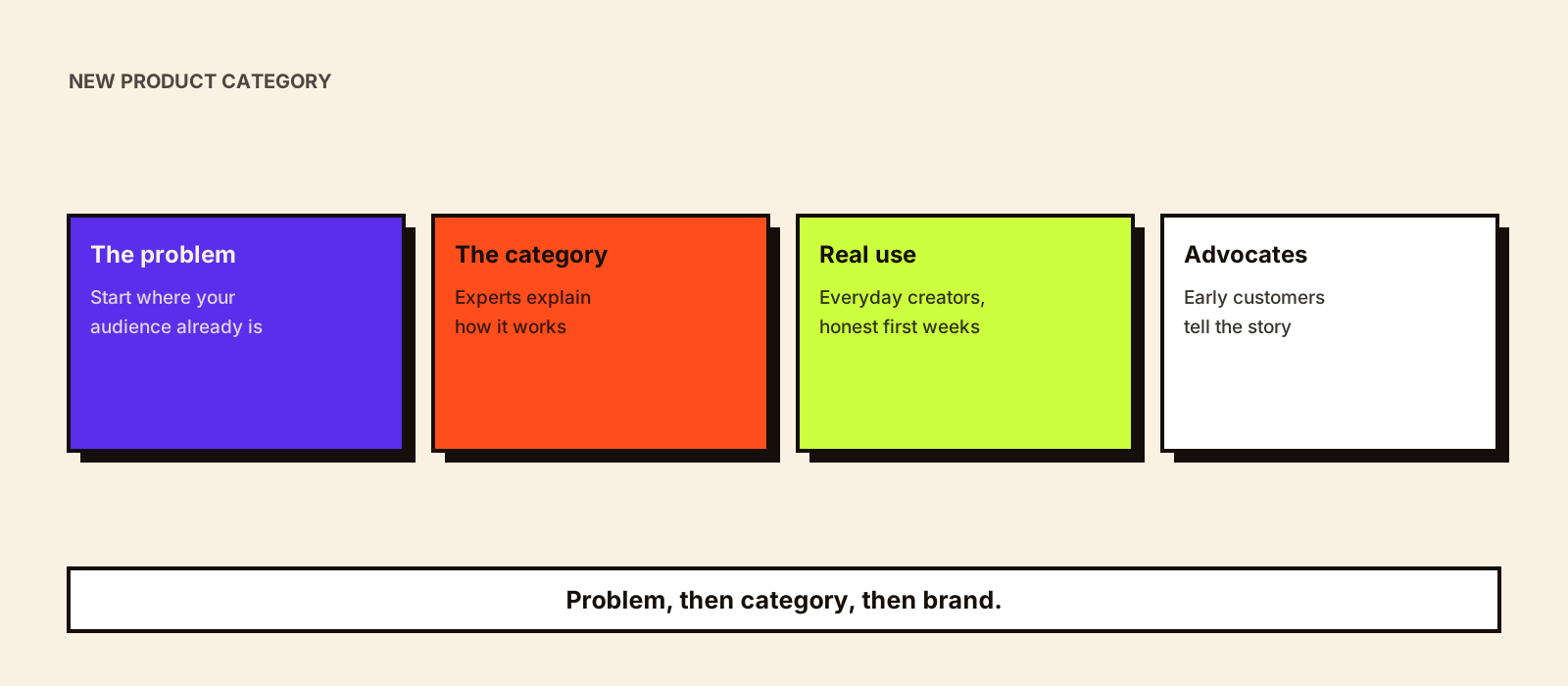
A new product in a known category has a head start: people already search for it, compare options and know roughly what it costs. A new category has none of that. Nobody is looking for you, the words you use to describe the product mean nothing yet, and a creator saying 'try this brand' gets polite indifference. The job of creators here is different: they have to make a problem feel real and a new kind of solution feel normal before the brand matters.
Quick answer
In a new category, sequence creator content from problem to category to brand. Start with creators who talk about the problem your audience already has, then use expert creators to explain the new kind of solution and why it works, then everyday creators and early customers to show real use, including the awkward first week. Keep one consistent category name across every creator so search and word of mouth can build. Turn early customers into an advocacy programme. Measure category understanding and demand (search for the category term, questions in comments, survey recall) before judging on sales, and plan for a longer runway than a normal launch.
How a new category differs from a new product
| New product, known category | New category | |
|---|---|---|
| What the audience knows | The category and its main brands | The problem, at best |
| Main question in comments | 'How is this better than X?' | 'What is this?' and 'Do I need it?' |
| Creator's job | Compare and recommend | Explain, normalise, then recommend |
| Search behaviour | People search the category or brand | People search the problem, if anything |
| Typical timeline to sales | Weeks | Months, often several waves |
| Biggest risk | Being ignored among competitors | Being misunderstood, or over-promising to make the case |
The four stages of category content
1. Name the problem
Start where your audience already is. If you sell a smart water bottle, people don't search for smart bottles; they talk about forgetting to drink water or afternoon headaches. Problem-first content from creators who genuinely live with that problem earns attention without a hard sell. Customer research is the best source of the language to use; see using customer insights in influencer briefs.
2. Explain the category
Once the problem is on the table, someone credible has to explain the new kind of solution: what it is, how it works, who it suits and who it doesn't. This is where subject-matter experts earn their fee, because they can explain the mechanism without sounding like an ad. Keep claims to what you can prove; new categories tempt brands to overstate the science to win attention. See expert creator marketing for verifying expertise and protecting independence.
3. Show real use
People adopt a new kind of product when they can picture it in their own routine. Everyday creators, and early customers who create content, should show setup, the first week, what took getting used to and where it actually fits. Honest friction is persuasive in a new category, because the audience assumes there's a catch and is reassured when someone names it.
4. Build advocates
Early customers are your most believable voices. Invite the enthusiastic ones into a structured advocacy programme with early access, a direct line to the product team and clear disclosure rules. Customer advocacy programmes covers how to find, invite and reward them without buying opinions.
Which creators play which role
| Creator type | Role in a new category | Content that suits them |
|---|---|---|
| Problem-adjacent creators | Make the problem feel real and shared | Day-in-the-life, frustrations, 'how I used to handle this' |
| Subject-matter experts | Explain the mechanism and set honest expectations | Explainers, myth-busting, Q&A |
| Early-adopter or tech-curious creators | Try new things first; give permission to experiment | First impressions, setup, honest pros and cons |
| Everyday creators and customers | Normalise use in ordinary routines | Week-one diaries, routines, before-and-after of the routine (not of results) |
| Community leaders | Spread it inside a specific group | Group demos, discussions, AMAs |
Agree the category name before anyone posts
If one creator calls your product a 'gut health shot', another a 'probiotic drink' and a third a 'fermented tonic', you've created three tiny categories instead of one. Pick the term your audience will understand and search for, put it in every brief, and ask creators to use it naturally in captions and on screen. Check which words people already use in reviews, comments and search suggestions; the category name you like internally may not be the one that spreads. Creator content also influences how a category shows up in search, covered in influencer marketing and SEO.
Plan in waves, not a single launch
| Wave | Focus | Creators | Main signal to watch |
|---|---|---|---|
| Wave 1 (seed) | Problem and first explanations | Experts plus a handful of problem-adjacent creators | Comment questions shift from 'what is this?' to 'how does it work?' |
| Wave 2 (show) | Real use and honest first weeks | Everyday creators, early customers | Category search term starts to appear; saves and shares rise |
| Wave 3 (compare) | Versus what people do today | Experts and trusted reviewers | Questions about price and where to buy |
| Wave 4 (scale) | Sales-focused content and offers | Best performers from earlier waves, plus new creators | Conversion and repeat purchase |
A normal product launch compresses all of this into a few weeks; see influencer marketing for new product launches for that playbook. For a new category, each wave tells you whether the market understands enough to move on. Kudozz's influencer marketing strategy work often starts by mapping these waves against budget and the evidence each one needs to produce.
Measuring while demand is still forming
Judging wave 1 on sales usually kills a new category too early. Measure whether understanding and demand are building, then move to commercial metrics as the waves progress.
- Category search: track your category term and problem terms in Google Trends and Search Console, against a pre-campaign baseline.
- Comment analysis: tag comments as confused, curious, sceptical or ready to buy, and watch the mix change wave by wave.
- Recall and understanding: a short survey or brand lift study asking whether people can describe what the category does.
- Saves and shares: signals that people want to come back to or pass on the explanation.
- Sales and repeat purchase: from wave 3 onwards, by creator cohort.
For survey design, see influencer brand lift surveys.
An illustrative example
Hypothetical: a start-up launches a countertop composter in Bengaluru, a category most buyers haven't seen. Wave 1 pairs two waste-management experts with eight apartment-living creators who talk about wet-waste segregation rules and smell. Wave 2 sends units to twenty households, half of them existing customers, for honest four-week diaries. Comments move from 'what is this?' to 'how much electricity does it use?', and the brand answers that question in wave 3 with an expert explainer. Only in wave 4 does it run creator codes. Every number of creators here is illustrative.
Common mistakes
- Leading with the brand and offers before anyone understands the category.
- Overstating benefits to make a new idea sound compelling.
- Letting every creator invent their own name for the category.
- Using only lifestyle creators, so nobody credible explains how it works.
- Judging the first wave on sales and stopping before demand has formed.
- Ignoring the questions in comments, which are the brief for the next wave.
Conclusion
Creators are well suited to new categories because they can explain and normalise in a way ads can't, but only if the content is sequenced: problem, category, real use, then brand. Agree the category name, plan in waves, measure understanding before sales, and invite your earliest customers to help tell the story.