Influencer Marketing in Regulated Categories in India: What Brands Must Check
Health, food supplements, finance, insurance, gaming, alcohol, crypto, real estate and coaching each add their own rules on top of India's general advertising rules. A category-by-category map, a claims review process and the checks to run before a creator posts.
If you sell a supplement, a mutual fund platform, an insurance product, a coaching course or a housing project, a creator campaign has two rulebooks to satisfy. The first applies to every brand in India: disclose the partnership and don't mislead. The second belongs to your sector, and it's usually the one that catches brands out, because creators rarely know it and briefs rarely mention it.
Quick answer
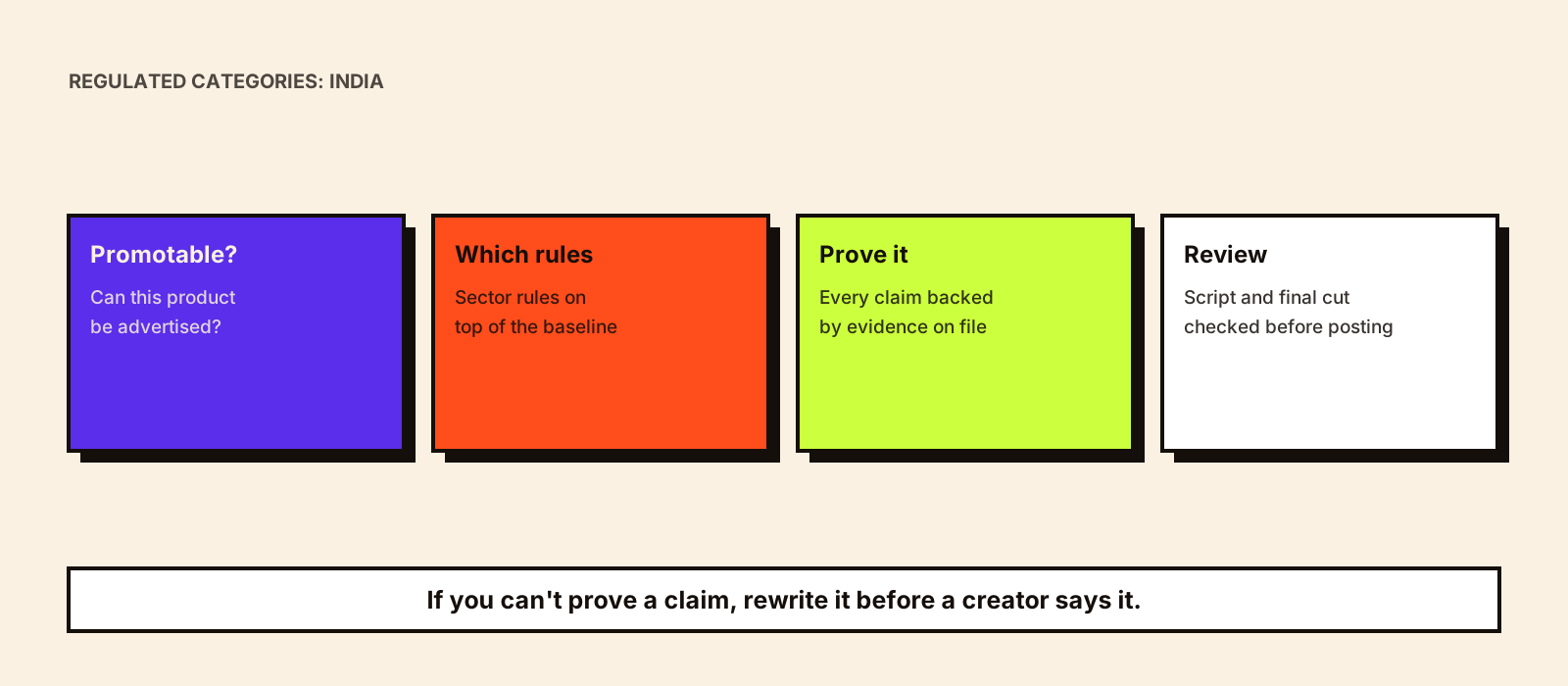
Before you brief a creator in a regulated category, answer four questions. Can this product be advertised to consumers at all (prescription medicines, online money games and alcohol, for example, can't be in the usual way)? Which sector rules apply on top of the Consumer Protection Act, the CCPA's 2022 advertising guidelines and the ASCI Code? Can you prove every claim the creator will make, with evidence on file? And who reviews the script and final cut before it goes live? Give creators a claims sheet with approved wording, use qualified creators for technical health or financial advice, and keep records. This is general information, not legal advice: check your specific product with a lawyer who knows your sector.
The two rulebooks
Every creator campaign in India sits under the Consumer Protection Act, 2019, the CCPA's Guidelines for Prevention of Misleading Advertisements and Endorsements for Misleading Advertisements, 2022, the Department of Consumer Affairs' endorsement guidance for influencers, and ASCI's Code and influencer guidelines. Those cover disclosure, honest endorsement and misleading claims for everyone. The CCPA guidelines also deal with surrogate advertising. Influencer campaign compliance covers this baseline in detail, so this guide concentrates on what changes by category.
Primary sources for the baseline: the CCPA guidelines announcement, the Department of Consumer Affairs endorsement guidance and ASCI's influencer guidelines.
Category-by-category map
| Category | Main rules to check | What creators can usually do | What to keep out |
|---|---|---|---|
| Prescription medicines | Drugs and Cosmetics Act and Rules; Drugs and Magic Remedies (Objectionable Advertisements) Act, 1954 | Corporate and employer content; unbranded education by qualified doctors, disclosed | Naming or hinting at a prescription drug; results, dosage or before-and-after content |
| OTC and AYUSH medicines | Drugs and Cosmetics Act and Rules; 1954 Act | Correct use, reading the label, when to see a doctor | Claims to cure, treat or prevent the diseases the 1954 Act lists |
| Supplements, nutraceuticals, functional foods | FSS Act, 2006; FSS (Advertising and Claims) Regulations, 2018; FSSAI's 2026 advisory to influencers | Routines, taste, ingredients, approved and substantiated claims | Disease-treatment claims; 'boosts immunity' or 'burns fat' without evidence |
| Securities, investments, trading | SEBI's 2024 circular restricting regulated entities from associating with unregistered persons who give advice or claim returns; ASCI's finance rules | Financial literacy and product mechanics by qualified, disclosed creators, where the regulated entity's own compliance allows it | Stock tips, return claims or performance promises from unregistered creators |
| Insurance | IRDAI's advertisement rules for insurers and intermediaries | Explaining how a type of cover works; education-led content reviewed by compliance | Product claims without the required disclosures; 'guaranteed' language |
| Online money games | Promotion and Regulation of Online Gaming Act, 2025 | Esports and social or casual games, which remain permitted | Any promotion of online money games, including rummy, poker and fantasy formats |
| Alcohol and tobacco | Restrictions on advertising these products; surrogate advertising rules in the CCPA 2022 guidelines | Very little; treat brand-extension content as high risk | Content that refers, directly or indirectly, to the restricted product, including through a shared brand name or logo |
| Crypto and other virtual digital assets | ASCI's 2022 guidelines for advertising virtual digital assets | Disclosed content carrying the required risk disclaimer | Profit promises; presenting crypto as a fix for money problems; missing disclaimer |
| Real estate projects | Real Estate (Regulation and Development) Act, 2016 and state RERA orders | Walkthroughs and location content showing the project's RERA details | Ads for registrable projects without the registration number and website; investment-return promises |
| Coaching and test preparation | CCPA's Guidelines for Prevention of Misleading Advertisement in Coaching Sector, 2024 | Course formats, teaching approach, honest student stories with consent | '100% selection' or job guarantees; unverified rank or result claims |
Several of these categories have a full guide of their own: pharmaceutical companies, Ayurveda and supplement brands, personal finance platforms, insurance companies, gaming brands, real estate brands and education and EdTech brands. Use them for campaign ideas and creator selection; the rest of this page is about the checks they share.
Categories without a dedicated guide
Alcohol, tobacco and surrogate content
Alcohol and tobacco can't be advertised in the usual way in India, and the CCPA's 2022 guidelines also address surrogate advertising: content that refers directly or indirectly to a product that can't be advertised. A creator promoting a soda, glassware or music event under the same name and logo as a liquor brand is the classic example. Commentators have noted grey areas around genuine brand extensions, so this is a decision for your lawyers, not for a creator brief. See this analysis of the 2022 guidelines.
Crypto and virtual digital assets
ASCI's guidelines for virtual digital assets, in force since April 2022, require a specific risk disclaimer stating that crypto products and NFTs are unregulated and can be highly risky, displayed prominently enough for an ordinary viewer to notice, with specific placement rules by ad format. They also rule out promising future profits or presenting crypto as a solution to money problems, and they apply to influencers who endorse these products. Summary: ASCI's VDA guidelines.
Real estate projects
Section 11(2) of RERA requires a promoter's advertisements for a registered project to show the project's registration number and the authority's website, and some states add more: Maharashtra, for example, requires a QR code and has penalised developers for unclear details. Creator walkthroughs of a registrable project are advertisements, so the details belong on screen and in the caption. An example of state enforcement: this MahaRERA penalty order.
Coaching and test preparation
The CCPA's coaching guidelines, notified in November 2024, cover advertising by coaching providers and the people who endorse them. They rule out claims such as 100% selection or guaranteed jobs and require honesty about results, which matters for creator content built around toppers and success stories. Summary: the CCPA coaching guidelines.
Reviewing creator content for unsupported claims
Most problems in regulated categories aren't about disclosure. They're about a creator saying something the brand can't prove. Under the CCPA guidelines and the ASCI Code, objective claims need evidence, and endorsers are expected to have used the product and to avoid misleading statements. In practice, the brand has to supply that evidence before the creator writes anything.
| Claim type | Example | Evidence to hold before approving |
|---|---|---|
| Objective product fact | 'Contains 20 g protein per serving' | Label, lab report or specification sheet |
| Performance or results | 'Visible results in 4 weeks' | Study or test on the product itself, with the conditions it was tested under |
| Comparative | 'Cheaper than other term plans' | Current, like-for-like comparison data, dated |
| Absolute | '100% safe', 'no side effects', 'guaranteed' | Usually unprovable: rewrite rather than look for evidence |
| Personal experience | 'This helped my knee pain' | Genuine use by the creator; health experiences can still imply a treatment claim, so review against sector rules |
| Expert advice | 'As a nutritionist, I recommend…' | Proof of the qualification, declared in the content |
A five-step claims review
- Build a claims sheet before outreach: approved claims, the evidence behind each, mandatory disclaimers and banned words.
- Put the claims sheet in the brief and the contract, and say that anything outside it needs written approval.
- Review the script or outline against the claims sheet before filming, not only the final cut.
- Check the final cut, caption, on-screen text and any pinned comment: claims often creep in through captions and replies.
- File the approved version, the evidence and the approval record together, so you can answer a complaint quickly.
Product: [name, licence category]
Approved claims:
  1. [exact wording]  | Evidence: [document, date]  | Where it may appear: [video / caption / both]
Required disclaimers: [wording, placement, spoken or on screen]
Banned words and ideas: [cure, guaranteed, 100%, returns, …]
Topics creators must not address: [dosage, medical advice, stock tips, …]
Qualified creators only for: [technical health / financial advice]
Reviewer and turnaround: [name, role, 2 working days]
Who can give technical advice
ASCI's April 2025 update to its health and finance influencer rules expects creators who give technical health, nutrition or financial information to hold relevant qualifications and declare them; general or awareness content doesn't need them. The Department of Consumer Affairs issued similar expectations for health and wellness influencers in 2023, and FSSAI has asked influencers to check food and supplement claims themselves. Sources: ASCI's update, the 2023 health guidance and FSSAI's advisory. Choosing and briefing qualified creators is covered in expert creator marketing.
In securities, the issue is sharper. SEBI's circular restricts regulated entities and their agents from associating with people who give securities advice or make return claims without being registered, so a broker or fund platform has to check who it pays before anything else. Source: SEBI's circular and its January 2025 clarification.
A workflow for regulated-category campaigns
| Stage | Check | Owner |
|---|---|---|
| Before planning | Is the product promotable this way? Which sector rules apply? | Legal or compliance |
| Shortlisting | Qualifications where needed; registration status for finance; past sponsored posts disclosed | Campaign team |
| Brief and contract | Claims sheet, disclaimers, disclosure, banned topics, approval rights | Campaign team with legal |
| Pre-filming | Script or outline checked against the claims sheet | Compliance reviewer |
| Pre-publishing | Final cut, caption, on-screen text, disclaimers, disclosure label | Compliance reviewer |
| Live | Comment moderation; no advice in replies or DMs; adverse events routed where relevant | Community or campaign team |
| After | Records filed: evidence, approvals, live links, screenshots | Campaign team |
A regulated campaign usually needs an extra review round, so plan for it in the timeline rather than squeezing compliance at the end. The creator content approval process shows how to run reviews in parallel without stalling. If you'd rather not build this process yourself, Kudozz's influencer outreach and management service runs contracting, claims checks and approvals as part of a managed campaign.
Platform rules add a third layer
Platforms restrict some categories in branded content regardless of local law, and YouTube applies its advertising policies to paid product placements. Check Instagram's branded content eligibility and YouTube's paid product placement policy before agreeing deliverables, especially for finance, health, gambling-adjacent and alcohol-adjacent products. Running abroad too? Rules differ by market; see regulated products in the UK for one comparison.
Common mistakes
- Assuming the creator knows the sector rules. Most don't, and the brand carries the risk too.
- Briefing on benefits without a claims sheet, then trying to fix claims at final review.
- Treating a personal story as safe. 'It cured my acidity' is still a treatment claim.
- Using a lifestyle creator for technical health or financial advice.
- Checking the video but not the caption, pinned comment or replies.
- Running 'awareness' content that points clearly at a product you can't advertise.
- Keeping no record of the evidence or the approval.
This page is general information about Indian rules as reported up to November 2026, not legal advice. Rules change and their interpretation depends on your product and licence, so confirm your campaign with a qualified lawyer before launch.
Conclusion
Regulated categories can still use creators well, but the work moves earlier: decide whether the product can be promoted, write down what may be claimed and prove it, choose creators who are allowed to say it, and review before anything goes live. Brands that do this find careful creators say yes more often, because the brief already answers the questions those creators would ask.