Social Media Marketing for Homegrown Indian Brands: Building Trust Before Customers Place an Order
A trust-building content framework for lesser-known Indian brands: brand story, founder visibility, honest delivery and returns communication, responsible testimonials and regional language choices.
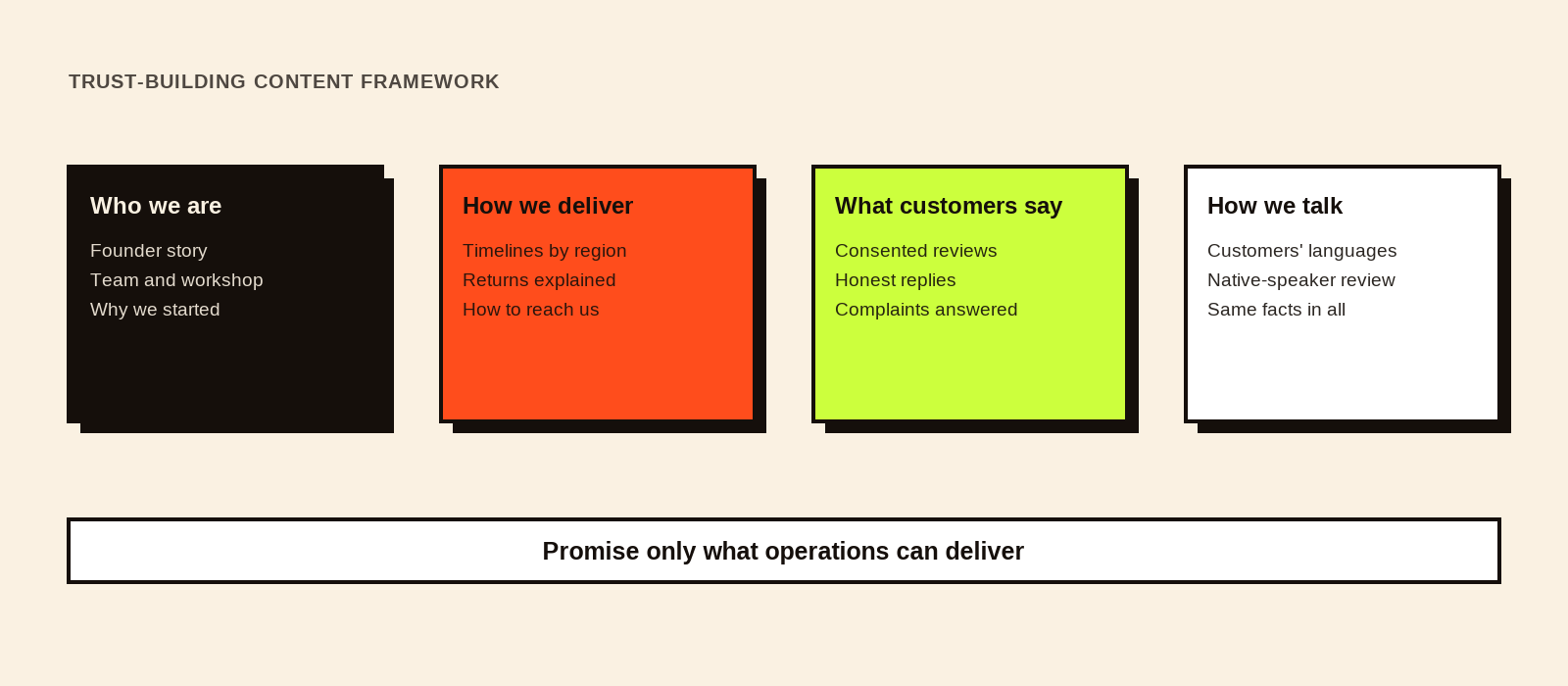
Someone in Nagpur sees your Reel, likes the product and taps through to your website. They've never heard of you. There's no store to visit, no marketplace badge, and the price is a little higher than a familiar brand. Before they pay, they open your Instagram again to check one thing: are these people real, and will they sort it out if something goes wrong?
Quick answer
Homegrown Indian brands build trust on social media by showing the people, process and policies behind the product, not just the product. Make the founder and team visible, explain how orders are packed, delivered and returned, share genuine customer feedback with consent, and talk in the languages your customers use. Every promise in your content should match what operations can deliver, because a first-time buyer is checking exactly that.
Why trust comes before the order
A well-known brand borrows trust from years of advertising, shelf presence and word of mouth. A newer brand starts at zero, and the buyer is taking the risk: paying upfront to a company they can't visit. Your social accounts are often the first place they check whether that risk is reasonable. A feed of polished product shots with no faces, no address, no returns information and comments switched off doesn't answer the question.
This isn't about looking bigger than you are. Small can be an advantage when it's visible: a founder who answers comments, a workshop customers can see, a team that admits a delay and fixes it. What hurts is vagueness. The general D2C content system is in our guide to social media management for D2C brands; this article focuses on the trust gap specifically.
A trust-building content framework
Think of trust as four questions a first-time buyer asks, consciously or not. Each needs regular content, and each depends on something real behind it. If the 'proof the brand must hold' column is empty for a row, fix that before you post about it.
| Trust question | Content that answers it | Proof the brand must hold | Owner |
|---|---|---|---|
| Who are these people? | Founder story, team introductions, workshop or warehouse walkthroughs, why the brand exists | Real people willing to appear, a registered business name and contact details | Founder, marketing |
| Will my order arrive, and what if it's wrong? | How we pack, delivery timelines by region, returns and exchange explained, how to reach support | A written returns policy, realistic delivery data, a staffed support channel | Operations, support |
| Do other people like me actually buy this? | Consented customer reviews, unboxings, replies to real questions, honest responses to complaints | Consent records, unedited review text, a process for handling criticism | Marketing, support |
| Do they speak my language? | Captions, subtitles or posts in the languages customers use, local festivals marked respectfully | Native-language review of copy, support that can reply in those languages | Marketing |
| Is what they say true? | Origin, materials and process explained plainly, with no inflated claims | Evidence for every factual claim, label and spec sheets | Product, legal |
Brand story and founder visibility
Tell the story in specifics. 'We started in 2021 because we couldn't find a cotton kurta that survived a monsoon wash' is more believable than 'born out of a passion for quality'. Show where things are made, who makes them, and what decisions you took and why. Keep it to what's true. If you source from a partner factory, say so; customers forgive a supply chain, not a cover-up.
Founder visibility works because buyers can see a person accountable for the brand. That doesn't mean the founder has to become an influencer. A short monthly video, replies to tough comments, or explaining a price rise in their own words is enough. Decide early which topics the founder speaks on, who drafts and who approves, and keep personal opinions separate from brand positions.
Origin claims
'Made in India', 'handmade', 'small batch' and 'artisan-made' are factual claims. Under the ASCI Code, claims about objectively ascertainable facts should be capable of substantiation. If part of the product is imported or machine-made, say so accurately rather than letting a broad label imply otherwise.
Delivery, returns and contact: say it before they ask
For a first-time buyer, fulfilment information is marketing. Create a Highlight or pinned post that covers delivery timelines by region, shipping charges, how cash on delivery works if you offer it, the returns and exchange policy in plain words, and how to reach a person. Update it when anything changes, especially before festive peaks.
This also matches the direction of Indian e-commerce regulation. A PIB release from the Department of Consumer Affairs (July 2020) explains that e-commerce entities must provide information on return, refund, exchange, warranty and guarantee, delivery and shipment, and grievance redressal so consumers can decide before buying. The Consumer Protection (E-Commerce) (Amendment) Rules, 2026, announced in September 2026 and coming into force on 1 January 2027, add requirements including showing the prior price alongside any announced price reduction and complying with the 2023 dark patterns guidelines. Your website and checkout carry the legal obligations; check them with counsel. Social content should simply never contradict them.
When delivery slips, say so early, in public if many customers are affected, with a realistic new timeline. Our sister guide on communicating stock-outs and delivery delays has template posts and replies.
Reviews and testimonials, responsibly
Customer voices are the strongest trust signal a new brand has, and the easiest to misuse. Share real reviews with the customer's permission, keep the wording as written, and show some balanced ones, not only five-star praise. Respond to criticism politely and publicly, then move details to a private channel. Deleting genuine complaints tells every reader what happens when something goes wrong.
Don't pay or reward people for reviews without clear disclosure, and don't ask only happy customers to review. Google's Maps user-generated content policy, for example, prohibits reviews paid for directly or in kind, and says merchants may not discourage negative reviews or selectively solicit positive ones. Our guide to customer testimonials and UGC covers permissions and evidence in detail.
Regional language considerations
Speaking a customer's language signals that the brand is made for them. Look at your own data first: where orders ship, which languages DMs and comments arrive in, and which regions return most. Then decide whether to add subtitles in one or two languages, post some content in a regional language, or run a separate regional account. A separate account only makes sense if you can staff it properly.
- Have a native speaker write or review copy; machine translation of product claims can change their meaning.
- Keep product facts, prices and policies identical across languages.
- Make sure someone can reply to comments and DMs in each language you post in.
- Mark regional festivals with care and accuracy, and only where it fits the brand.
- Avoid stereotypes about regions or communities, including in humour.
If you work with regional creators to reach these audiences, that's a separate influencer programme; see regional influencer marketing in India.
Trust breakers to avoid
- Comments turned off, or complaints deleted.
- Stock images of 'the team' or 'our workshop'.
- Countdown timers and 'only 2 left' messages that aren't true.
- Offers where the conditions only appear at checkout.
- Bought followers, which buyers and platforms can often spot.
- Delivery promises the logistics partner can't meet in every region.
- Claims such as 'chemical-free', 'eco-friendly' or 'No. 1' without evidence.
Where to start
Open your Instagram as a stranger would and check the five trust questions in the framework. Fill the biggest gap first, usually a delivery and returns Highlight and one founder or team post. Then add one consented customer story a month and one post in the language your customers use most.
If you want help planning trust-building content alongside product posts, what an agency like Kudozz includes is set out on our social media management page; policy decisions and customer support stay with your team.