Social Media Management for D2C Brands: Building a Consistent Content and Community Strategy
How D2C brands in India can run their own social accounts: product storytelling, education, customer questions, brand identity, UGC, creators, launches, community, planning and reporting with attribution caveats.
A D2C brand sells on its website, Amazon, Flipkart and a couple of quick-commerce apps. Instagram is where most customers first see it, and where they come back to check it's real before ordering. Yet the account gets attention only around launches and sales, and the questions in the comments ('Is COD available?', 'Is this the same as the one on Amazon?') go unanswered for days.
Quick answer
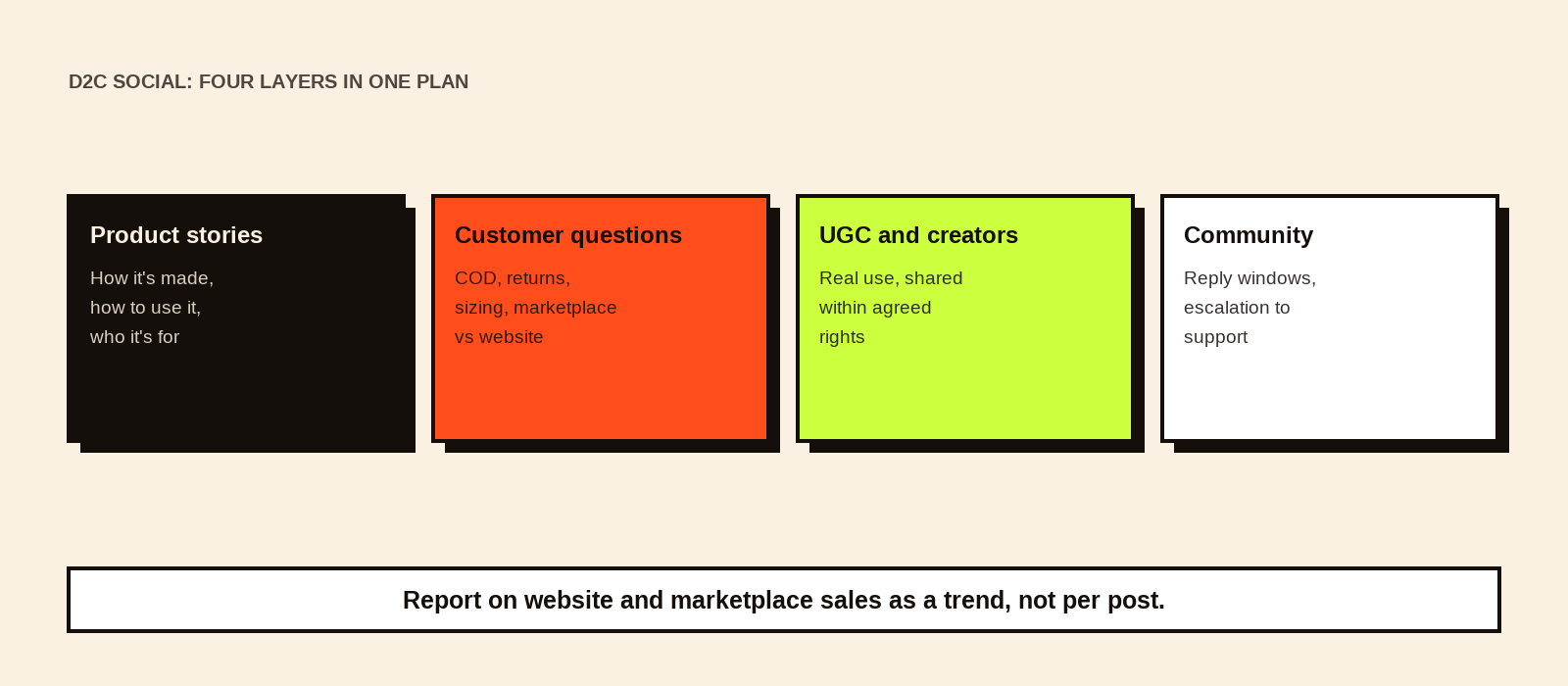
Social media management for a D2C brand means running its own accounts as a steady system: product storytelling and education, answers to real customer questions, a recognisable brand identity, UGC and creator content used within agreed rights, planned launches and festive moments, and community replies within an agreed scope. Report on what social contributes to website and marketplace sales, but treat attribution as directional, because many buyers see you on social and purchase elsewhere.
Why D2C social is different
For a D2C brand, the social profile often does the job a shop window and a salesperson do for a retail brand. People find you through a creator, an ad or a friend, then check your profile to decide whether you're trustworthy. That makes consistency more important than virality. A profile that looks active, answers questions and shows real customers can close the gap between interest and a first order.
The Indian context adds its own patterns. Many shoppers compare your website with marketplace listings, ask about cash on delivery and returns, and wait for festive sales. Your content and community replies should handle all of that clearly.
Product storytelling, education and customer questions
D2C brands usually have a reason for existing: a better ingredient, a fit nobody else gets right, a product made locally. Tell that story in pieces rather than once.
- How it's made: sourcing, materials, manufacturing steps you're comfortable showing.
- How to use it: short demos, routines, care instructions and common mistakes.
- Who it's for, and who it isn't for.
- Comparisons with your own older products or variants, so people choose the right one.
- Category education that helps customers decide, even if they don't buy today.
Every factual claim, especially about ingredients, results, health or sustainability, should be something you can substantiate. ASCI's Code expects advertising claims to be truthful and capable of substantiation, and that applies to brand posts as much as to ads.
Customer questions as a content engine
D2C brands get a steady flow of the same questions: sizing, shade matching, delivery times, COD, returns, whether marketplace stock is genuine. Each repeated question is a post, a Story highlight or a pinned comment waiting to be made. Turn the most frequent ones into recurring FAQ series rather than one-off replies.
Keep answers consistent across social, your website FAQ and support scripts. If your COD or return policy differs between your website and a marketplace, say so plainly rather than letting customers find out at checkout.
Brand identity, UGC and creators
Brand identity that carries across channels
Customers see your product in your posts, in creators' videos, on marketplace listings and on the box. Keep the product looking the same in all of them: colours, packaging shots, how the product is framed. A short visual guide and a written voice guide, shared with designers, creators and the marketplace team, prevent the slow drift that makes a brand look like several different businesses.
UGC and creator partnerships
D2C brands rely heavily on real-people content, because buyers can't touch the product. Customer UGC shows real use; creator videos bring new audiences and planned demonstrations. On your own feed, these should sit alongside brand creatives and product videos, each doing a different job. Our guide to combining UGC, brand creatives and product videos covers how to plan that mix.
Two rules apply throughout. Reuse customer or creator content only with written permission covering that use, and keep the paid partnership label and disclosure on any content that was paid for or gifted. For the influencer side of D2C, see our influencer marketing playbook for D2C brands in India, and for customer and creator content at volume, our guide to UGC marketing for D2C brands.
Launches, festive sales and drops
Launches and sales are where D2C social gets most attention and most often goes wrong: a burst of posts, then silence. Plan them as a sequence instead.
| Phase | What to post | Watch out for |
|---|---|---|
| Two to four weeks before | Teasers, behind-the-scenes, problem the product solves | Don't announce dates you can't commit to |
| Launch week | Reveal, demo video, creator content, FAQ answers | Have stock, links and marketplace listings live first |
| Two to four weeks after | Customer UGC (with consent), how-to content, answers to new questions | Respond quickly to early complaints |
| Festive or sale period | Offer creatives, gift guides, delivery cut-off reminders | Accurate terms, real end dates, no false urgency |
Sale creatives need particular care. India's Central Consumer Protection Authority issued guidelines on dark patterns in November 2023 that name practices such as false urgency, drip pricing and bait and switch. A countdown that resets or an 'only a few left' line that isn't true is a risk, not a tactic. Short-form video often carries launches, and our guide to building an Instagram Reels strategy around your products covers how to plan it.
Community engagement
For a D2C brand, comments are often pre-purchase questions in disguise. Fast, accurate replies in the brand voice help the person who asked and everyone reading later. Agree what the social team handles (product questions, general queries, positive comments) and what goes straight to support (order problems, refunds, delivery complaints). Order-level issues should move to a private channel quickly, without asking people to post order numbers or phone numbers publicly.
- Set reply windows for comments and DMs, including weekends during sales.
- Keep an approved answer bank for the 20 most common questions.
- Escalate complaints, safety concerns and anything legal to the named person on your side.
- Thank and, with permission, feature customers who share genuinely helpful content.
Content planning for a D2C calendar
A workable monthly plan starts from the business calendar: launches, restocks, sales, festive dates and delivery cut-offs. Then fill in the steady layer around them: product education, customer answers, UGC, creator content and founder updates. Plan the steady layer first so sales don't take over the whole month, and keep a little room for timely moments.
Assign every post a job (discover, consider, decide, retain) and a source (brand, product video, UGC, creator, founder). That makes the monthly review far more useful than a list of posts and their likes.
Reporting: connecting social to sales
Founders want to know whether social sells. Report what you can measure, and be honest about what you can't.
- Website: sessions and orders from social sources, using UTM-tagged links in bios, Stories and posts.
- Marketplaces: use whatever attribution tools your marketplace seller programme offers, where available; otherwise watch branded search and sales trends around big social moments.
- Platform metrics: reach, saves, shares, profile visits and link clicks, read by the job each post was meant to do.
- Community: response time, recurring questions and complaint themes.
Attribution is directional. A customer may see a Reel, search on a marketplace two days later and pay cash on delivery, and no tool connects those steps perfectly. Use trends over several months, not single-post claims. Our guide to social media KPIs by business goal explains which metrics fit which objective.
Common mistakes
- Posting only around launches and sales, then going quiet.
- Answering 'Is COD available?' differently in comments, DMs and on the website.
- Reusing creator videos beyond what the agreement covers.
- Running fake scarcity or countdowns on festive creatives.
- Claiming that a single post drove a spike in marketplace sales without evidence.
- Treating complaints in comments as a content issue rather than a support issue.
Practical recommendations
- Fix the profile basics first: bio, highlights for FAQs, delivery and returns, and a clear link.
- Pick two content series built on customer questions and run them for three months.
- Plan your next festive sale's social sequence at least a month ahead.
- Agree with your creator and UGC partners how their content can appear on your feed.
- Review the mix and the sales trend quarterly, not weekly.
A D2C social media checklist
- Profile clearly says what you sell, where to buy it and how delivery, COD and returns work.
- Content plan covers storytelling, education, customer questions, UGC and offers, not just offers.
- Visual and voice guides shared with designers, creators and the marketplace team.
- Rights and consent recorded for every UGC and creator asset you reuse.
- Launch and sale sequences planned weeks ahead, with accurate offer terms.
- Reply windows and escalation rules agreed for comments and DMs.
- UTM links in place, and a monthly report that separates measured results from estimates.
D2C brands often get the best results when their own accounts, creator partnerships and UGC are planned together. That's the reason Kudozz runs social media management for D2C brands alongside UGC content production and influencer campaign strategy, with one calendar connecting them.
Where to start
Spend an hour looking at your profile as a first-time buyer would. Can they see what you sell, how to buy it, whether real people use it, and whether their questions get answered? Fix those gaps first, then build the monthly plan around launches, customer questions and real-people content.