How to Build an Instagram Reels Strategy Around Your Products, Customers and Brand Story
How brands can plan Instagram Reels around product education, customer questions, founder and behind-the-scenes video, creators and recurring series, then test with Trial Reels and read the right insights.
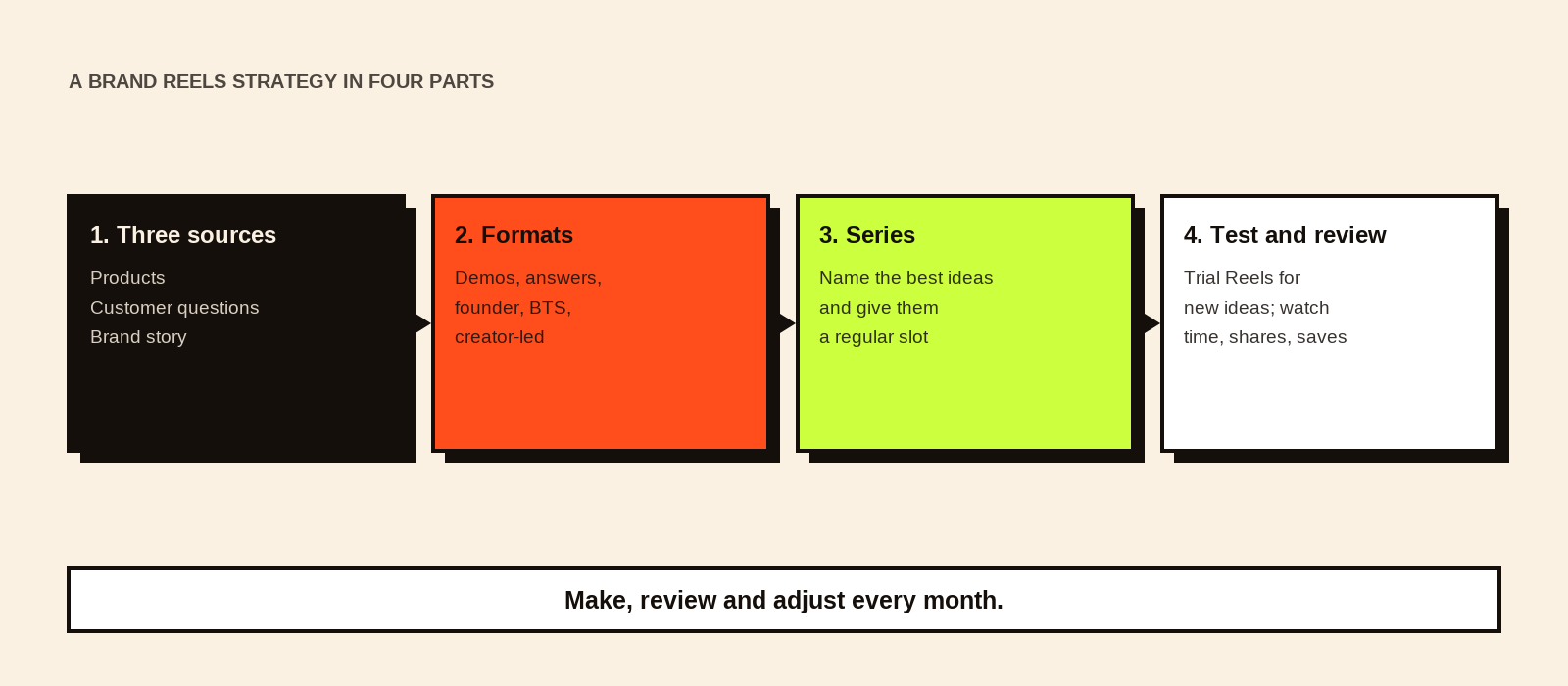
Your team posted eleven Reels last quarter. Two did well, a quick product demo and a clip of the founder answering a customer's question, and nobody is sure why. The rest were a mix of trending audio, offer announcements and a festive greeting. Everyone agrees Reels matter. What's missing is a reason for each one to exist.
Quick answer
A brand Reels strategy starts from three sources you already own: your products, your customers' questions and your brand story. Turn each into a few repeatable formats, such as demos, answers to real questions, founder explainers and behind-the-scenes clips, then run the best ones as recurring series. Add creator-led Reels where a third-party voice helps. Test uncertain ideas with Trial Reels, read watch time and shares alongside views, and change the plan each month based on what you learn.
Start with the job Reels do for your brand
Instagram's own explanation of ranking, published by Adam Mosseri in May 2023, says Reels are designed to help people discover new things, and that most Reels people see come from accounts they don't follow. That shapes the brief. A Reel has to make sense to someone who has never heard of you, in the first few seconds, often with the sound off. Inside jokes, unexplained product names and offers without context work poorly with strangers.
The same explainer says Instagram aims to show fewer low-resolution or watermarked Reels, and fewer Reels that have already been posted on Instagram. In April 2024 Instagram also said that when it finds identical pieces of content, it will only recommend the original. For a brand, the practical takeaway is simple: make original Reels for Instagram rather than reposting exports from other apps with their logos on them. That's the extent of what we'd treat as confirmed. Claims about posting at a magic hour or a fixed number of hashtags are not things Instagram has published, so we don't plan around them.
If you're deciding how Reels fit into a wider Instagram plan alongside Stories, carousels and your profile, start with what a professional Instagram management strategy includes. This guide stays on Reels.
Build Reels from your products, customers and story
Most brands have more Reel material than they think. It sits in product details, in the questions your sales and support teams answer every day, and in how the business actually works. Group it into a few types.
Product education and demonstrations
Show the product doing its job: how it's used, what it looks like at real size, what the texture or finish is, how long a step takes. Demonstrations answer the question a still image can't. Keep claims to what you can substantiate, and show the result rather than describing it.
Customer questions
Every repeated question in your DMs, comments, reviews or sales calls is a Reel brief. 'Does this work on curly hair?', 'Will it fit a 6-seater table?', 'How is this different from the cheaper one?' Answering on camera helps the person who asked and everyone who was wondering the same thing.
Founder-led and behind-the-scenes
A founder explaining why a product is made a certain way, a packing table on a busy day, a quality check, a supplier visit: these show the people and decisions behind the brand. They don't need polish. They need someone who can talk naturally and a clear point in each clip.
Brand storytelling
Storytelling Reels carry the bigger narrative: why the brand started, what problem it set out to fix, a product's journey from idea to shelf. Use them sparingly and make each one specific. A story about one decision lands better than a general montage about 'our passion'.
Where creator-led Reels fit
Creators add something your own account can't: a voice the audience already trusts, and a real-life setting. They work well for first impressions of a product, honest comparisons and routines. Choose creators whose audience matches yours, which is what creator discovery is for, and agree in writing whether you can reshare their Reels on your account. Instagram Reels influencer marketing covers briefing creators, hooks and campaign measurement in depth.
A Reels content framework
The table below maps each Reel type to the job it does and what to watch. The examples are hypothetical, for a small cookware brand selling online in India.
| Reel type | Job it does | Hypothetical example | What to watch |
|---|---|---|---|
| Product demonstration | Shows how it works and what it looks like in use | Making a dosa on the cast-iron tawa, from seasoning to flip | Average watch time, saves |
| Customer question | Removes a doubt that stops purchase | 'Can I use this tawa on induction?' answered in 20 seconds | Shares, comments with follow-up questions |
| Comparison or myth | Helps people choose | Cast iron vs non-stick: which one for daily rotis? | Shares, profile visits |
| Founder-led | Builds trust in the people behind the brand | The founder explains why the handle is riveted, not welded | Watch time, follows |
| Behind-the-scenes | Shows process and care | Pre-seasoning batch at the workshop | Views from non-followers, comments |
| Creator-led | Adds a third-party voice in a real kitchen | A home cook's first week with the pan, reshared with permission | Shares, saves, enquiries |
| Storytelling | Carries the brand's reason to exist | Why the founder started with one product, not twenty | Watch time, follows |
Turn good ideas into recurring series
A single good Reel is luck. A series is a system. When a type works, give it a name, a recognisable opening and a regular slot: 'Ask the founder' every Thursday, 'One pan, three dishes' each fortnight, a monthly 'What we changed and why'. Series make planning faster because the format is decided and only the topic changes. They also give viewers a reason to follow, since they know what's coming.
Two or three series are enough for most brands. Keep space around them for launches, timely moments and one-off ideas. How to fill a month without repeating yourself is covered in how to plan a month of Instagram Reels.
Test before you commit: Trial Reels
Trial Reels let you show a Reel to people who don't follow you before deciding whether to share it with everyone. At the time of writing (November 2026), Instagram's Help Centre says you need a professional account to use them, that followers won't see a trial in Feed or the Reels tab (though some may come across it in DMs or on pages for the same audio), and that insights appear within 24 hours. You can then share it to everyone, or switch on automatic sharing so Instagram shares it if it gets a lot of views within the first 72 hours. Meta announced the feature in December 2024.
For a brand, trials are useful for questions like: does a question hook beat a product shot in the first second? Does the founder or a team member explain this better? Does Hindi outperform English for this topic? Change one thing at a time and compare trials with other trials, not with Reels your followers saw. Avoid trialling time-bound content such as a launch announcement, which needs your followers on the day. Our creator-side guide to Instagram Trial Reels has a step-by-step testing routine you can adapt.
Reading Reels performance
Instagram's Help Centre, at the time of writing, defines views as the number of times content was played or displayed, viewers as the unique accounts that saw a Reel on screen at least once, and interactions as actions such as likes, comments, saves and shares. Instagram added total watch time and average watch time to Reels insights in April 2023. Metric names and layouts change, so check what your account shows each month rather than relying on an old screenshot.
Views alone tell you little. Read each metric against the question it answers:
- Did the opening hold people? Average watch time compared with the Reel's length.
- Was it worth passing on? Shares, especially for educational and comparison Reels.
- Was it worth keeping? Saves, for tutorials and how-tos.
- Did it reach new people? The split between followers and non-followers, where shown.
- Did it move people closer to buying? Profile visits, link taps or enquiries, where you track them.
- Is the series improving? The same metrics across five or six episodes, not one.
Write one sentence per Reel on why you think it did well or badly, and decide whether to repeat, change one variable or drop the format. Which numbers matter for which business goal is covered in social media KPIs by goal.
Common mistakes
- Treating Reels as ads: an offer with a price and a 'shop now' does little for people who've never heard of you.
- Chasing every trending audio, even when it has nothing to do with the brand.
- Reposting videos from other apps with their watermark still on.
- Making one-off Reels each week instead of building two or three series.
- Burying the point: a logo intro or a slow pan before anything happens.
- Judging a format on one Reel, or on views without watch time and shares.
- Resharing a creator's or customer's video without written permission.
Practical recommendations
- List your 20 most common customer questions. That's your first month of ideas.
- Pick two series to run for at least six weeks before judging them.
- Find one person on the team who is comfortable on camera, and plan around their time.
- Collect raw footage every week: packing, making, testing, unboxing. Editing is easier than shooting from scratch.
- Use Trial Reels for one deliberate test a fortnight.
- Review Reels monthly with watch time, shares and saves side by side, and change something each time.
If you need help scripting and editing Reels from your own or creators' footage, this is what our Reels and short-form video service covers. You can also see how we work with brands more broadly.
Where to start
Start with what you already know: your products, the questions customers ask and the story behind the business. Turn the strongest ideas into two or three named series, test uncertain ones with Trial Reels, and judge them on watch time, shares and saves rather than views alone. A Reels strategy is mostly a habit of making, reviewing and adjusting every month.