How to Plan a Month of Instagram Reels Without Repeating the Same Ideas
A practical way to plan a month of brand Reels: content categories to rotate, an idea bank that refills itself, creative variations of one idea, a 30-day plan by week, batching and a monthly review.
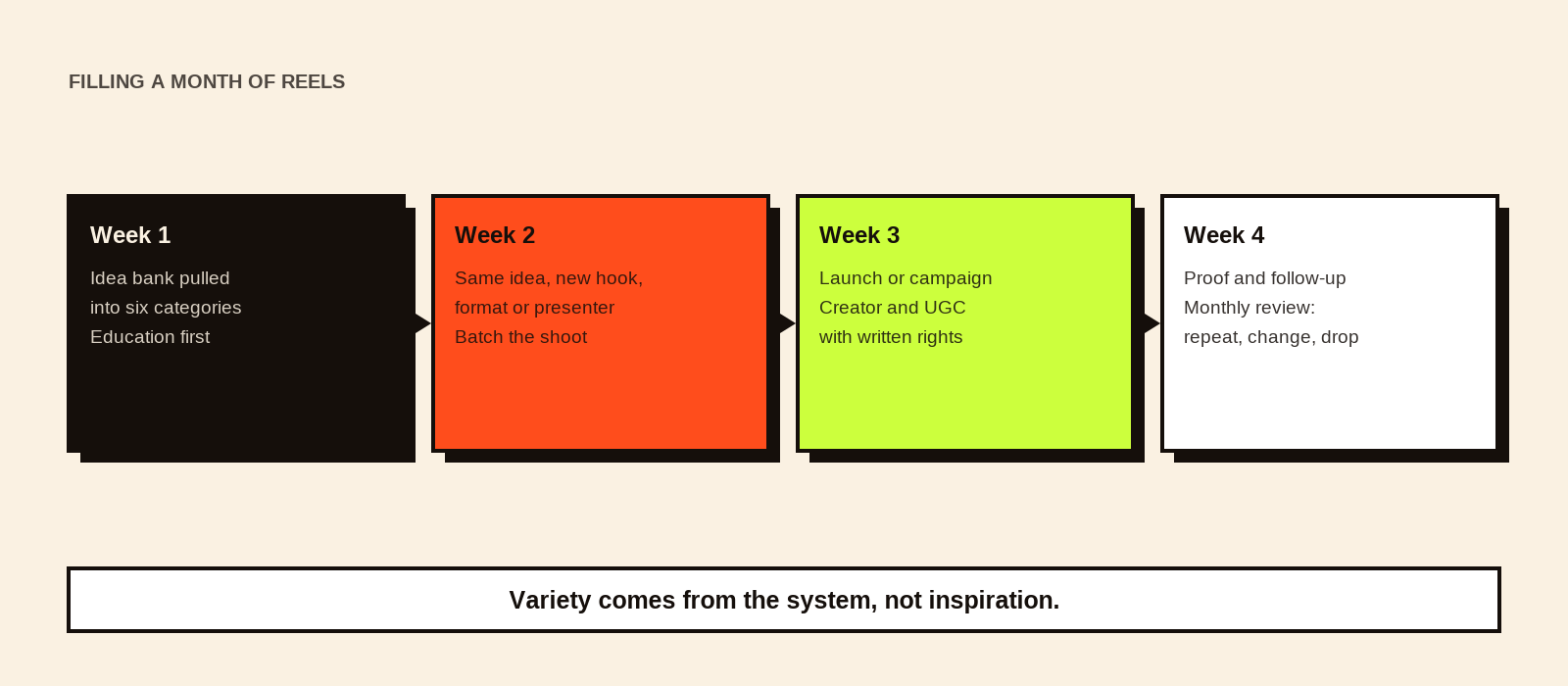
It's the 26th and next month's Reels plan is a blank sheet. Last month's ideas were 'something for the sale', 'a trending audio' and 'the founder talking about something'. Three weeks in, the team was repeating the same product shot with a new caption. The problem isn't creativity. It's that nobody kept a running list of ideas, and nobody decided which types of Reel the month needed.
Quick answer
Plan a month of Reels by rotating five or six content categories, such as education, demos, founder clips, customer questions, behind-the-scenes and UGC, and filling them from an idea bank you add to every week. Stretch each strong idea into variations with a different hook, format or presenter. Map ideas to a four-week plan, batch the scripting and shooting, and review the month to decide what to repeat, change or drop.
Before you plan: inputs for the month
This guide is about filling a month. It assumes you already know why you're on Reels and which series you run. If not, read how to build an Instagram Reels strategy first. Then gather four inputs before the planning meeting:
- The month's business priorities: launches, offers, stock you need to move, festive moments.
- What footage exists or can be shot: product clips, team availability, customer or creator videos you have rights to.
- Who can present: the founder's available hours, a team member who is comfortable on camera.
- Last month's learnings: which Reels held attention, got shared or saved, and which didn't.
Six Reels categories to rotate
Repetition usually comes from making the same type of Reel every time. Rotating categories forces variety and covers different stages of a customer's thinking.
| Category | What it is | Where ideas come from | Production need |
|---|---|---|---|
| Educational | Teaches something useful about the problem your product solves | Search queries, sales calls, category myths | Script, simple shoot or screen recording |
| Product demo | Shows the product in use, at real size and speed | Product features, returns reasons, launch briefs | Product, hands, good light |
| Founder or team | A person explains a decision, a standard or a lesson | Founder notes, team meetings, 'why we did this' | A presenter for 20 to 30 minutes |
| Customer questions | Answers one real question per Reel | DMs, comments, reviews, support tickets | Script, presenter or text-led edit |
| Behind-the-scenes | Process, packing, testing, sourcing, the office | Whatever happens this week | Phone footage collected through the month |
| UGC and creator | Customers or creators using the product | Tagged posts, creator deliverables, reviews | Written permission and the original file |
Build an idea bank that refills itself
An idea bank is a shared sheet where anyone can drop a Reel idea at any time, so planning starts from 40 options, not zero. Feed it from places that produce ideas without extra effort: the customer service inbox, comments on your posts, sales call notes, product reviews, competitor content you'd do differently, and questions the founder keeps answering at events. Tag each idea so you can pull a balanced month from it.
Idea (one sentence)
Category: educational / demo / founder / customer question / BTS / UGC
Source: DM, review, sales call, team, trend
Series it belongs to (if any)
Hook options (write two)
Presenter: founder / team / creator / text-only
Footage needed and whether we have it
Rights status (for customer or creator content)
Priority for the month: high / later / park
Status: idea / scripted / shot / edited / approved / published
Clean the bank once a month. Merge duplicates, park ideas that depend on footage you can't get, and move anything time-bound into the right month.
Same idea, different Reel
You don't need 20 new ideas a month. You need a few strong ideas made in different ways. Take one idea and change one element at a time:
- Hook: open with the question, the result, a common mistake, or a surprising number you can verify.
- Format: talking head, hands-only demo, text on screen with voiceover, split-screen comparison, a quick list.
- Presenter: the founder, a team member, a creator, a customer (with permission), or no face at all.
- Length: a short answer and a fuller walkthrough of the same topic.
- Language: English, Hindi or a regional language, where your audience uses it.
Say a hypothetical skincare brand's idea is 'How much sunscreen to apply'. Week one, a team member demonstrates with a measuring guide. Week two, the founder answers 'Why do I still tan?' in a talking-head Reel, a different angle on the same topic. Week three, a creator's routine Reel shows it in daily use. One idea, three Reels that don't feel repeated.
UGC and creator footage: rights first
Customer and creator videos add variety and a voice that isn't yours, but a tag is not permission. Before a UGC Reel goes into the plan, get written consent for where and how long you'll use it, and the original file rather than a screen recording. UGC content usage rights explains what to agree. If you need UGC made to a brief rather than collected, that's what UGC content production is for.
Check audio too. At the time of writing, Instagram's Help Centre says licensed audio must credit the artist and track, and can be muted if agreements with rights holders change. Original audio, voiceovers and royalty-free tracks are safer for brand Reels you want to keep.
A 30-day Reels plan for a hypothetical brand
Here's a sample month for a hypothetical home-fragrance brand with a new candle range launching in week three, posting three Reels a week. Adjust the volume to what your team can make well.
| Week | Focus | Reel 1 | Reel 2 | Reel 3 |
|---|---|---|---|---|
| Week 1 | Education and trust | Educational: 'How long should a candle burn the first time?' | Customer question: 'Why does my candle tunnel?' | BTS: pouring and curing a batch |
| Week 2 | Build-up to launch | Founder: why the new range uses a different wax | Demo: same room, three scents, three moods | Customer question: 'Which scent suits a small bedroom?' |
| Week 3 | Launch | Launch Reel: the new range in real homes | Creator Reel reshared with permission: first impressions | Demo: what's in the gift box |
| Week 4 | Proof and follow-up | UGC: customer room tour, with consent | Educational: candle care myths | Founder: what we learned from launch week questions |
Notice the pattern: every week mixes at least two categories, the launch sits between education and follow-up rather than alone, and two named series (customer questions and founder clips) recur. Leave one slot a fortnight free for a timely idea or a Trial Reel test.
Batch production and review the month
A month of Reels falls apart when every video is scripted, shot and edited separately. Batch instead: write all scripts in one sitting, shoot all founder clips in one session with outfit changes, and collect behind-the-scenes footage through the month. Edit in two rounds so approvals don't pile up at the end. The full brief-to-publish pipeline is covered in our social media content workflow guide, so we won't repeat it here.
At the end of the month, run a short review:
- Which three Reels held attention best (average watch time against length)?
- Which got shared or saved most, and which category were they?
- Which hook styles worked, and which can be reused with a new topic?
- Which ideas did we park, and why?
- What questions came up in comments that belong in the idea bank?
- Which series should continue, change one element, or stop?
Common mistakes
- Planning the month around trends, then scrambling when none fit the brand.
- Making every Reel a product Reel, so the feed reads like a catalogue.
- Waiting for perfect footage instead of collecting usable clips every week.
- Booking the founder for one Reel at a time.
- Using a customer's video because they tagged you, without asking.
- Judging the plan on one Reel's views instead of the month's pattern.
Practical recommendations
- Set up the idea bank this week and ask sales and support to add to it.
- Plan the month on one page before scripting anything.
- Give each week a focus and at least two categories.
- Write two hooks for every idea and pick one at the edit.
- Keep one flexible slot every fortnight.
- Put the monthly review on the calendar before the month starts.
Reels usually sit inside a wider calendar with posts, carousels and Stories. Building that calendar is covered in our guide to a monthly social media content calendar, and Kudozz's content planning work for brands follows the same monthly rhythm.
Where to start
Start a shared idea bank today and fill it from customer questions. Next month, rotate at least five categories, turn your best idea into two or three variations, and batch the shooting. Review at the end of the month and carry the lessons into the next plan. Variety comes from the system, not from waiting for inspiration.