What Is Agentic Commerce? What D2C Founders in India Need to Know
Agentic commerce means AI assistants that don't just recommend products but act for the shopper, up to paying. Here is what that means in plain terms, what is actually live, in pilot or only announced in India as of November 2026, and what a D2C brand should do now.
Every few weeks a founder WhatsApp group lights up with a new announcement: a payments company has done something with ChatGPT, Google has added a buy button somewhere, an AI agent has ordered groceries. It's hard to tell which of these changes how your customers shop this quarter and which are demos. This guide separates the two for Indian D2C brands, with dates, so you can decide what deserves attention now.
Quick answer
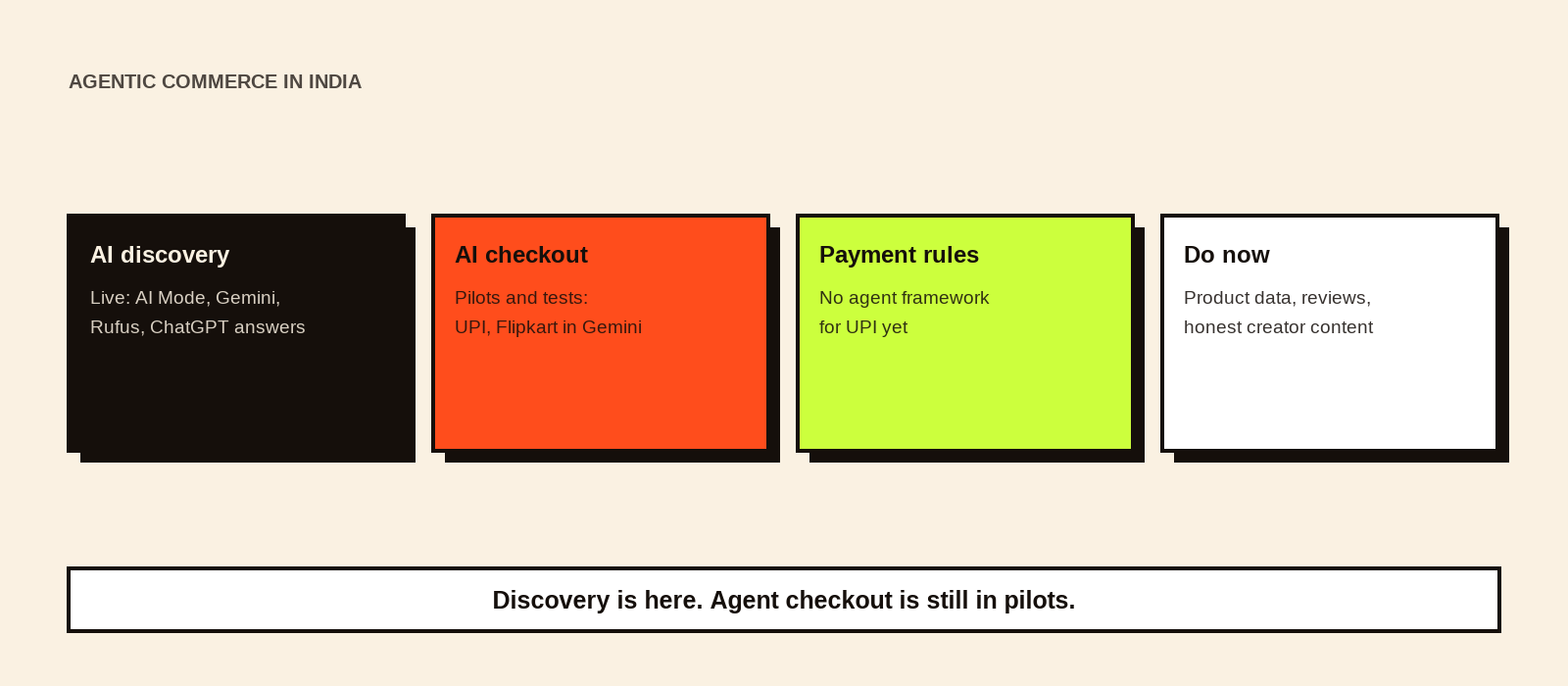
Agentic commerce is shopping in which an AI agent acts on the shopper's behalf: searching, comparing, choosing and, in some set-ups, paying. In India as of November 2026, AI-assisted discovery is live (Google's AI Mode in English, the Gemini app in English and Hindi, Amazon's Rufus and ChatGPT's product answers), while AI-completed checkout exists only in pilots and tests, and NPCI has not yet published rules for AI agents on UPI. For a D2C brand, the practical work today is discoverability: accurate product data, genuine reviews, and honest creator and video content that answers comparison questions.
Agentic commerce in plain terms
Google's developer documentation describes AI agents as 'autonomous systems that can perform tasks on behalf of people'. Applied to shopping, the difference from today's search is who does the work. In ordinary online shopping, the customer searches, opens tabs, compares and pays. In AI-assisted shopping, an assistant does the comparing and the customer still decides and pays. In agentic commerce, the assistant can also complete the purchase within limits the customer has set, for example 'reorder my usual detergent when it runs out, up to ₹500'.
| Stage | Who searches and compares | Who pays | Status in India (Nov 2026) |
|---|---|---|---|
| Ordinary online shopping | The customer | The customer | How most purchases still happen |
| AI-assisted discovery | An AI assistant, with the customer | The customer, on the brand's or marketplace's site | Live on several platforms |
| Agentic checkout | An AI agent | The agent, within limits the customer approved | Pilots and tests only |
Behind the scenes, companies are building shared standards so agents can read catalogues and complete orders. OpenAI and Stripe introduced the Agentic Commerce Protocol in September 2025, and Google and Shopify announced the Universal Commerce Protocol in January 2026. You don't need to implement either today as an Indian D2C brand; they matter because they show where the platforms are heading.
What is live, in pilot or announced in India
Status as of November 2026, from the platforms' own announcements where available. Items marked 'reported' come from credible press, not from the platform itself. These change quickly, so check before planning around any of them.
| Capability | India status | Date and source |
|---|---|---|
| Google AI Mode shopping (prices, reviews, comparison tables) | Live in English; Hindi described as rolling out soon | Google India blog, April 2026 |
| Gemini app shopping (shoppable listings, comparisons) | Live in English and Hindi | Google India blog, April 2026 |
| Amazon Rufus shopping assistant on amazon.in | Live since 2024 | Reported, 2024 |
| ChatGPT product answers | Available; OpenAI's merchant product-feed specification targets the US, and no India merchant programme has been announced | OpenAI developer docs |
| ChatGPT ads | Live in India since late August 2026 | Reported, citing OpenAI, August 2026 |
| ChatGPT Instant Checkout (buy inside the chat) | Was US-only; OpenAI moved away from it in March 2026 towards checkout on merchants' sites or apps | Reported, March–April 2026 |
| Google agentic checkout (buy button in AI Mode) | No India launch announced | Our review of Google's announcements, November 2026 |
| Flipkart purchase inside Gemini and AI Mode | Limited test with some users, mainly electronics | Reported by TechCrunch, September 2026 |
| UPI agentic payments on Claude (Razorpay and NPCI) | Closed pilot with Zomato, Swiggy and Zepto | Razorpay, February 2026 |
| UPI payments inside ChatGPT (NPCI, Razorpay, OpenAI) | Pilot announced October 2025; current status not confirmed | Reported, October 2025 |
| D2C brand shopping inside ChatGPT (GoKwik and PayU) | Live with early brands Hyphen, Beardo and Kilrr | Reported by Business Today, July 2026 |
| NPCI rules for AI agents on UPI | No agent-specific framework yet | Reported by MediaNama, September 2026 |
The pattern is clear. AI discovery is here: Google's India blog announced shopping in AI Mode and the Gemini app in April 2026, and Amazon's Rufus has been on amazon.in since 2024. AI checkout is not, at scale. Razorpay's agentic UPI payments on Claude run as a closed pilot, and at the Global Fintech Fest in September 2026 NPCI's chair said that 'AI may recommend, but authentication and final settlement must follow deterministic auditable rules', as reported by MediaNama. Until those rules exist, most Indian shoppers will discover with AI and pay the way they do today.
Why discovery matters more than checkout right now
If an AI assistant shortlists three serums or three air fryers and yours isn't among them, it doesn't matter how the payment would have worked. Shortlisting is the part already happening for Indian shoppers. In a Google-commissioned Ipsos survey of Indian festive shoppers (n=2,450, late 2025), people who used AI chatbots for shopping research also kept using other sources: 94% of them used Google Search and 87% used YouTube as well. AI is adding steps to the shopping journey, not replacing the rest of it.
What feeds those shortlists differs by platform. Google says Merchant Center feeds can help products appear in AI responses and that its AI features can bring in relevant images and video. OpenAI's product-feed specification includes prices, availability, variants, review counts and star ratings, but no video field, so creator video reaches ChatGPT only indirectly, through the wider web. On Amazon, the assistant works from the marketplace itself, so your listing, reviews and on-listing video carry most of the weight. How to make your brand easier to find in these assistants, and what creator content can and can't influence, is covered in creator reviews and AI shopping assistants.
What D2C founders should do now
| Area | Do now | Why |
|---|---|---|
| Product data | Complete, consistent titles, attributes, variants (size, shade, pack) and prices across your site, Merchant Center and marketplaces | Assistants compare attributes; missing or conflicting data drops you from comparisons |
| Reviews | Grow genuine reviews on the platforms you sell on; never buy or swap product for reviews | Review counts and ratings feed AI comparisons; fake or undisclosed incentivised reviews breach platform and Google rules |
| Creator and video content | Honest demonstrations and comparisons that answer real buying questions, disclosed as ads where paid | Google says video can appear in its AI features, and creator content shapes what the web says about you |
| Your own site | Clear answers to sizing, ingredients, compatibility and returns; product structured data | Assistants and search engines read pages that answer questions plainly |
| Checkout and payments | Keep UPI, COD and returns smooth; watch payment-gateway announcements on agentic payments | When agent payments open up, they'll likely arrive through your existing gateway |
| Measurement | Track referral traffic from AI assistants in analytics; watch branded search | There's no reliable 'AI share of voice' number yet; trends in your own data are more honest |
Notice what's missing: no special file, secret schema or 'AI SEO' trick. Google's own guidance says no special optimisation is needed for its AI features beyond normal indexability, and warns that 'seeking inauthentic mentions across the web isn't as helpful as it might seem'. Be wary of anyone selling guaranteed placement in AI answers.
Where creators fit
AI assistants summarise what is already said about a product. Creators are one of the main places where products get explained in real use: what the texture is like, how a size runs, whether the gadget works with a particular phone. That content shapes shopper decisions directly today and adds to the material assistants can draw on, especially on Google, which can bring video into AI answers and added a creator property to its video structured data in September 2026. The useful content is specific and honest: comparisons, limitations, who the product is not for. Hype rarely helps a shopper or an assistant decide.
Disclosure stays non-negotiable. Paid or gifted creator content needs a clear label under ASCI's guidelines, and undisclosed incentivised reviews can also fall foul of Google's review policies. If you use AI tools in creator briefs or editing, set rules for that too; how to build an influencer marketing AI policy covers oversight and disclosure.
Risks to keep in view
- Hype risk: spending on 'agentic readiness' projects for checkout features that aren't available to Indian shoppers yet.
- Data risk: inconsistent prices or stock across channels can lead assistants to show wrong information about your product.
- Payment rules: India has no agent-specific UPI framework yet, and recurring-payment rules already require advance notice before debits, so automated reordering will take time.
- Platform dependence: as on marketplaces, an assistant's shortlist can change without notice. Keep direct channels (your site, WhatsApp, email) healthy.
- Trust: content created only to influence AI answers, rather than to help shoppers, tends to be thin and can break disclosure rules.
Social shopping in India already shows how new channels arrive: discovery first, purchase routed through familiar payments and marketplaces. Social commerce in India for D2C brands describes that pattern, which agentic commerce is likely to follow.
Conclusion
Agentic commerce is real, but in India it is arriving in two speeds. AI-assisted discovery is live now on Google, Gemini, Amazon and ChatGPT; AI-completed checkout is limited to pilots while payment rules are written. Spend your effort where shoppers already are: accurate product data, genuine reviews and honest creator content that answers buying questions. Then keep an eye on your payment gateway's announcements, because that is where agent checkout is most likely to reach you.