AI Influencer Campaign Management: How Brands Can Automate Creator Workflows
Where AI assistants help inside a running creator campaign (brief versions, inbox triage, draft checks, deadline chasing, report drafts), the controls that stop errors reaching creators, and a sample workflow.
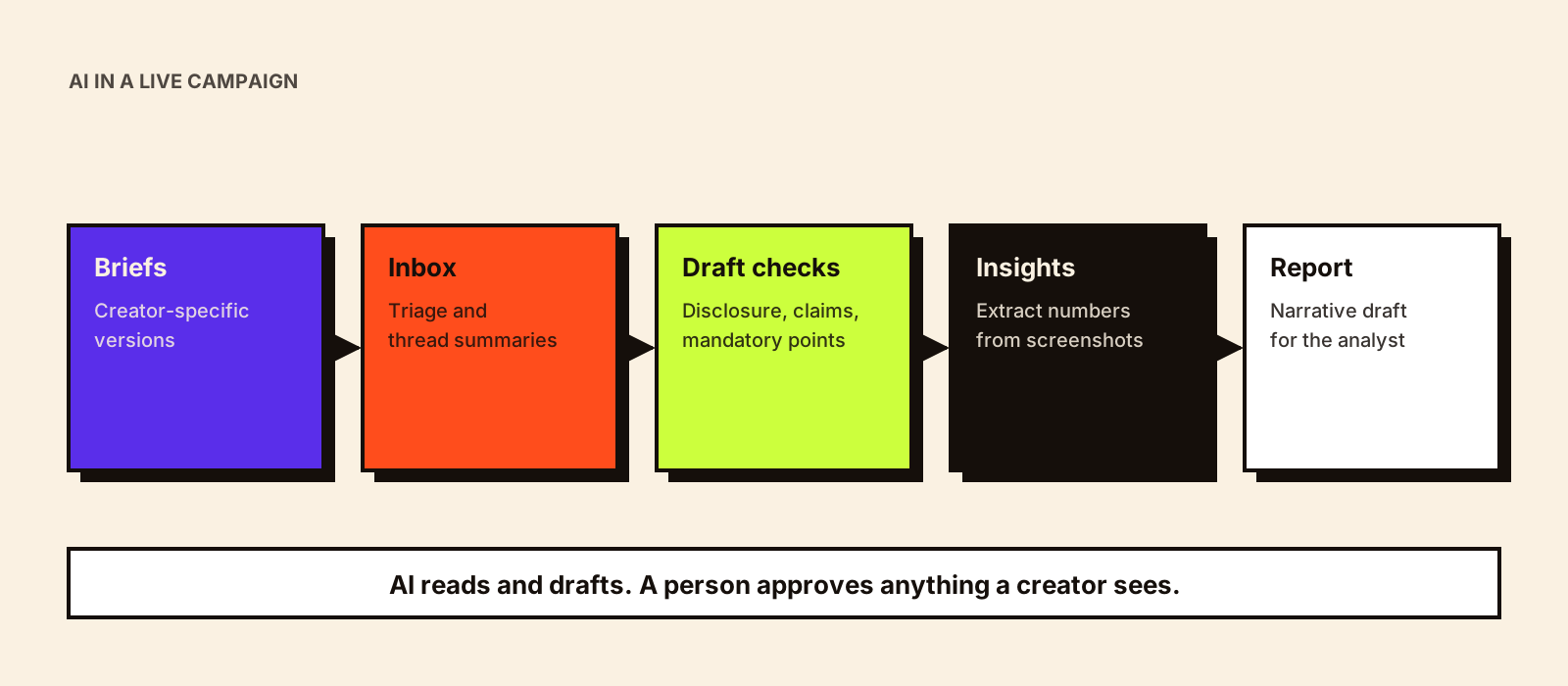
Once creators are booked, a campaign becomes an operations job. Twenty creators can easily mean a few hundred messages, sixty drafts and revisions, a dozen deadline changes and a report that someone has to pull together from screenshots. This is where AI assistants can save the most time, because much of the work is reading, sorting, checking and summarising. It's also where a careless AI message can embarrass a brand in front of a creator.
Quick answer
In campaign management, AI is useful for adapting briefs per creator, triaging and summarising creator messages, checking drafts against the brief's mandatory points and disclosure rules, drafting reminders, extracting numbers from insight screenshots and drafting the campaign report. Rule-based automation handles the predictable parts (status changes, reminders, approvals routing); AI handles the parts that involve reading and writing. Keep a person on anything that goes to a creator for the first time, every content approval, every payment and every claim.
AI vs automation: a useful distinction
| Rule-based automation | AI assistance | |
|---|---|---|
| What it does | If X happens, do Y | Reads, writes, classifies or summarises unstructured content |
| Examples | Draft overdue → send reminder; contract signed → move to 'briefed' | Summarise a creator's 14-message thread; check a script against the brief |
| Predictability | Same input, same output | Output varies; can be wrong in plausible ways |
| Control needed | Test the rule once, monitor exceptions | Review outputs, especially anything external |
Most good campaign workflows use both. Influencer campaign automation covers the rule-based workflows in detail; this article focuses on where AI adds to them.
Where AI helps during a live campaign
Brief adaptation
Start from one master brief and have AI produce a version per creator: adjusted for their format (a 60-second Reel vs an 8-minute YouTube integration), their language and their usual content style, with the mandatory points and banned claims copied word for word. A person reviews each version before it goes out. Influencer campaign brief covers what the master brief needs.
Inbox triage
Creator communication arrives by email, Instagram DM and WhatsApp, often through managers. AI can classify incoming messages (question about brief, deadline request, rate query, draft submitted, payment query) and summarise long threads so a campaign manager sees what needs action today. It shouldn't reply on its own to anything involving money, deadlines or creative feedback.
Draft pre-checks
Before human review, AI can transcribe a draft video and compare it to a checklist: disclosure label present and early, product name pronounced correctly, mandatory messages covered, no unapproved claims (for example 'cures acne' when the approved claim is 'helps reduce breakouts'), correct link and code in the caption. It returns a short list of issues. The reviewer still watches the draft; the pre-check makes the review faster and more consistent.
Feedback drafting
Turning internal comments ('too salesy, product appears too late, missing the humidity point') into clear, polite feedback a creator can act on is a good AI task. Keep feedback to the brief's requirements, not personal taste, and send it from a person.
Data capture from screenshots
Creators often share performance as insight screenshots. AI can extract reach, views, saves, shares and link taps into your tracker, with the date the screenshot was taken. Someone should spot-check figures against the images, especially when numbers are close to a payment threshold.
Report drafting
Given the campaign table and comment samples, AI can draft a summary: what was delivered, how each creator performed against the agreed KPI, common audience questions and suggestions for next time. The analyst then corrects it, adds context the data doesn't show and signs it off. Influencer marketing report has the full report structure.
A sample AI-assisted campaign workflow
CONTRACT SIGNED
→ [Automation] Move creator to 'Briefing'. Create tasks and deadlines.
→ [AI] Draft creator-specific brief from master brief.
→ [Human] Review and send brief. ✔ checkpoint

DRAFT SUBMITTED
→ [Automation] Notify reviewer. Start 48-hour review clock.
→ [AI] Transcribe and pre-check against brief, claims and disclosure.
→ [Human] Watch draft, approve or request changes. ✔ checkpoint
→ [AI] Turn reviewer notes into creator-friendly feedback.
→ [Human] Send feedback. ✔ checkpoint

POST LIVE
→ [Automation] Log link, check disclosure label is visible, schedule 7-day insights request.
→ [AI] Summarise early comments: questions, objections, sentiment.

INSIGHTS RECEIVED
→ [AI] Extract numbers from screenshots into tracker.
→ [Human] Spot-check figures. Approve payment. ✔ checkpoint

CAMPAIGN END
→ [AI] Draft report narrative from tracker and comment summaries.
→ [Human] Edit, add interpretation, present. ✔ checkpoint
Controls that keep AI errors away from creators
- Nothing AI-written goes to a creator without a person reading it, at least until the workflow has run cleanly for several campaigns.
- Mandatory messages and claims are pasted verbatim from an approved source, never paraphrased by AI.
- AI pre-checks can only add issues for the reviewer, never mark a draft as approved.
- Payment amounts and dates come from the contract record, not from AI-extracted text.
- Keep a log of AI-assisted outputs per campaign so errors can be traced and prompts improved.
- Check the data terms of any AI tool before uploading unreleased product details, contracts or creator personal information.
These controls belong in your wider approval process; influencer marketing governance covers who approves what. For disclosure and claims rules, see influencer marketing compliance.
What it saves, and what it doesn't
We won't quote a time-saving percentage, because it depends heavily on campaign size and how messy the current process is. The pattern teams usually notice is that AI removes reading and typing time (summaries, first drafts, data entry) but not decision time. If approvals are slow because three stakeholders disagree about creative direction, AI won't fix that. If they're slow because nobody has had time to read the drafts, it can help a lot.
Tools: general AI or campaign software?
Many teams start with a general-purpose AI assistant and good templates, which is enough for brief adaptation, feedback drafting and report narratives. Dedicated campaign management software becomes worth it when you need these features connected to creator records, deadlines and approvals in one place. Influencer campaign management software covers what to look for.
Who does what in an AI-assisted campaign
| Task | AI | Campaign manager | Brand lead | Legal / compliance |
|---|---|---|---|---|
| Creator-specific brief versions | Drafts | Edits and sends | Approves master brief | Approves claims list |
| Inbox triage | Classifies and summarises | Replies | ||
| Draft pre-check | Lists issues | Reviews draft | Approves content | Reviews regulated claims |
| Creator feedback | Drafts from notes | Edits and sends | Sets priorities | |
| Insights capture | Extracts figures | Spot-checks | ||
| Payment | Raises request | Approves | ||
| Report | Drafts narrative | Builds and edits | Signs off |
Prompts that produce usable drafts
Generic prompts produce generic briefs. Give the model the structure, the facts that must not change and the creator's context:
You are adapting an approved influencer brief for one creator.
MASTER BRIEF: [paste]
MANDATORY POINTS (copy word for word, do not paraphrase): [list]
BANNED CLAIMS: [list]
CREATOR: [name], [platform], [format and length], creates in [language], audience mostly [region], usual style: [2–3 lines from watching their content]
TASK: Rewrite the brief for this creator in under 300 words. Keep mandatory points verbatim. Suggest 2 content angles that fit their usual style. Do not add claims. Flag anything in the master brief that doesn't fit their format.
Regional-language campaigns
AI tools handle English best. For Hindi, Tamil, Telugu, Bengali, Marathi and other regional campaigns, use AI for first-draft translation and transcription but have a native speaker review briefs, feedback and any claims check. Transcription of code-mixed speech (Hinglish, Tanglish) is often imperfect, so an AI pre-check may miss a spoken claim or mispronounced product name. Regional influencer marketing in India covers language planning in more depth.
Common mistakes
- Letting AI send follow-ups that ignore context (chasing a creator who already told your colleague on WhatsApp that the draft is delayed).
- Paraphrasing approved claims, which can turn a compliant claim into a non-compliant one.
- Relying on AI disclosure checks without looking at the live post.
- Using AI feedback that sounds harsher or more generic than your team would.
- Automating a broken process: if the brief is unclear, AI will produce unclear versions faster.
Conclusion
AI earns its place in campaign management by handling the reading, sorting, checking and first-draft writing that buries campaign teams. Pair it with simple automation for the predictable steps and human checkpoints at every creator-facing message, approval and payment. For the full process this sits inside, see how influencer campaign management works.