How to Create Creator Content for Products That Are Hard to Demonstrate
Supplements that work slowly, insurance you hope never to use, software that lives behind a login, services that happen off camera: some products don't show well in a 30-second video. Seven content formats that work instead, how to brief them and where the claim limits are.
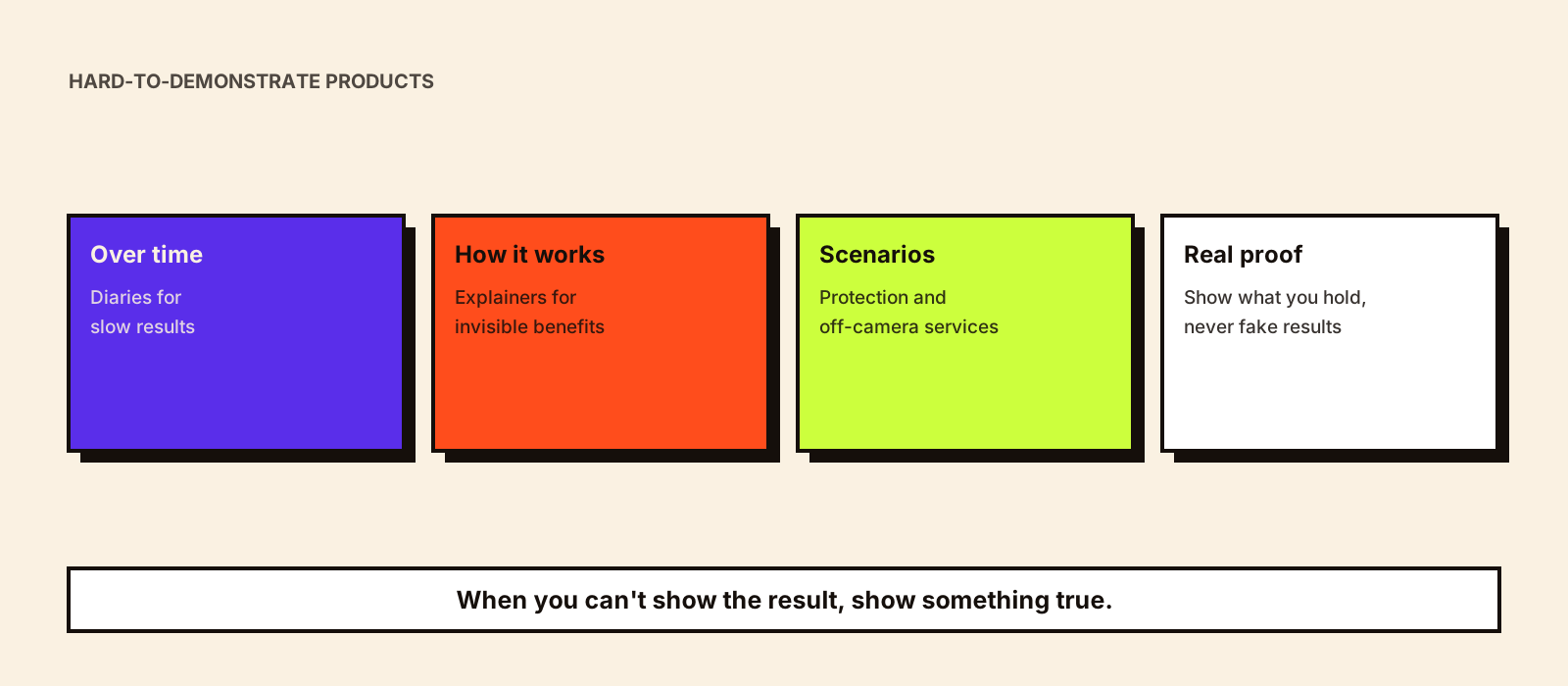
Creator content is at its best when the product does something visible: a stain disappears, a gadget unfolds, a dish comes together. Plenty of products don't work like that. A supplement takes weeks, an insurance policy matters on a day you hope never comes, a B2B tool's value sits in a dashboard, and a cleaning service happens while the customer is at work. Asking creators to 'show the results' for these products leads either to boring content or to faked results, which is worse.
Quick answer
When you can't show the result, show something true that stands in for it: the process over time (diaries), how it works (explainers), the situation without it (scenarios), an honest comparison with what people do now, the experience of using it (screen recordings and walkthroughs), an expert's explanation, or the proof you genuinely hold (certifications, test reports, guarantees). Brief creators on which of these to use, give them a claims sheet, and never let editing simulate a result the product didn't deliver.
Why some products are hard to show
| Type | Examples | What you can show instead |
|---|---|---|
| Slow results | Supplements, skincare, haircare, fitness programmes, courses | A documented routine over time, with honest expectations |
| Invisible benefit | Air and water purifiers, mattresses, ergonomic chairs | How it works, the problem it addresses, how it feels to use |
| Prevention or protection | Insurance, security, warranties, maintenance plans | Scenarios, the claim or service process, what's covered and what isn't |
| Services delivered off camera | Cleaning, repairs, accounting, legal, logistics | Booking, the handover, the before-and-after of the space or task |
| Software and digital products | SaaS, apps, fintech | Screen recordings of a real task, start to finish |
| Experience goods | Fragrance, taste, comfort | Reactions, comparisons with familiar references, use occasions |
| Complex or B2B | Industrial products, enterprise tools | Expert explanation, customer workflow, time or effort saved described honestly |
Seven formats that work
1. The diary
For slow products, film the routine rather than the result: day one, week two, week six. The creator says what they're noticing and what they aren't. The honesty is the persuasion; a diary that admits 'nothing much yet' at week two is more believable at week six. Agree up front that the creator will report what really happens, and that you won't ask them to show changes that didn't occur.
2. The mechanism explainer
When the benefit is invisible, explain how the product works in plain language, ideally with a simple physical demonstration (filter layers laid out on a table, a cutaway of a mattress). Explainers suit qualified or technically fluent creators. Keep every claim inside what the brand can prove.
3. The scenario
For protection products, show the situation the product is for: a hospital admission, a phone stolen on a train, a delayed shipment. The creator walks through what would happen with and without cover, including what isn't covered. Make clear when a scenario is a dramatisation, and have regulated categories such as insurance reviewed by compliance; see influencer marketing in regulated categories in India.
4. The honest comparison
Compare the product with what the audience does today, not with a straw man: the gym versus the home programme, the spreadsheet versus the app, the local plumber versus the service. Honest comparisons include where the alternative wins. The full method is in the honest product comparison brief.
5. The walkthrough
For software and services, record a real task from start to finish: booking a cleaner, filing an expense, setting up a policy claim. Screen recordings with the creator's face or voice over them work well because they show the effort involved, which is usually the real question. Use a demo account or blur personal data.
6. The expert explanation
A dermatologist on why results take weeks, an engineer on what a certification test measures, a chartered accountant on what the software automates. Experts set expectations credibly, which reduces disappointment later. In health and finance, they also need to hold and declare relevant qualifications.
7. Proof you can show
If you hold real proof, let creators show it rather than assert it: a lab report, a certification mark and what it means, a warranty card, a free-trial or return policy, aggregate customer reviews on the product page. Showing proof is more persuasive than a creator saying 'it really works', and it's easier to substantiate.
Picking the right format for your product
| Main barrier for buyers | Best formats | Supporting format |
|---|---|---|
| 'I don't believe it works' | Diary, proof you can show | Expert explanation |
| 'I don't understand it' | Mechanism explainer, expert explanation | Walkthrough |
| 'I don't think I need it' | Scenario | Honest comparison |
| 'It looks complicated' | Walkthrough | Diary of the first week |
| 'What I use now is fine' | Honest comparison | Scenario |
The barrier usually comes straight from customer research and sales conversations, so start there; see using customer insights in influencer briefs. Your creative strategy should then assign formats to creator types, as described in building an influencer creative strategy.
Claim limits: what not to fake
- Don't use editing, lighting, filters or staged footage to suggest a result the product didn't produce.
- Don't present a dramatised scenario as a real event.
- Don't let a time-lapse imply results came faster than they did; show dates.
- Don't suggest one creator's experience is typical unless you have evidence it is.
- Don't show proof you don't hold, or describe a certification as more than it is.
- Health, finance, insurance and other regulated products need the claims checked against sector rules before filming.
These limits come from India's general rules on misleading advertising and endorsements, which expect claims to be truthful and substantiated; see influencer campaign compliance for the baseline.
Product: [name]   Main buyer barrier: [don't believe / don't understand / don't need / looks complicated]
Format: [diary / explainer / scenario / comparison / walkthrough / expert / proof]
What you can show: [routine, process, screen, scenario, proof document]
What you must not show or say: [simulated results, unproven claims, 'guaranteed']
Honest expectations to state: [e.g. 'most people notice changes after several weeks, if at all']
Approved claims: [claims sheet attached]
Diary dates (if relevant): [day 1, week 2, week 6]
Demo account or data handling: [details]
Disclosure: [platform label plus spoken or on-screen disclosure]
Production tips
- Budget for time: diaries need several shoots, so pay for the full schedule rather than one deliverable.
- Send creators the product early enough to use it genuinely before filming.
- Give creators props that make the invisible visible: cutaways, test kits, diagrams they can hold.
- For software, provide a clean demo account with realistic sample data.
- Ask for raw footage of reactions and process; it's often more useful for ads than the polished edit.
If you need this kind of content in volume for ads and product pages, Kudozz's UGC content production service briefs and manages creators for exactly these formats.
Measuring content that explains rather than shows
Explainer and diary content often converts later than a flashy demo, so judge it on signals of understanding and intent as well as clicks: average watch time and completion, saves and shares, the questions in comments, and assisted conversions over a longer window. Comparing one format with another inside the same campaign tells you more than comparing it with a different product's demo video.
Common mistakes
- Forcing a 'results' format on a product whose results are slow or invisible.
- Faking or exaggerating results through editing.
- Briefing lifestyle creators to explain technical mechanisms they don't understand.
- Paying for one post when the format needs a diary over weeks.
- Hiding the effort or limits of using the product, which comes back as returns and complaints.
- Judging explainer content on click-through rate alone.
Conclusion
Products that are hard to demonstrate aren't bad candidates for creator content; they just need a different brief. Identify the buyer's real barrier, pick the format that answers it, show only what's true and give creators the time and props to do it well.