How D2C Brands Can Reach Gen Z Through Niche Creator Communities
Gen Z doesn't gather in one feed. It gathers in fandoms, hobbies and subcultures with their own language and their own trusted voices. A practical playbook for D2C brands: finding those communities, choosing creators who belong to them, formats that don't feel like ads, and measuring what matters.
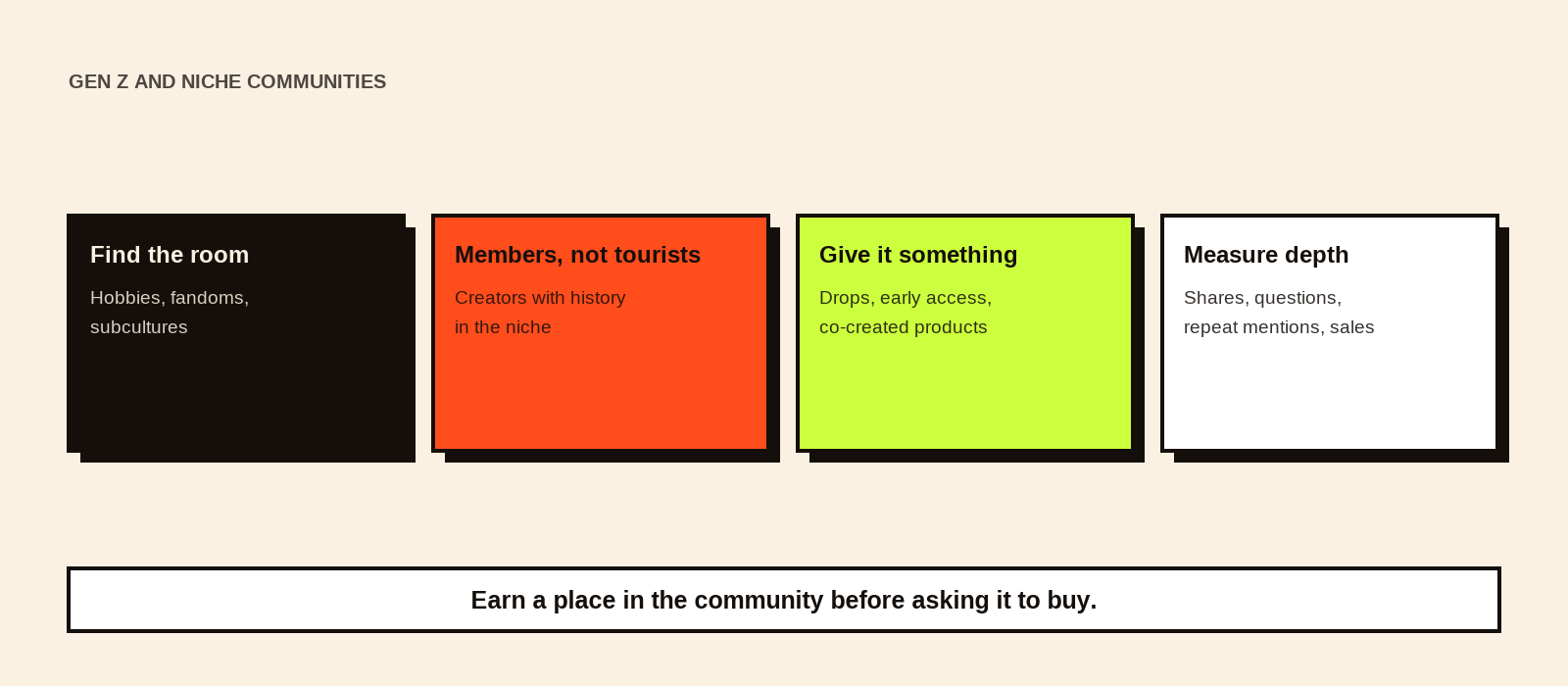
Ask a 21-year-old in Pune where they found their last pair of sneakers, their sunscreen or their protein bar, and the answer is rarely 'an ad'. It's usually a person inside a corner of the internet they care about: a sneaker reseller on Instagram, a skincare channel that reads ingredient lists, a gaming streamer, a college meme page, a running club's group chat. Gen Z influencer marketing in India works when a brand earns a place inside those corners, not when it buys a broad post from the most-followed creator in the age bracket.
Quick answer
To reach Gen Z, pick two or three niche communities where your product genuinely has a role (a hobby, fandom, subculture or life stage), work with nano and micro creators who are active members of those communities rather than lifestyle creators visiting them, let those creators shape the format and language, give the community something of its own (an inside joke, a drop, a co-created product, early access), disclose every paid post clearly, and measure community signals such as saves, shares, comment quality and repeat mentions alongside tracked sales.
Why Gen Z needs a different plan
The commercial case is simple. Bain's How India Shops Online 2026 report, produced with Flipkart, puts Gen Z at 40–45% of India's e-retail shoppers and close to half of incremental orders in 2025. For many D2C categories, especially beauty, fashion, snacks, fitness and gadgets, this is the customer base you're building for the next decade.
What makes the plan different is how attention is organised. Gen Z audiences are less likely to share one mass feed and more likely to sit inside overlapping niches, each with its own references, humour and gatekeepers. A Snap-commissioned study with GWI reported that 70% of Indian Gen Z respondents said creator content helps them discover products, and 63% share products with friends or family before buying. Treat those figures as directional (the published summary doesn't give full methodology), but the second number is the useful one: discovery happens through creators, and the decision often happens in a group chat.
Step 1: Map the communities your product actually belongs to
Start from use, not demographics. 'Gen Z, 18–24, metros' describes millions of people with nothing in common. 'People who train for their first 10K', 'college students who cook in hostel kitchens' or 'anime fans who cosplay at Comic Con' describes a community with shared problems, shared spaces and shared creators.
| Community | Where it gathers | Products with a natural role | What earns respect |
|---|---|---|---|
| Skincare ingredient nerds | Instagram, YouTube long-form, Reddit threads | Actives, sunscreen, haircare | Ingredient literacy, honest negatives, patch tests |
| Gaming and esports | YouTube Live, Instagram, Discord | Snacks, energy drinks, headphones, chairs, apparel | Playing the game well, in-jokes, not interrupting streams |
| Anime, K-pop and fandoms | Instagram fan pages, X, Telegram, fan edits on YouTube | Merch, stationery, beauty, snacks | Knowing the lore, respecting the fandom's rules |
| Sneakers and streetwear | Instagram, resale groups, YouTube | Footwear, apparel, accessories, sneaker care | Drop knowledge, authenticity checks, styling |
| Thrift and sustainable fashion | Instagram thrift stores, Reels | Pre-loved, upcycled, slow fashion | Transparency on sourcing and price |
| Fitness and running clubs | Strava, Instagram, WhatsApp groups | Nutrition, shoes, recovery, wearables | Showing up to runs and training, not posing |
| College and exam prep | YouTube, Telegram, Instagram meme pages | Stationery, tech, snacks, budget food, study apps | Relatability, humour, value for money |
Pick two or three communities to begin with. Spreading a small budget across seven niches makes you a stranger in all of them. For more niches beyond the usual lifestyle categories, see 13 creator niches brands can explore beyond lifestyle influencers.
Step 2: Choose creators who are members, not tourists
The most common failure with Gen Z is booking a polished lifestyle creator to 'do' a subculture for one post. The community spots it in the first three seconds, and the comments say so. A member creator has history in the niche: their old posts are about it, their followers talk to them about it, and other members tag them.
- Scroll back six months. Is the niche a recurring part of their content, or a one-off?
- Read the comments. Do followers ask niche questions ('which size for wide feet?', 'does this pill?') or just leave emojis?
- Look for peer recognition: collaborations with other niche creators, mentions in community pages, invites to community events.
- Check audience age and city in the creator's insights, since a niche creator's audience can skew older or international.
- Ask how they would talk about your product. Members usually have an opinion, including what they don't like.
Most of these creators will be nano or micro accounts. That's a feature: smaller creators inside a niche often have closer relationships with their audience than large generalists. How Indian brands can work with micro-influencers covers briefing, seeding and measuring a group of smaller creators at once.
Step 3: Let the community shape the format
Gen Z content norms change by niche. A skincare explainer can run eight minutes on YouTube; a gaming integration has to fit the rhythm of a stream; a meme page collaboration lives or dies on whether the joke lands. Write the brief around the message and the non-negotiables, then let the creator choose the format.
| Format | Works for | Watch for |
|---|---|---|
| Long-form explainers and honest reviews | High-consideration or ingredient-led products | Allow genuine negatives; Gen Z distrusts reviews with none |
| Memes and meme-page partnerships | Snacks, apps, apparel, anything with a sense of humour | Humour that punches at the brand, not the audience; clear disclosure on memes too |
| Live streams and in-stream integrations | Gaming, music, fandom events | Don't script the creator's banter; agree a natural slot |
| Duets, stitches and remixable templates | Products with a visible result or a challenge | Rights to reuse remixes must be agreed with each creator |
| Community spaces (Discord, Telegram, WhatsApp groups) | Drops, early access, feedback loops | Moderation, consent and not spamming members |
| Fan edits and collabs with fan pages | Fandom-adjacent merch and beauty | IP and image rights of the artists or franchises featured |
Reddit deserves its own caution. Communities there are explicitly hostile to undisclosed promotion and moderators remove it fast. If your audience is active there, read Reddit community marketing for Indian brands before posting anything.
Step 4: Give the community something of its own
Paying for posts gets you seen. Giving the community something it can claim gets you talked about. The strongest Gen Z programmes usually include at least one of these:
- A limited drop designed with a member creator: a colourway, a flavour, a bundle with the creator's name on it.
- Early access for the community: a code or link that works for 48 hours before the public launch.
- A product decision the community votes on: name, shade, packaging, the next flavour.
- An in-joke the brand adopts in its own channels, with credit to where it came from.
- Presence at the community's real-world moments: a run club Sunday, a college fest, a fan meet, a LAN event.
Co-created products need clear terms on design ownership, revenue share and what happens if the partnership ends. Co-branded creator products explains how to structure them.
Tone mistakes that cost brands with Gen Z
- Using slang from last year, or slang from a different niche. If a 35-year-old wrote the caption, the audience will know.
- Over-scripting. A creator reading brand lines in their own voice still sounds like a brand.
- Hiding the ad. Undisclosed partnerships get called out in comments and screenshotted.
- Discount-only messaging. Gen Z is price-sensitive, but a code with no reason to care is just noise.
- Arriving only at the launch and disappearing afterwards. Communities remember brands that show up once.
- Ignoring criticism in the comments. A short, human reply does more than deleting it.
Disclosure and claims still apply
Niche and humorous formats don't change the rules. Under ASCI's influencer guidelines, paid, gifted and affiliate content needs a clear, upfront disclosure label such as 'Ad', 'Collab' or 'Sponsored', placed where people will see it before they engage, including on memes, Stories and live streams. Claims about results (skin, performance, health) need substantiation whatever the format. Influencer campaign compliance in India lists what to check before content goes live.
Be careful with age. Some fandom and gaming communities include minors. Avoid targeting or featuring under-18s in paid content without proper consent, and keep categories such as energy drinks or supplements away from creators whose audiences skew very young.
Budget: how to split it
Gen Z community programmes usually spend more on many small relationships than on a few big posts. A simple starting structure for a first quarter, illustrative only:
| Layer | Share of creator budget (illustrative) | Purpose |
|---|---|---|
| Nano creators inside each community (10–25 per niche) | 35–45% | Breadth inside the niche, honest reviews, comment conversations |
| Micro creators who lead the niche (3–6 per niche) | 30–40% | Credibility, longer formats, co-creation |
| One community moment or drop | 10–15% | Something the community owns: an event, a limited product, early access |
| Paid amplification of the best organic posts | 10–20% | Extend proven posts to lookalike audiences as partnership ads |
If you're deciding how far down the tiers to go, nano vs micro influencers compares cost, effort and fit for each tier.
Measuring community, not just reach
Reach is a weak signal for niche work, because the point is depth inside a small group. Track two sets of numbers and report them side by side.
| Community signals | Commercial signals |
|---|---|
| Saves and shares per view (shares often mean 'sent to a group chat') | Orders and new customers from creator codes and links |
| Comments that ask product questions or mention other members | Share of orders from customers under 25, where you can see age |
| Unprompted mentions by non-paid community members afterwards | Sell-through of the drop or early-access stock |
| Creator retention: do members want to work with you again? | Repeat purchase at 60 and 90 days |
| Growth of your own community space (group, server, list) | Cost per new customer by community |
Give a community at least two or three cycles before judging it. The first month buys attention; the second and third show whether the community accepts you. For separating real engagement from inflated numbers, see influencer engagement quality.
A hypothetical 90-day plan
Hypothetical, for illustration only. A D2C sunscreen brand wants to grow with Gen Z buyers in Tier 1 and Tier 2 cities.
- Weeks 1–2: choose two communities: skincare ingredient explainers and college students on a budget. Shortlist 4 micro and 30 nano creators who already post about sun protection or hostel life.
- Weeks 3–6: seed product with a short brief (SPF claims are fixed; everything else is the creator's call). Two micro creators do long-form honest reviews; nano creators post daily-use content in Hindi, Tamil and English.
- Weeks 7–8: launch a 'campus kit' with one micro creator: sunscreen plus a mini, priced for students, with 48-hour early access for followers of participating creators.
- Weeks 9–12: run the three best organic posts as partnership ads, rebook the creators whose comments were full of product questions, drop those whose audiences didn't engage.
Conclusion
Reaching Gen Z isn't about finding the right age bracket. It's about finding the right rooms and being invited in. Pick a few communities where your product genuinely belongs, work with creators who are already members, let them set the tone, give the community something of its own and measure depth as well as sales. Brands that keep showing up after the launch become part of the niche; brands that visit once are forgotten by the next drop.