Hospital Social Media Strategy: Content Planning for Patient Education, Reputation and Community Engagement
How a multi-department hospital can plan and govern its social media: a medical review committee, an approval matrix, department content, public health awareness, consent, crisis communication and measurement without outcome claims.
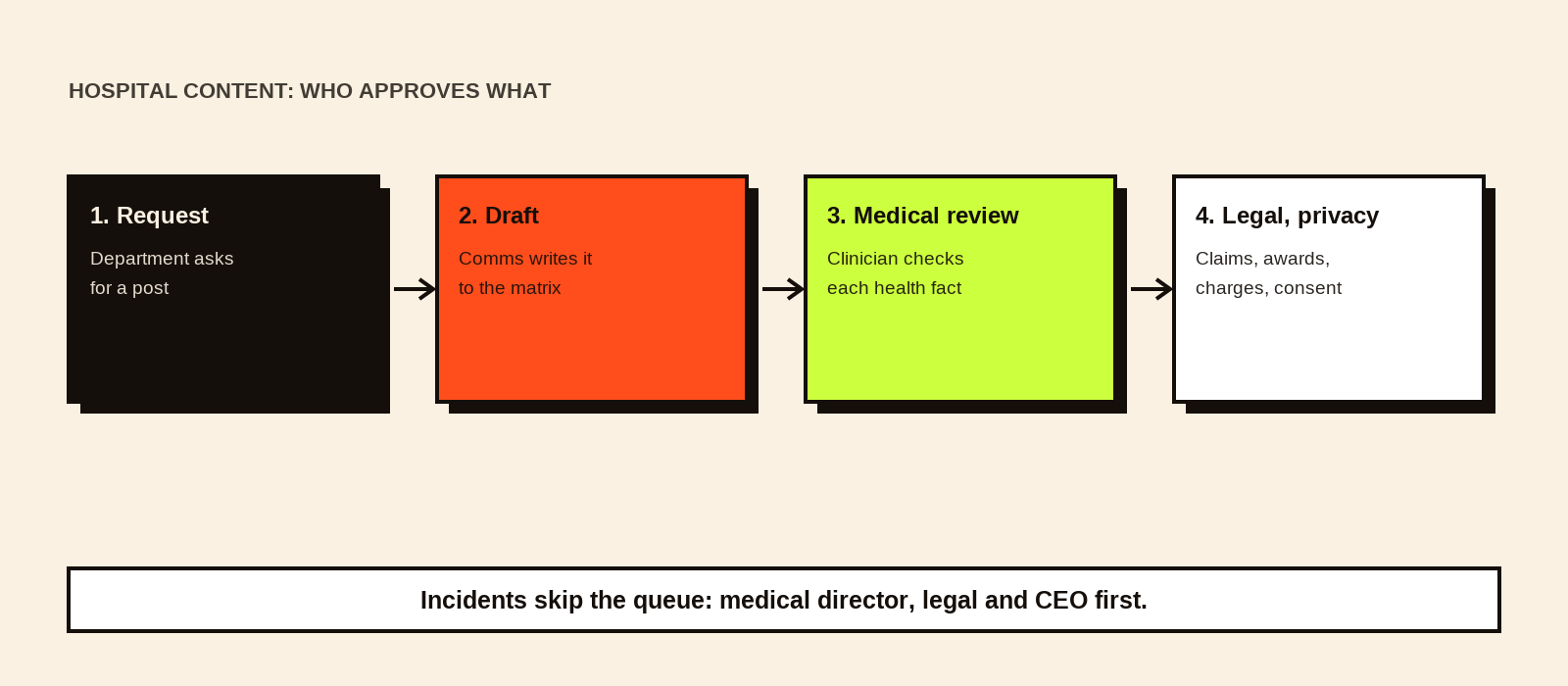
The cardiology department wants a post about its new cath lab. Orthopaedics wants to celebrate a milestone number of knee replacements. The CEO wants the hospital's latest award on every channel, and a patient's relative has just posted an angry video from the emergency waiting area. A hospital's social media team meets all four of these in a normal week, and each one needs a different decision-maker.
Quick answer
A hospital social media strategy in India should publish factual, verifiable information about departments, facilities and services, public health education checked by clinicians, and community programmes, all under a written approval matrix. Under the NMC's guidelines of 6 October 2026, hospitals must avoid solicitation, superiority claims, outcome guarantees and promotional portrayal of individual doctors. Medical, legal and privacy owners approve content; the social team or agency runs the calendar.
What a hospital may publish
The National Medical Commission's Guidelines on Ethical Advertising and Public Communication by Hospitals/Medical Institutions and Registered Medical Practitioners (No. R-13014/01/2024-Ethics, 6 October 2026, in force with immediate effect) are the starting point. Clause 8.3 allows hospitals to share factual, objective and verifiable information about their name, location, contact details, departments, facilities, equipment, services, emergency services, accreditation status and charges. The same clause rules out patient solicitation, inducements, comparative superiority claims, guarantees of cure or outcome, unverifiable or exaggerated claims, and promotional portrayal of an individual doctor. It adds that the form, medium or frequency of communication must not turn factual information into solicitation.
- New equipment or technology: allowed as factual information, without superiority, guaranteed accuracy, guaranteed outcomes or comparisons (Explanation II to clause 3.2).
- Doctors: posts should name the doctors involved with their qualifications, registration status and SMR/NMR number (Explanation IV). A directory of doctors with recognised qualifications, specialties, registration details and availability that serves a patient-information function is treated as distinct from promotional advertising (clause 9.1).
- Awards and rankings: words like best, No.1, leading, most trusted or top are barred unless objectively verifiable through a transparent, independent methodology; any award used should disclose the awarding body, methodology and date where needed (clause 8.1(ix) and its proviso). ASCI's guidelines on awards and rankings (21 April 2022) set extra requirements for healthcare.
- Charges and packages: any lawful disclosure must be factual, transparent and not misleading, and inducements likely to encourage unnecessary tests or treatment are barred (clause 8.1(x)).
- Reviews: hospitals must not solicit, buy, manipulate or cause to be published fake, paid or misleading reviews, ratings or testimonials (Explanation V), and must not buy followers or engagement (clause 8.1(xii)).
For hospitals, the guidelines are read with the applicable Clinical Establishments Act, Rules or state law, and that law prevails if there is an irreconcilable conflict (clause 4.3). Violations by a hospital are handled under that law, and a doctor who personally authorised a prohibited post can be examined separately by the State Medical Council (clause 11.5). Your legal team should confirm which state law applies to you. ASCI's awards guidance is listed on its guidelines page.
Set up the governance group first
A clinic can run on one doctor's approval. A hospital needs a small standing group with named people and deputies, because content touches clinical accuracy, patient privacy, law and reputation at once. A typical group looks like this:
- Medical review: a senior clinician (or a rota of department reviewers) who checks every health statement and every post about a department.
- Communications: owns the calendar, voice, scheduling and community management, and drafts or briefs every post.
- Legal and compliance: reviews new formats, awards, charges, campaigns, partnerships and anything about an incident.
- Privacy or data protection: checks consent records and anything involving patient or staff personal data.
- Quality or patient safety: joins when a post touches outcomes, accreditation or an incident.
The approval matrix
This is the practical resource: agree a version of it in writing before you post. The turnaround depends on your committee's capacity, so build lead times into the calendar instead of promising same-day approvals. Our guide to the social media approval process covers stages and tools in more depth.
| Content type | Drafted by | Medical review | Legal / privacy | Final sign-off |
|---|---|---|---|---|
| Department and service information | Communications with the department | Department head or nominee | Only for new service claims | Communications lead |
| Doctor directory-style posts | Communications | Medical administration checks credentials | Privacy if photos are used | Medical director's office |
| Public health awareness | Communications or clinician | Clinician in that specialty | Not usually | Medical reviewer |
| Equipment and facilities | Communications | Department head | Legal checks wording for comparisons | Communications lead |
| Awards, accreditation, rankings | Communications | Quality team verifies | Legal, always | Leadership |
| Charges, packages, health check-ups | Communications with billing | Medical reviewer for inclusions | Legal, always | Leadership |
| Staff or patient stories | Communications | Clinician | Privacy checks consent, always | Medical director's office |
| Community programmes and camps | CSR or communications | Clinician running it | Legal if partners or offers involved | Communications lead |
| Incident, complaint or crisis statements | Communications with leadership | Medical director | Legal, always | CEO or nominee |
Content to plan, department by department
Hospitals rarely run short of ideas; they run short of approved, accurate content. Plan by department and by patient need, then rotate through these categories so no single department dominates the month:
| Category | Example posts | Keep in mind |
|---|---|---|
| Department and service information | What the department treats, OPD days, how referrals work, which tests are available | Factual, no outcome or superiority claims |
| Specialists | Directory-style profiles with qualifications, registration numbers and consultation timings | No promotional portrayal of an individual doctor (clause 8.3(ii)) |
| Patient processes | Admission steps, visiting hours, insurance and cashless desk, discharge, what to bring | Update when processes change; date anything time-bound |
| Facilities | Emergency entrance, pharmacy hours, parking, accessibility, wayfinding | Equipment posts stay factual (Explanation II) |
| Public health awareness | Seasonal illness precautions, vaccination drives, screening awareness | Take health facts from official sources such as MoHFW or WHO; government programme campaigns are exempt (clause 7.3) |
| Community programmes | Blood donation drives, first-aid training, school health talks | Show the programme, not patients; no inducements |
| People behind the hospital | Nursing, lab, housekeeping and support teams at work | Written consent from staff; no patients in frame |
For health facts, cite primary public health sources such as the Ministry of Health and Family Welfare or the World Health Organization, and have a clinician confirm the advice suits your patients. Doctors may give public health talks on electronic media in their own name and designation, but clause 8.2(iii) says this should not promote their employer, so plan clinician-led education carefully.
Consent and privacy in a hospital setting
Hospitals are full of identifiable people at their most vulnerable. Clause 6.1 of the NMC guidelines says patient information, images, records and treatment details shall not be used for advertising unless the law permits it and consent and safeguards are in place; clause 6.2 says consent alone does not make a prohibited testimonial or before-and-after acceptable; clause 6.4 asks for cropping, blurring or removing identifying marks even where disclosure is lawful. Clause 7.5 says live broadcast of surgical or clinical procedures must follow the NMC's separate framework on live surgery. Clause 7.6 requires compliance with the IT Act, the Digital Personal Data Protection Act, 2023 and its 2025 Rules, which were notified on 14 November 2025 with an eighteen-month phased compliance period (PIB, 17 November 2025).
- Create a photography policy: approved zones, approved times, and a rule that wards, ICUs and emergency areas are never filmed while patients are present.
- Keep a consent register for staff and any other person shown, with expiry and withdrawal handled.
- Never confirm in public that someone is or was a patient, even when they post about it themselves.
- Brief every department that personal phones and personal accounts must not be used to post from clinical areas.
Crisis communication: incidents, complaints and misinformation
Hospitals face situations most brands never will: an allegation of negligence going viral, a violent incident in the emergency department, a data breach, or a false message about the hospital forwarded across WhatsApp groups. Set severity levels and a holding-statement route in advance using our guide to building a social media crisis response plan, and add three hospital-specific rules: never discuss a patient's care or condition publicly, even to correct a claim; route anything involving an incident to the medical director and legal team before replying; and correct misinformation with verifiable facts about services, not with arguments. Serious incidents need specialist legal and PR advice; a social media team or agency does not replace them.
We're sorry to see this and we take every concern seriously. To protect patient privacy we can't discuss anyone's care here. Please contact our patient relations team on [number / email] so that a senior member of staff can look into it with you directly.
Measure without outcome claims
Clause 8.1(iii) bars doctors from advertising professional success rates or numbers of patients treated, and hospital communication must not carry unverifiable or exaggerated claims, so 'our 5,000th surgery' milestone posts and success-rate graphics stay out of the feed. Measure what the channel can honestly influence: reach and saves on education posts, questions answered, response times, accuracy of information, the share of comments escalated correctly, and how often people use the booking or helpline details you post. Report trends to leadership, not single-post spikes. Our guide to social media KPIs by business goal covers metric selection.
Common mistakes
- Letting each department run its own account without the approval matrix.
- Posting award graphics without the awarding body, methodology and date.
- Featuring a star surgeon in a promotional series.
- Sharing recovered patients' stories or before-and-after images because the patient agreed.
- Replying to a complaint with details of the patient's treatment.
- Boasting about patient volumes, success rates or 'first in the city' claims that can't be independently verified.
Where to start
Form the governance group, agree the approval matrix and the photography policy, then build a month of department information, process posts and clinician-checked awareness content. Smaller doctor-led practices can use our clinic social media guide instead. For creator partnerships, our guide to influencer marketing for healthcare brands covers campaigns with creators, which sit outside the hospital's own feed.
An agency's role, including what Kudozz includes in social media management, is planning, drafting, design, publishing and moderation inside the approvals you set; medical, legal and privacy decisions stay with the hospital.