How to Build a Social Media Crisis Response Plan for Your Brand
Most brands write their crisis plan during the crisis. This guide sets severity levels, a response checklist, approval roles, holding statements, what to pause, when to bring in lawyers or specialist PR, and how to review and rehearse.
It's Saturday evening. A customer's video showing a foreign object in your product has been shared a few thousand times, your festive offer post is scheduled for 7 pm, and the founder is on a flight. The social media manager is asking a group chat whether to reply. Without a plan, the first public response is improvised, and that's usually the one people screenshot.
Quick answer
A social media crisis response plan defines what counts as a crisis, who decides and approves, what gets paused, and what you'll say first. Set three severity levels, name a decision-maker and approvers including legal, prepare holding statements in advance, pause scheduled posts and ads when a serious issue starts, monitor closely, and review afterwards. Bring in lawyers or specialist crisis PR for safety, legal, data or regulatory issues.
What is and isn't a crisis
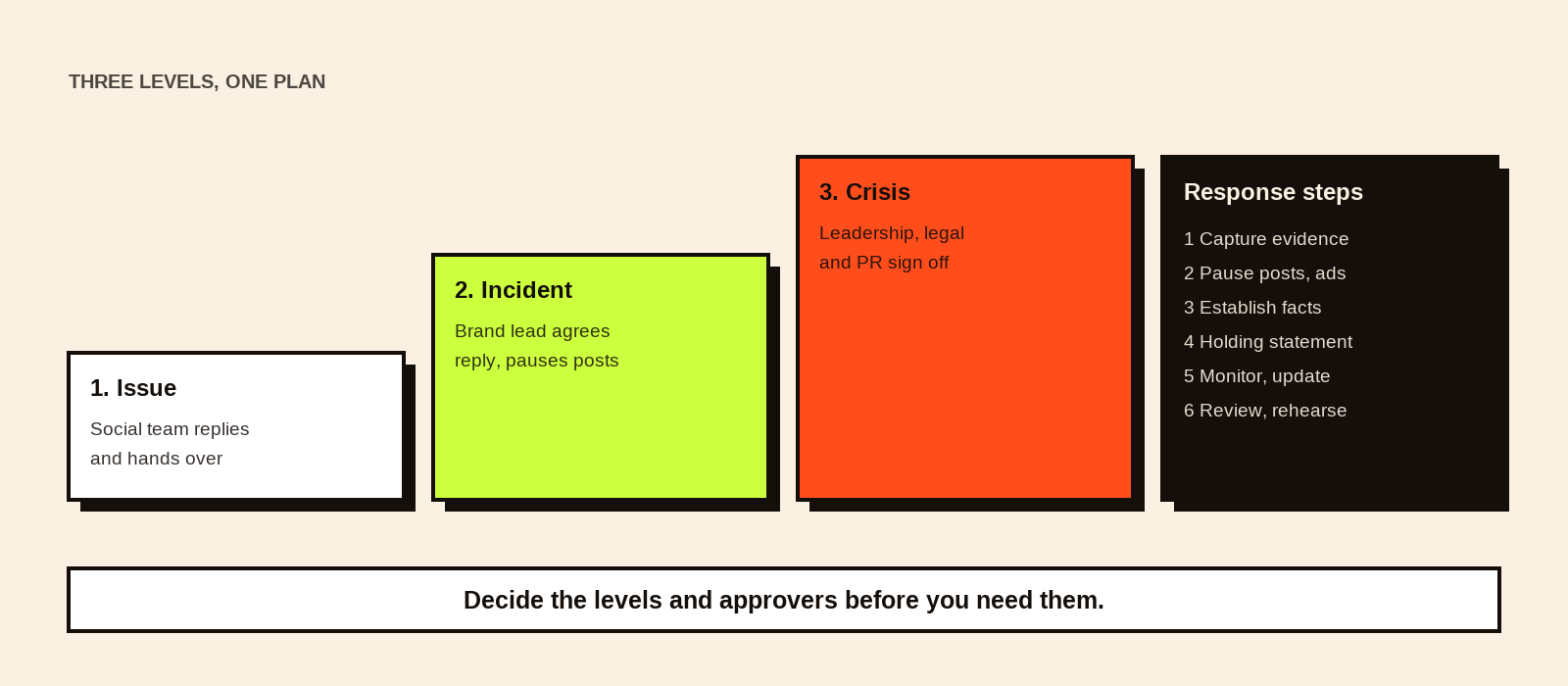
Calling everything a crisis wears people out, and calling nothing a crisis means the real one gets a routine reply. Agree three levels and the signals for each. The signals below are examples; set your own based on your normal comment volume.
| Level | What it looks like | Who leads | Typical response |
|---|---|---|---|
| 1. Issue | Individual complaints, a handful of negative comments, a bad review | Social team with support | Normal reply and handover rules |
| 2. Incident | A complaint gaining traction, a cluster of similar complaints, a creator post backfiring, an error in a published post | Brand lead, social team | Pause related content, agree a reply, monitor closely |
| 3. Crisis | Possible harm to people, product safety, legal or regulator involvement, data breach, account hacked, media coverage, a story spreading beyond your audience | Crisis lead with leadership, legal and PR | Full plan: pause, holding statement, specialist advice, regular updates |
Volume alone doesn't define level 3. One credible report of a child harmed by your product is a crisis even with five comments. A thousand angry comments about a discontinued flavour may only be an incident.
Who decides, drafts and approves
Write names, not job titles, and a backup for each. Include out-of-hours phone numbers. The crisis plan is useless if the only person who can approve a statement is unreachable.
| Role | Responsibility | Usually |
|---|---|---|
| Crisis lead (decides) | Declares the severity level, decides whether and when to respond | Founder, CEO or marketing head |
| Drafter | Writes holding statements, replies and updates | Social media lead or agency, with PR input |
| Fact owner | Confirms what actually happened | Operations, quality, product or customer support lead |
| Legal sign-off | Reviews anything touching liability, safety, data or regulators | In-house counsel or external lawyer |
| PR sign-off | Aligns social with media statements | In-house PR or specialist crisis PR firm |
| Publisher | Posts approved statements, pauses content, monitors | Social team or agency |
A social media agency can draft, publish and monitor. It is not a substitute for legal advice or specialist crisis communication, and should not be the one deciding what the brand admits or promises. At Kudozz, crisis communication is scoped separately from regular social media management, as our service scope explains.
The first hours: a crisis response checklist
- Capture evidence: screenshots with URLs and timestamps of the original post and key replies.
- Tell the crisis lead and agree a severity level.
- Pause scheduled posts and ads on all platforms (see below).
- Stop replying piecemeal. One agreed line for the social team until the statement is approved.
- Establish facts with the fact owner: what happened, how many people, what's known and not known.
- Decide whether legal or specialist PR needs to be involved now.
- Publish a holding statement if silence would be read as indifference.
- Brief the support team and anyone customer-facing, including creators currently posting for you.
- Set a monitoring rota and an update rhythm.
- Keep a log of decisions, times and who approved what.
Holding statements to prepare in advance
A holding statement says you know, you care and you're acting, without guessing at causes or admitting fault before the facts are clear. Get these pre-approved by legal so they can go out quickly once the crisis lead says yes.
GENERAL ISSUE
We're aware of [posts / reports] about [issue]. We're looking into it now and will share an update by [time]. If you've been affected, please contact [support channel] so we can help directly.

PRODUCT CONCERN
We've seen reports about [product, batch if known]. Your safety comes first. While we investigate, please [stop using / set aside] the product and contact [support channel]. We'll update here by [time].

SERVICE OUTAGE OR DELIVERY DELAY
Some customers are facing [problem] since [time]. We're sorry, and our team is working on it. We'll post an update by [time]. Orders affected will be [what you can confirm].

ACCOUNT COMPROMISED
Our [platform] account was accessed without permission on [date]. Please ignore any messages or offers sent from it since [time]. We never ask for payment or OTPs through DMs. We're working with the platform to secure it.

CONTENT ERROR OR OFFENSIVE POST
We posted [content] that [was wrong / hurt people]. We've removed it. We're sorry. [One sentence on what changes, only if confirmed.]

UPDATE TEMPLATE
Update on [issue], [date, time]: Here is what we know: [facts]. Here is what we're doing: [actions]. Next update: [time].
Don't delete critical comments during a crisis unless they break your guidelines. Screenshots of a brand deleting criticism tend to become the story. For day-to-day moderation rules, see community management vs customer support.
Pause scheduled posts, ads and creator content
A cheerful offer post going out in the middle of a crisis looks careless at best. Keep a list of every place content is scheduled so you can stop it in minutes.
- Scheduling tools and native schedulers for each platform.
- Paid campaigns in ads managers, including boosted posts and always-on retargeting.
- Creator posts due to go live, with a message to each creator or their manager.
- Email and WhatsApp broadcasts that may reference the same product or offer.
- Automated DM replies that might sound tone-deaf.
Decide in advance who has the access to pause each of these, and test that they actually can. Approval workflows designed for normal weeks, such as those in the social media content approval process, need an emergency override.
Monitoring during an incident
Monitor your own comments and DMs, mentions and tags, relevant hashtags, the original post's shares and replies, review sites and news. Track the volume of new mentions, the main themes, whether new facts or claims are appearing, and whether the story is moving to new platforms or media. Report to the crisis lead on a fixed rhythm, such as every two hours at level 3, rather than forwarding every comment. Social listening for brands explains how to set up the queries in advance.
When you need lawyers or specialist crisis PR
These situations need qualified advice before you say anything substantive in public:
- Product safety: contamination, injury, allergic reactions or anything that may need a recall.
- Legal threats: notices, consumer forum complaints, defamation claims, IP disputes.
- Data breaches or hacked accounts that expose customer data.
- Contact from a regulator, police or government body.
- Harm to people: accidents, deaths, harassment or allegations against staff or creators.
- Anything likely to attract national media coverage.
In India, cyber incidents can carry reporting duties. CERT-In's directions of 28 April 2022 require service providers, intermediaries, data centres, body corporates and government organisations to report listed incidents, which include data breaches and unauthorised access to social media accounts, within six hours of noticing them. Separately, the government's PIB backgrounder on the DPDP Rules, 2025 says organisations must inform affected individuals and the Data Protection Board of personal data breaches, with obligations phased in over eighteen months from November 2025. Timelines and applicability can change, so check current legal obligations with counsel.
If the crisis involves a creator you've worked with, the contract and brand-safety side is covered in influencer brand safety.
After the incident: review and rehearse
Within two weeks, run a blameless review with everyone involved. Then rehearse the plan at least once a year with a tabletop exercise: a hypothetical scenario, the real people, a clock, and someone playing the angry customer and the journalist.
- Timeline: when it started, when you noticed, when you responded.
- What worked and what slowed you down, especially approvals and access.
- Whether the severity level was right.
- What customers and the public said, and whether sentiment recovered.
- Changes to the product, process, policy or plan, with owners and dates.
- When paused content and ads restart, and whether the tone of the next few weeks needs to change.
Common mistakes
- Replying fast with a guess, then having to correct it.
- Silence for a full day because nobody could approve a statement.
- Letting the agency or a junior team member decide what the brand admits.
- Leaving scheduled offers and ads running.
- Posting the same copy-pasted reply under hundreds of comments.
- Restarting normal posting the next morning as if nothing happened.
- Storing the plan somewhere nobody can open on a phone at night.
Where to start
This week, write down your three severity levels, the names and numbers of the crisis lead, legal and PR contacts, and a list of everywhere content is scheduled. Draft the holding statements and get them approved. That alone will make your first hour calmer than most brands manage.
Then rehearse it once, fix what breaks, and revisit the plan whenever your team, agency or product range changes.