How Brands Can Use Social Listening to Understand Customers and Competitors
Social listening is reading what people say about you, your category and your competitors, then acting on it. A practical workflow with Hinglish and misspelling queries, mention categories, a competitor framework, tool categories, limits and ethics.
A cookware brand keeps seeing comments asking whether its pans work on induction. The answer is on the product page, but nobody reads product pages. Across Instagram, YouTube reviews and a couple of Reddit threads, the same question keeps coming up, along with complaints that a competitor's handle gets hot. None of this shows up in the brand's insights dashboard. It only shows up if someone goes looking.
Quick answer
Social listening means tracking conversations about your brand, competitors and category across platforms, then using what you learn to change content, products, service or campaigns. Start with three or four business questions, build keyword queries that include Hinglish and common misspellings, collect mentions weekly, sort them into categories, act on patterns, and report monthly. Native tools cover your own accounts; paid tools add breadth but still miss private spaces.
Monitoring vs listening
Monitoring is reactive: finding mentions and responding to them, such as a complaint that tags you. Listening is analytical: stepping back to see patterns, such as the fact that 'induction' keeps appearing in questions about your pans. Most brands do some monitoring already. Few turn it into listening, because nobody owns the step from 'we saw it' to 'we changed something'.
| Monitoring | Listening | |
|---|---|---|
| Question | Who mentioned us and do we need to reply? | What are people telling us, and what should we change? |
| Timeframe | Real time or daily | Weekly and monthly patterns |
| Output | Replies, escalations | Insights, content ideas, product feedback, briefs |
| Owner | Community or support team | Strategy or marketing lead |
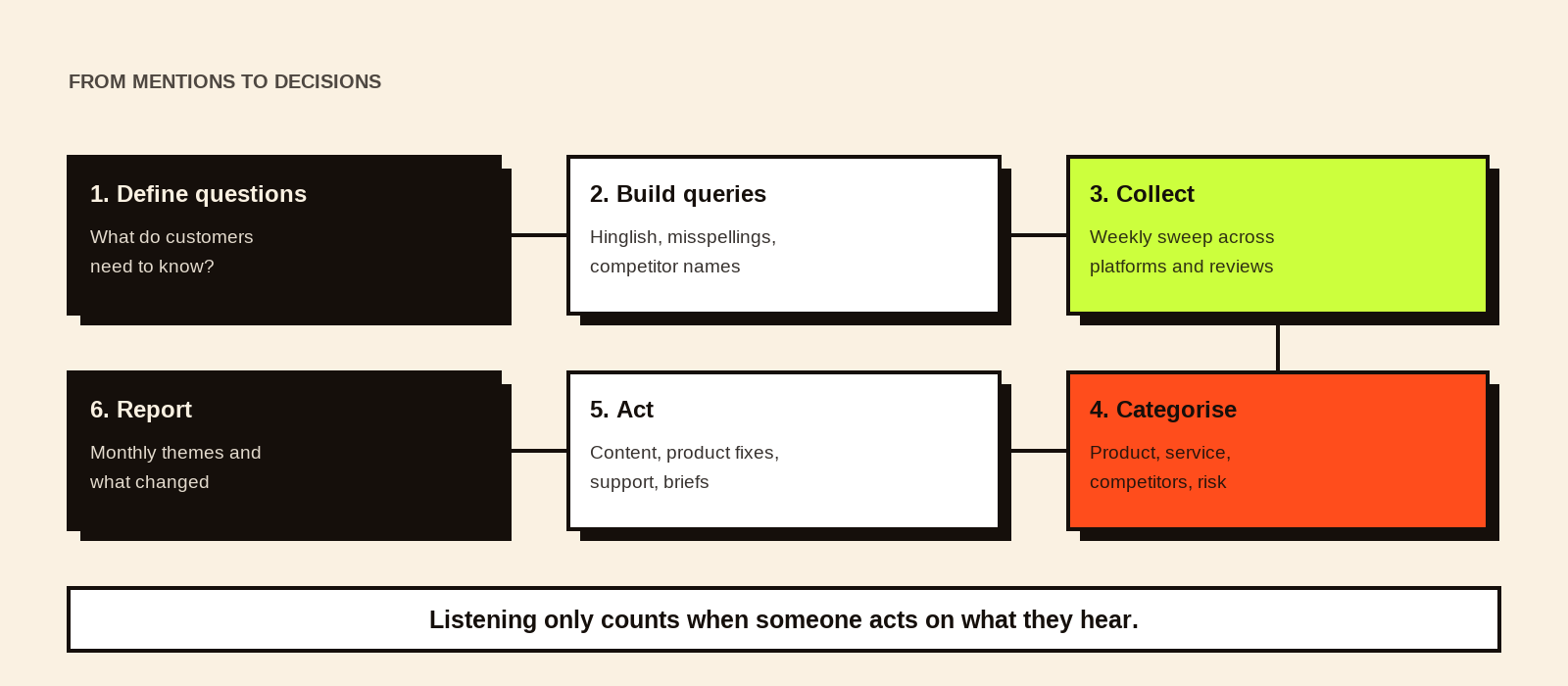
A social listening workflow
1. Define the questions
Listening without a question produces a pile of screenshots. Pick a few: What do customers complain about after delivery? Why do people choose a competitor? What words do people use for our category? Which questions come up before purchase?
2. Build keywords and queries
Indian conversations mix English, Hindi and regional languages, often in Roman script. Your query list should reflect how people actually type.
- Brand name, handle, product names and common misspellings (for a hypothetical brand 'Kaashvi': kashvi, kaashvi, kaasvi).
- Hinglish and transliterated phrases: 'accha hai kya', 'paisa vasool', 'worth it ya nahi', plus regional equivalents for your key markets.
- Category terms people use, not the ones in your brief: 'pan for induction' as well as 'induction-compatible cookware'.
- Competitor names, handles and product names.
- Problem phrases: 'not working', 'refund', 'fake', 'broke after', 'reaction'.
- Exclusions to cut noise, such as a common word that shares your brand name.
3. Collect
Decide where to look and how often. For most brands a weekly sweep of your own comments and DMs, tagged mentions, relevant hashtags, YouTube comments on review videos, marketplace reviews, Reddit and X is enough. Log each relevant mention in a simple sheet or your listening tool with date, platform, link, text and category.
4. Categorise
| Category | Examples | Usually goes to |
|---|---|---|
| Product feedback | Feature requests, quality issues, sizing | Product team |
| Purchase questions | Compatibility, ingredients, price, where to buy | Content team, FAQ, product pages |
| Service complaints | Delivery, refunds, support experience | Customer support and operations |
| Praise and advocacy | Recommendations, unboxings, tagged photos | Community team, UGC permissions |
| Competitor comparisons | 'X vs Y', switching stories | Marketing and strategy |
| Category trends | New needs, formats, rituals, seasonal shifts | Content and campaign planning |
| Risk signals | Safety claims, misinformation, legal threats, fake accounts | Brand lead, crisis process |
5. Act
Each category needs an owner who does something with it. A recurring purchase question becomes a Reel and an FAQ. A delivery complaint pattern goes to operations with examples. A risk signal goes straight into the crisis process. Keep a short 'actions taken' column in your log, so you can show later which insights changed something and which were only noted.
6. Report
A monthly one-page summary is enough: top themes with example quotes, changes since last month, what was done about each, and what's open. Count mentions by category, but don't present those counts as market share.
A competitor and audience insight framework
Competitor analysis on social is often reduced to follower counts. Listening tells you more: what people praise, what frustrates them and what they wish existed.
| Look at | Questions to ask | What you might do |
|---|---|---|
| Competitor praise | What do their customers love that we don't offer or don't talk about? | Fill a product or messaging gap |
| Competitor complaints | Where do they let customers down? | Make that a strength in content, without naming them |
| Switching stories | Why do people move between brands? | Address the trigger in your messaging |
| Audience language | What words and phrases do customers use? | Use them in hooks, captions and search terms |
| Unmet needs | What do people ask for that nobody sells? | Pass to product; test content around it |
| Creators and communities | Who is trusted in this conversation? | Consider for partnerships |
If your goal is finding creators, listening works differently; see social listening for influencer marketing. For X specifically, where conversations are public and fast-moving, see X social listening.
Native tools vs paid listening tools
Native analytics on Instagram, Facebook, LinkedIn and YouTube report on activity around your own accounts: comments, mentions and tags you receive, and how your content performs. They don't search the wider conversation about your category or competitors. Platform search lets you read public posts by keyword or hashtag manually, which works for small volumes.
| Option | Good for | Limits |
|---|---|---|
| Native insights and inboxes | Your own comments, DMs, tags and performance | Little or no view of conversations you're not tagged in |
| Manual platform search | Small brands, specific questions, qualitative reading | Time-consuming; hard to track trends |
| Social media management suites with listening add-ons | Combining publishing, inbox and basic keyword tracking | Coverage and history vary by plan and platform |
| Dedicated listening platforms | Volume, history, multiple sources including news and forums | Cost; coverage depends on platform data access |
| Review and marketplace monitoring | Product feedback on Amazon, Flipkart and similar | Separate from social; may need its own tool |
Before paying for a tool, ask the vendor for a trial on your own queries, including Hinglish terms, and check which platforms and how much history it actually covers. Paid listening tools are a separate cost from Kudozz's social media management; a managed social media service can still run a manual weekly listening sweep as part of strategy work.
The limits of social listening
- Private accounts, closed groups, WhatsApp chats and DMs between users are not visible, and a lot of Indian product conversation happens there.
- Platforms restrict what third-party tools can collect, and those access terms change, so tool coverage is never complete.
- Automated sentiment scores are approximate. Read samples yourself before trusting a trend.
- Sarcasm ('wow, delivered in just 3 weeks, amazing') is often scored as positive.
- Regional languages and Hinglish are handled unevenly by tools; native speakers need to check results.
- Loud voices are not the whole market. A few heavy posters can skew a month.
- Mentions show what people say in public, not what most customers do.
For a closer look at reading audience reactions, influencer sentiment analysis explains how to check automated scores by hand.
Turning insights into content and campaigns
- Answer the top three recurring questions as Reels, carousels or pinned FAQs.
- Use customers' own words in hooks and captions.
- Brief creators on the objections you keep hearing, so their content addresses them.
- Plan campaigns around rising category themes, not just your launch calendar.
- Share praise and UGC on your channels, with the person's permission.
- Feed recurring complaints to product and operations, then tell customers what changed.
Insights from listening often shape the creator side too. Social campaigns built around real audience questions tend to brief better, and customer insights for influencer briefs shows how to pass them on.
Ethics and privacy
- Listen to public conversations only. Don't join private groups under false pretences.
- Don't contact people who didn't tag you in a way that feels like surveillance. Join a public conversation only if you can genuinely help.
- Ask permission before reposting anyone's content.
- Store only what you need: themes and anonymised quotes are usually enough for reports.
- Don't build profiles of individual customers from their social activity.
- Treat personal data with care under India's DPDP framework, and check obligations with counsel if you store mentions with personal details.
Common mistakes
- Buying a tool before deciding what questions it should answer.
- English-only queries for an audience that types in Hinglish.
- Reporting sentiment percentages nobody has checked by reading posts.
- Listening without owners, so insights never reach product or support.
- Copying competitors' content instead of learning from their customers.
Where to start
Write down three questions, build a query list of 20 to 30 terms including Hinglish and misspellings, and spend an hour a week for a month collecting and categorising what you find. You'll know by the end whether you need a paid tool, and you'll already have content ideas.
Listening also works well as part of a wider review of your accounts; a social media audit is a good moment to run your first sweep.