How to Conduct a Social Media Audit Before Changing Your Marketing Strategy
Before you change agencies, platforms or content direction, audit what you have: who owns the accounts, what your profiles say, what content works, what the numbers show, and where compliance gaps sit. A step-by-step process, checklist and summary template.
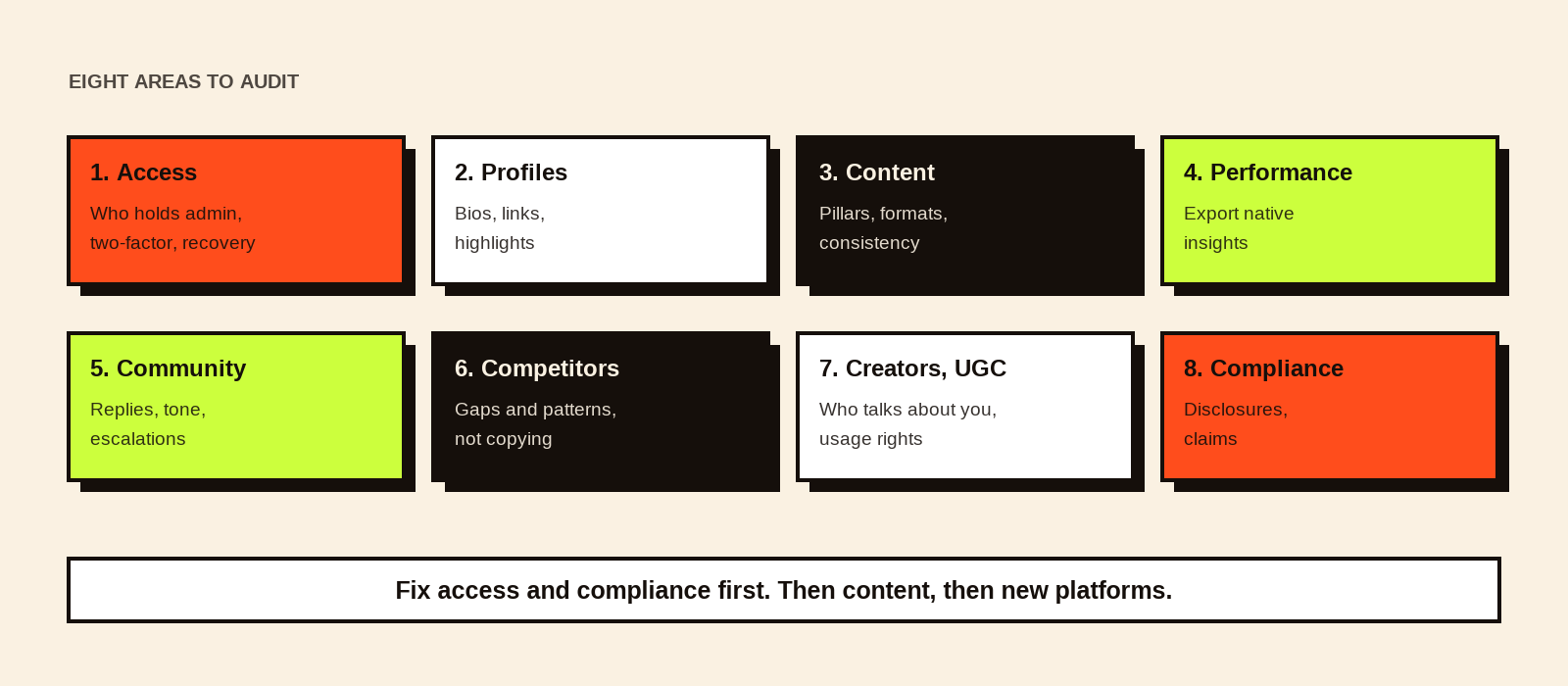
A brand decides its Instagram isn't working and hires a new agency. In week one, nobody can find the login for the Facebook Page, the LinkedIn page admin left two years ago, and the only performance data is a few screenshots in old monthly decks. The new strategy gets built on guesses. An audit before the change would have taken a couple of weeks and saved months.
Quick answer
A social media audit is a structured review of your accounts before you change strategy. Check who owns and can access each account, whether profiles are complete and consistent, what content you post and how it performs, how you handle your community, how competitors compare, how creators and customers talk about you, and whether disclosures are in order. Export at least six to twelve months of native insights where available, then turn findings into a short list of priorities.
When to run an audit
- Before hiring, changing or bringing social media in-house.
- Before a rebrand, a major launch or entering a new market.
- When results have stalled and nobody can say why.
- When adding or dropping a platform.
- Once a year as a routine strategy review.
A step-by-step audit process
- List every account: official, regional, product, old and abandoned. Search each platform for your brand name to find ones you forgot.
- Confirm access and ownership before anything else.
- Export performance data from native insights for the agreed period.
- Review profiles and a sample of content against the checklist below.
- Review community handling: response coverage, tone and escalations.
- Compare with three to five competitors or brands your customers also follow.
- Check creator, UGC and disclosure practice.
- Summarise findings, score each area, and agree priorities.
Access and ownership
This is the most common gap and the most expensive to fix later. The business, not an employee or an agency, should own every account and hold top-level admin rights.
- Who holds admin on each account, and are they current employees?
- Are Facebook Pages and Instagram accounts held in a business portfolio owned by the company?
- Is two-factor authentication on, and tied to a company phone or email rather than a personal one?
- Which agencies, freelancers and connected apps still have access?
- Where are passwords stored, and who can recover each account?
Profiles and content
Profiles
- Consistent name, handle and profile image across platforms.
- Bio says what you sell and who it's for, with a clear next step.
- Links work and go to the right page, with tracking parameters where you measure clicks.
- Contact details, category and location are correct.
- Instagram highlights or pinned posts are current, not last year's festive offer.
- Abandoned or duplicate accounts are identified for closing or redirecting.
Content
Review the last three to six months of posts. Tag each one by pillar or theme, format and purpose, and note quality issues. A simple spreadsheet with one row per post is enough, and it becomes the raw material for the performance section, because you can sort by pillar or format and see which groups consistently do better.
- Do you have clear content pillars, or is it a mix of offers and festival greetings?
- What's the mix of formats: Reels, carousels, static posts, Stories, long-form video?
- Is posting consistent, or does it come in bursts around sales?
- Is the visual and written style recognisably yours?
- Is each platform getting content made for it, or the same post everywhere?
- Which posts would you be embarrassed by today?
If voice is a recurring problem in the audit, the social media brand voice guide is the next step.
Performance: what to export and over what period
Native insights are the most reliable source for your own accounts, but they don't keep everything forever, and metric names change. At the time of writing (November 2026), Instagram's help centre describes account insights including views, interactions and follower changes, with date ranges going back up to 90 days. That's a reason to export regularly rather than relying on the app later.
For other platforms at the time of writing: LinkedIn lets Page admins export visitor, content, follower and competitor analytics as a spreadsheet, YouTube Studio lets you export reports from Advanced mode, and Facebook's help centre covers exporting Page insights data.
| What to look at | Why | Period |
|---|---|---|
| Reach or views by post and format | Shows which content travels beyond followers | Last 3 to 12 months, as far as each platform allows |
| Interactions, saves and shares by post | Signals usefulness, not just visibility | Same |
| Follower change over time | Context, not a goal on its own | 12 months where available |
| Profile visits and link clicks | Shows whether interest turns into action | Same |
| Video watch time or retention, where reported | Tells you whether people actually watch | Last 3 to 6 months |
| Website sessions and enquiries from social | Connects social to business results, if tracking exists | 12 months in your web analytics |
Compare like with like: the same months year on year where possible, and posts of the same format. Which metrics matter depends on your goal; social media KPIs by business goal covers that choice.
Community, competitors, creators and compliance
Community
Sample 50 to 100 recent comments and DMs. How many got a reply? How long did it take? Was the tone right? Which questions keep recurring, and which complaints were left public and unresolved?
Competitors
Pick three to five competitors or brands your customers also follow. Note their platforms, posting rhythm, formats, pillars and the kinds of posts that get a visible response. You're looking for gaps and patterns, not things to copy. For the conversation around them, a quick listening sweep using social listening for brands adds what people actually say.
Creators and UGC
Search for creator posts and customer content about your brand. Who already talks about you? Are past creator posts reused on your channels, and do you have the rights to do that? UGC content usage rights explains what to check.
Compliance and disclosures
In India, ASCI's guidelines for influencer advertising in digital media require a clear, upfront disclosure label when there's a material connection between a brand and the person posting, and the advertiser shares responsibility for it. Check past creator collaborations, reposted creator content and giveaways. Also check claims in your own posts, especially health, finance or 'best in India' style claims you'd need to substantiate. Disclosure rules by country covers other markets.
An audit summary template
SOCIAL MEDIA AUDIT SUMMARY
Brand: [name]   Audit period: [dates]   Prepared by: [name]   Date: [date]

ACCOUNTS IN SCOPE
[Platform, handle, owner, admin holders, status: active / dormant / close]

SCORES (1 = serious gaps, 5 = strong)
Access and ownership: [ ]   Profiles: [ ]   Content: [ ]   Performance tracking: [ ]
Community: [ ]   Competitive position: [ ]   Creators and UGC: [ ]   Compliance: [ ]

TOP 3 STRENGTHS
1.
2.
3.

TOP 5 ISSUES (with evidence)
1. [Issue] | Evidence: [link, metric or example] | Impact: high / medium / low
2.
3.
4.
5.

WHAT THE DATA SAYS
Best-performing formats and pillars: [ ]
Weakest: [ ]
Data gaps (what we couldn't measure): [ ]

PRIORITIES
Fix now (next 2 weeks): [access, broken links, compliance]
Next 90 days: [content pillars, platform focus, community process]
Later: [new platforms, tools, bigger projects]

DECISIONS NEEDED FROM LEADERSHIP
[ ]
Turning findings into priorities
Sort every finding by impact and effort. Access, broken links and compliance gaps go first, whatever their effort, because they carry risk. Next come changes that affect every post, such as pillars, formats and voice. Platform additions and new tools come last, once the basics work. For each priority, name an owner, a date and the evidence that will show it worked, so the next audit can check progress rather than start again.
Keep the priority list short: five or six items the team can actually finish in a quarter. A strategy built on an audit at Kudozz starts the same way, as described in what an agency like Kudozz includes in strategy work.
Common mistakes
- Auditing only Instagram and forgetting the LinkedIn page, YouTube channel or regional accounts.
- Judging performance on follower count alone.
- Relying on screenshots instead of exported data.
- Comparing yourself with a competitor ten times your size.
- Producing a 60-slide audit nobody acts on.
- Skipping access checks because 'someone has the login'.
If you also run creator campaigns, audit those separately with how to audit an influencer marketing programme, since the questions are different.
Where to start
Start with the account list and access check this week; it takes an afternoon and often uncovers the biggest risk, such as a former employee or an old agency still holding admin rights. Then export whatever insights each platform lets you download, before more history ages out, and save the files somewhere the business controls.
With those two done, the rest of the audit is a structured look at what you already have, and the summary template turns it into a plan your team or agency can work from.