How to Create a Social Media Brand Voice That Stays Consistent Across Platforms
A practical framework for a social media brand voice: voice attributes, vocabulary, emoji and Hinglish rules, the same message written three ways, platform adaptations and a one-page voice guide you can copy.
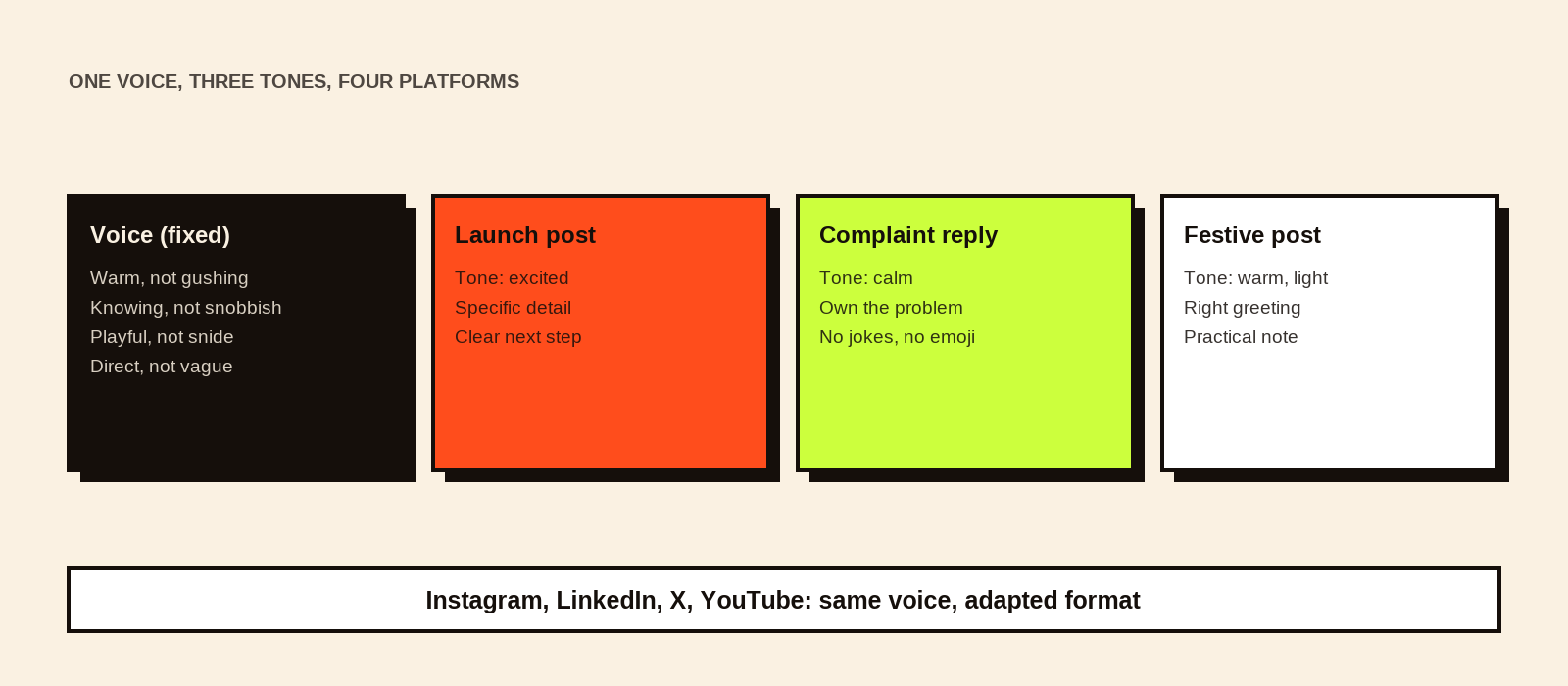
Scroll through most brand accounts and you can tell who wrote what. The Instagram captions are chirpy and full of emoji. The LinkedIn posts read like a press release. The reply to an angry customer sounds like a legal notice. Each one was written by a different person on a different day, and nobody had agreed how the brand is supposed to sound.
Quick answer
A consistent social media brand voice comes from writing down three to five voice attributes, each with a clear 'we are' and 'we are not', plus rules for vocabulary, emoji, slang and language mix. The voice stays fixed everywhere. The tone adjusts to the moment, such as a launch, a complaint or a festival, and the format adjusts to each platform. Put it on one page, use it in every brief and approval, and review it twice a year.
Voice versus tone: the difference that matters
Voice is who the brand is. It doesn't change between a product launch and an apology. Tone is how that same personality responds to a situation. A friend with a dry sense of humour doesn't crack jokes at a funeral, but you still recognise them. Brands get into trouble when they treat tone as voice and turn the jokes up everywhere, or treat voice as optional and let every writer improvise.
Platform is a third layer. It changes length, structure and how much context you give, not who you are.
Build the voice framework
1. Voice attributes with 'we are' and 'we are not'
Pick three to five adjectives, then pin each one down with what it rules out. 'Friendly' on its own means nothing; every brand thinks it is friendly. The 'we are not' column is what stops a writer drifting. Here is an example for a hypothetical Bengaluru coffee brand, which we'll call Brewline.
| Attribute | We are | We are not | In practice |
|---|---|---|---|
| Warm | Welcoming, generous with help | Gushing or over-familiar | We thank people by name; we don't call everyone 'fam' |
| Knowledgeable | Clear about how coffee is grown and brewed | Snobbish or full of jargon | We explain 'single origin' once, simply, then use it |
| Light-hearted | Playful about our own coffee habit | Sarcastic, or joking at customers | Jokes are about us or coffee, never the person asking |
| Straightforward | Direct about prices, delays and fixes | Vague or defensive | We say what went wrong and what happens next |
2. Vocabulary
- Words we use: the product names exactly as written on pack, two or three signature phrases, and the plain word for things ('order', not 'purchase journey').
- Words we avoid: superlatives we can't prove ('best', 'No. 1'), health or results claims the legal or regulatory team hasn't cleared, and internal jargon customers wouldn't use.
- Style: Indian English spellings, how we write prices (₹499, not Rs. 499/-) and the brand name.
3. Emoji and slang rules
- A short approved emoji set, usually three to six, and where they go (end of a line, not mid-sentence).
- No emoji in complaint replies, safety notices or anything about money owed.
- Slang only if your customers already use it and the writer genuinely understands it. If you have to look it up, leave it out.
- No meme formats that mock a group, region or religion.
4. Hinglish and regional language rules
In India this is where voice guides most often fall silent. Decide it explicitly.
- Where Hinglish is allowed (for example, Instagram captions and Stories) and where it isn't (LinkedIn, formal announcements, anything legal).
- Script: Hinglish in Roman script, or Devanagari? Pick one per platform so the feed doesn't look like two brands.
- Regional languages: which ones, for which audiences, and who checks them. A native speaker on your side should approve every regional post; machine translation alone misses tone.
- Replies: answer in the language the customer used where your team can do so accurately, otherwise reply in English and say so politely.
- Festive greetings: name the festival correctly, use the region's own greeting, and don't assume one festival is celebrated everywhere in the same way.
If regional content is a big part of your plan, regional and vernacular influencer marketing in India covers how language choices change by audience.
One message, three tones
Here is the same hypothetical Brewline voice in three situations.
Launch post (tone: excited, still clear)
Our first cold brew concentrate is here. Steeped for 18 hours, it's smooth enough to drink black and strong enough to stand up to milk. One bottle makes about eight glasses. Pour, top up, done. Available on our website from today.
Complaint reply (tone: calm, accountable, no jokes)
Hi Priya, we're sorry your order arrived with a broken seal. That shouldn't happen. Please DM us your order number and we'll sort out a replacement today. We're also checking the batch with our packing team.
Festive post (tone: warm, light)
Happy Diwali from all of us at Brewline. May your homes be bright, your sweets plentiful and your coffee strong enough for the late-night card games. We're closed on Diwali day and back the morning after.
What stays the same: plain sentences, a specific detail, no exaggeration, a practical next step. What changes: energy, humour and how much the brand talks about itself.
Adapting the voice by platform
The table below uses two hypothetical brands, Brewline (consumer) and a B2B payroll software company we'll call Ledgerly, to show how the voice flexes without breaking.
| Platform | What changes | Brewline (consumer) | Ledgerly (B2B) |
|---|---|---|---|
| Short first line; the visual carries the story; Hinglish if allowed | A playful hook, two lines of detail, one emoji | Behind-the-scenes of the team, light and human | |
| Longer, more context, fewer jokes, no slang | Sourcing stories, farmer partnerships, hiring | Payroll compliance explainers in plain English | |
| X | One idea per post; quick replies; wit only if it's natural | Short coffee observations, fast service replies | Product updates and short answers to questions |
| YouTube | Titles and descriptions searchable and literal; voice comes through on screen | 'How to make cold brew at home' style titles | Walkthrough titles that say exactly what's covered |
Copy that changes shape by platform while sounding like one brand is most of what social media copywriting involves day to day. When you reuse one idea across platforms, how to repurpose social media content for different platforms covers the formats in more detail.
A one-page voice guide template
Keep it to one page. A long brand book gets opened once; a single page gets pinned next to the content calendar.
BRAND: [name]          OWNER OF THIS GUIDE: [name, role]          LAST REVIEWED: [month, year]

WHO WE TALK TO
[One or two sentences on the main audience and how they speak.]

VOICE ATTRIBUTES
1. [Attribute]: we are [...]; we are not [...]
2. [Attribute]: we are [...]; we are not [...]
3. [Attribute]: we are [...]; we are not [...]

TONE BY SITUATION
Launch: [...]   Everyday post: [...]   Complaint reply: [...]   Festive: [...]   Sensitive news: [...]

VOCABULARY
We say: [...]
We never say: [...]
Claims needing approval: [...]

EMOJI AND SLANG
Approved emoji: [...]   Never in: [complaints, safety, payments]
Slang: [allowed / not allowed, examples]

LANGUAGE
Hinglish: [platforms allowed] in [Roman / Devanagari]
Regional languages: [which, for whom, who approves]
Replies: [match the customer's language where possible]

PLATFORM NOTES
Instagram: [...]  LinkedIn: [...]  X: [...]  YouTube: [...]

CREATOR AND UGC CONTENT
[How we caption, credit and reply around creator posts on our feed]

ESCALATE, DON'T REPLY
[Topics that go to a named person before anyone responds]
When creators and UGC appear on your feed
Creator and customer content is meant to sound like the creator, not like you. Rewriting a creator's script into brand voice usually makes it less believable. The voice guide still applies to everything around that content.
- The caption you write when you share or repost creator content is in your voice. The creator's words in the video stay theirs.
- Comment replies under collaboration posts are in your voice, even when the creator's audience is chattier than yours.
- Brief creators on what to avoid (claims, competitor digs, sensitive topics), not on how to talk.
- Keep disclosure intact. If the content came from a paid or gifted collaboration, it needs a clear label, and stripping it when you repost is a problem.
- Only reuse creator or customer content you have the rights to, for the platforms and period agreed.
If you commission UGC specifically for your feed, brief it with the voice guide attached so the creator knows the boundaries. A UGC content production team can then match edits and captions to your feed without flattening the creator's style.
Disclosure labels for paid or gifted content are set out in ASCI's influencer advertising guidelines. Before reposting anything a creator or customer made, check UGC content usage rights. For the briefing side, how to maintain brand consistency across influencer content goes deeper.
Keeping it consistent month after month
- Attach the one-page guide to every content brief, agency or in-house.
- Add one line to your approval checklist: 'Does this sound like us?' Reviewers should point to the attribute it breaks, not just say 'doesn't feel right'.
- Keep a swipe file of ten posts and five replies that are exactly right. New writers learn faster from examples than from adjectives.
- Write saved replies, in voice, for the most common comments and DMs.
- Review the guide every six months. Add new words, retire phrases that have gone stale, and note anything that caused confusion.
- Name one owner. When two senior people disagree about tone, someone needs the final say.
If you're setting up the approval step itself, the social media approval process explains who should sign off and when.
Common mistakes
- Adjectives with no 'we are not'. 'Bold, fun, authentic' describes every brand and guides nobody.
- Jokes in complaint replies. Humour reads as dismissive when someone is upset.
- Ignoring language. A guide written only for English leaves every Hinglish or regional caption to guesswork.
- Forcing creators into brand voice. It makes creator content sound like an ad and defeats the point of using creators.
- Writing the guide once and filing it. A voice guide that nobody opens is not a voice guide.
Where to start
Pull your last 30 posts and 20 replies, mark the ones that sound most like the brand you want to be, and write the attributes from those. Then draft the one-page guide, test it by having two people write the same launch post, and fix whatever they interpreted differently.
Brand voice and communication guidelines are part of the strategy work in Kudozz's social media management, but the guide only works if your own team uses it too.