The Social Media Approval Process: How Brands Can Publish Content Without Delays
Most social calendars slip at the approval stage, not the creative one. A three-stage approval workflow, who signs off on what, turnaround times we recommend, how to handle regulated claims and reactive posts, and how to cut revision rounds.
A Diwali carousel is designed on the 20th of the month. The marketing manager approves it, the founder asks for a different headline, the product team wants a disclaimer, and the founder's partner sees it at dinner and suggests new colours. It finally goes live two days after Diwali. Nobody was wrong to have an opinion; there just wasn't an approval process that said whose opinion counted, and when.
Quick answer
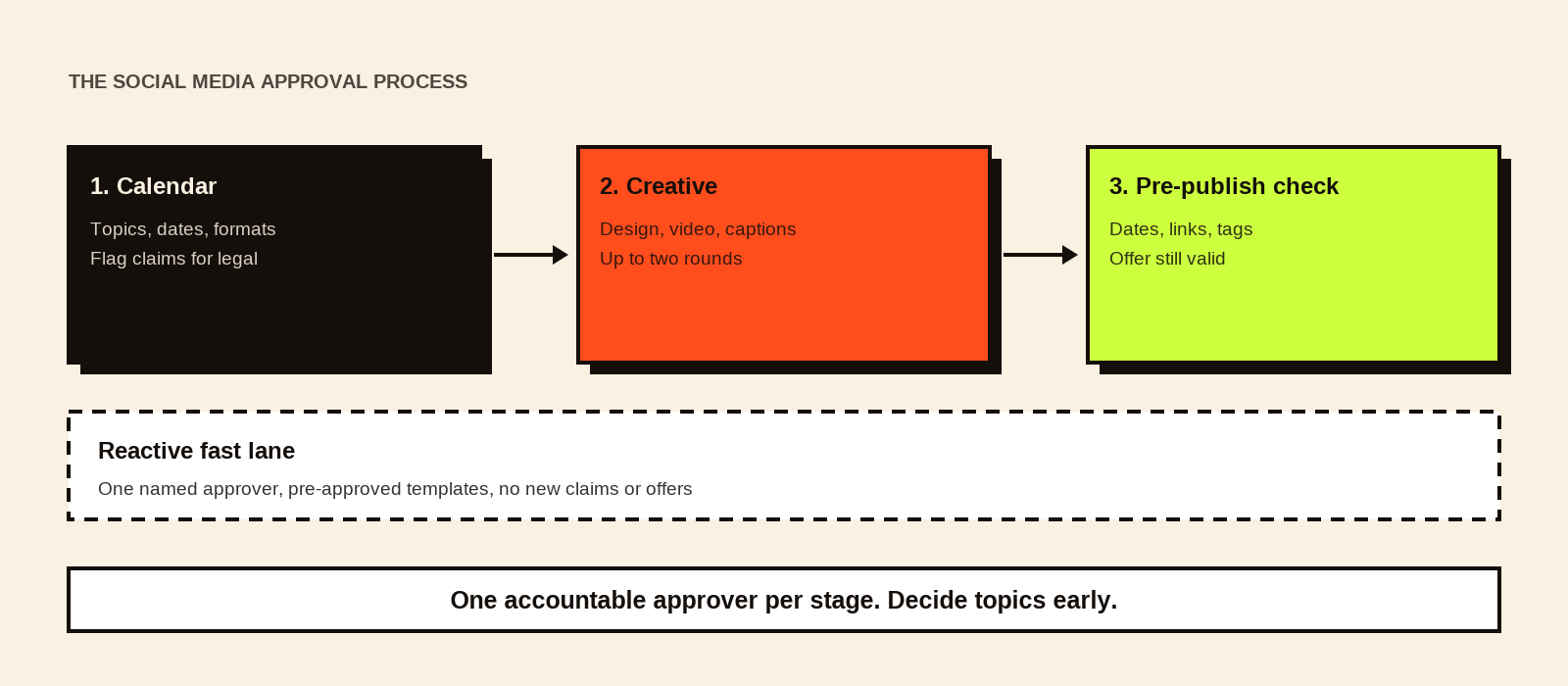
A good social media approval process has three stages: approve the monthly calendar (topics and dates), approve the creatives (design, video and captions) and run a final pre-publish check. Name one approver per stage with a backup, set turnaround times, send anything with regulated claims to legal at the calendar stage, and keep a separate fast lane for reactive posts. Fewer approvers and earlier feedback mean fewer revision rounds.
Why approvals are where calendars slip
Creating a post takes hours. Getting it approved can take weeks, because approvers are busy senior people who see content one piece at a time with no context. When feedback arrives late, it's usually about strategy ("should we even post this?") rather than detail, which means rework. A clear process moves the big decisions earlier, when changing them is cheap.
This guide is about brand-owned content on your own accounts. Creator content has different rules around creative freedom and usage rights; for that, see the creator content approval process.
A sample approval workflow in three stages
Stage 1: Calendar approval
The approver sees the whole month at once: dates, platforms, formats, topics, the purpose of each post and draft hooks. This is where you say "no" to a topic, move a launch date or flag that a post needs legal review. It's the most important stage, and the one most often skipped.
Stage 2: Creative approval
The finished designs, videos and captions are shared in batches, ideally a week or two at a time. Feedback here should be about execution: is the visual on brand, is the copy accurate, is the product shown correctly. If someone wants to change the topic at this stage, that's a sign stage 1 didn't happen properly.
Stage 3: Final pre-publish check
A short check before scheduling, usually done by the agency or social lead rather than the senior approver: correct dates and prices, working links, tags and mentions, spelling, alt text, platform formatting, disclosure labels where relevant, and that nothing has changed (an offer ending early, a product out of stock).
Roles, responsibilities and turnaround times
Who does what
A simple RACI table settles who does what. R is responsible for doing the work, A is accountable for the final decision, C is consulted and I is informed.
| Task | Agency or social team | Marketing lead | Founder or head | Legal or compliance | Product or sales |
|---|---|---|---|---|---|
| Draft monthly calendar | R | A | I | C (flagged posts only) | C |
| Approve calendar | I | A | C (big launches only) | C (flagged posts only) | I |
| Create designs, video and copy | R | I | I | I | C (product facts) |
| Approve creatives | R | A | I | C (claims posts) | C (accuracy) |
| Approve regulated claims | I | R | I | A | C |
| Pre-publish check | R | A | I | I | I |
| Reactive or real-time posts | R | A | I | C (if sensitive) | I |
The key rule: only one A per row. If the founder wants to be accountable for every creative, make it explicit and plan turnaround times around their availability, rather than adding them as an unofficial second approver.
Turnaround times we recommend
These are the timings we suggest to brands, not industry benchmarks. Adjust them to your team's size and how far ahead you plan.
| Stage | Shared by | Approver responds within | Revision rounds included |
|---|---|---|---|
| Calendar approval | Around the 15th to 20th of the previous month | 3 working days | 1 |
| Creative approval | In weekly or fortnightly batches, at least 7 days before posting | 2 working days | Up to 2 |
| Legal or compliance review | At calendar stage for flagged posts | Agreed with legal; often 3 to 5 working days | As needed |
| Final pre-publish check | 24 to 48 hours before posting | Same day | Fixes only |
| Reactive post | As soon as drafted | 2 to 4 hours | 1 |
Agree what happens if the approver doesn't respond in time. Common options are that the post moves to the next slot, or that the backup approver decides. "Silence means approved" is risky for anything with claims, so keep it for low-risk posts if you use it at all.
Regulated claims and legal review
If you sell anything related to health, nutrition, skincare, finance, insurance, education or children, some posts need legal or compliance review. The ASCI Code requires advertising to be truthful and claims of objectively ascertainable fact to be capable of substantiation. Sector regulators can add their own rules. The agency shouldn't be the one deciding what's acceptable; it should be working from a list your legal team has approved.
- Keep a pre-approved claims library: statements legal has signed off, with the evidence behind each.
- Flag claims posts at the calendar stage, so legal sees them early rather than the night before.
- Treat any new claim, statistic or comparison as needing review, even in a caption.
- Write disclaimers once, get them approved and reuse them exactly.
- Keep a record of who approved what and when, in case questions come up later.
For health and wellness brands specifically, influencer marketing for healthcare and wellness brands covers some of the category-specific care needed, much of which applies to your own posts too.
Approving real-time and reactive content
A cricket win, a viral trend or a news moment won't wait three working days. Set up a fast lane in advance instead of skipping approval.
- Agree topics that are always off-limits: tragedies, politics, religion, competitor attacks, or whatever fits your brand.
- Name one person who can approve reactive posts quickly, with a backup.
- Keep pre-approved templates and visual styles, so only the copy needs checking.
- Never use reactive posts for product claims, prices or offers that haven't been through the normal process.
- If in doubt, don't post. Missing a trend costs very little.
If a reactive post or anything else goes wrong publicly, that's a different process. A social media crisis response plan covers severity levels and escalation.
Approval tools, in general terms
You don't need specialist software to run a good approval process, but you do need everything in one place. Options range from a shared spreadsheet calendar with comments, to project management boards, to social media management tools with built-in approval steps. Whatever you use, check that it shows the post exactly as it will appear (with caption), keeps comments attached to the right version, records who approved and when, and sends reminders. Avoid approvals scattered across WhatsApp, email and calls, because feedback gets lost and nobody knows which version is final.
How to cut revision rounds
- Approve the calendar properly, so topics aren't questioned at creative stage.
- Consolidate feedback: one person collects comments and sends one list.
- Make feedback specific: "headline too long, try under eight words" instead of "doesn't feel right".
- Separate preferences from errors; fix errors always, discuss preferences at the monthly review.
- Keep a short brand voice and visual reference so recurring feedback is written down once.
- Review in batches rather than one post at a time.
Approvals are one part of the larger production pipeline; building a repeatable social media content workflow shows where they sit between planning, production and publishing.
Common mistakes
- Skipping calendar approval and going straight to finished creatives.
- Adding approvers without telling anyone, so feedback arrives from new people late in the process.
- Sending legal the post the day before it goes live.
- Approving visuals without reading the caption.
- Treating every post as high-risk, so simple posts wait as long as claims posts.
- No rule for what happens when an approver is on leave.
Practical recommendations
- Write your three stages, approvers and turnaround times on one page and share it with everyone involved.
- Split posts into low-risk and claims-related, with different approval paths.
- Build a pre-approved claims and disclaimer library with legal.
- Review the approval process itself every quarter: where did posts wait, and why?
- If an agency runs your social media, agree the approval process during onboarding, not after the first late post.
Recurring feedback about tone usually means the brand voice was never written down; our guide to a consistent social media brand voice helps fix that at source. In a managed social media service, content is shared for approval before anything goes live, so the stages above slot straight into onboarding.
Where to start
Start by naming one approver and one backup for each stage, then move the big decisions to calendar approval. Add a claims path for anything regulated and a fast lane for reactive posts. Most delays disappear once everyone knows when their input is needed and when it's too late to change the topic.