Social Media Community Management vs Customer Support: Where Should Brands Draw the Line?
Comments and DMs mix praise, product questions, order complaints and the odd legal threat. Here is how to split community management from customer support, with an escalation matrix, sample replies, handover rules and a community guidelines template.
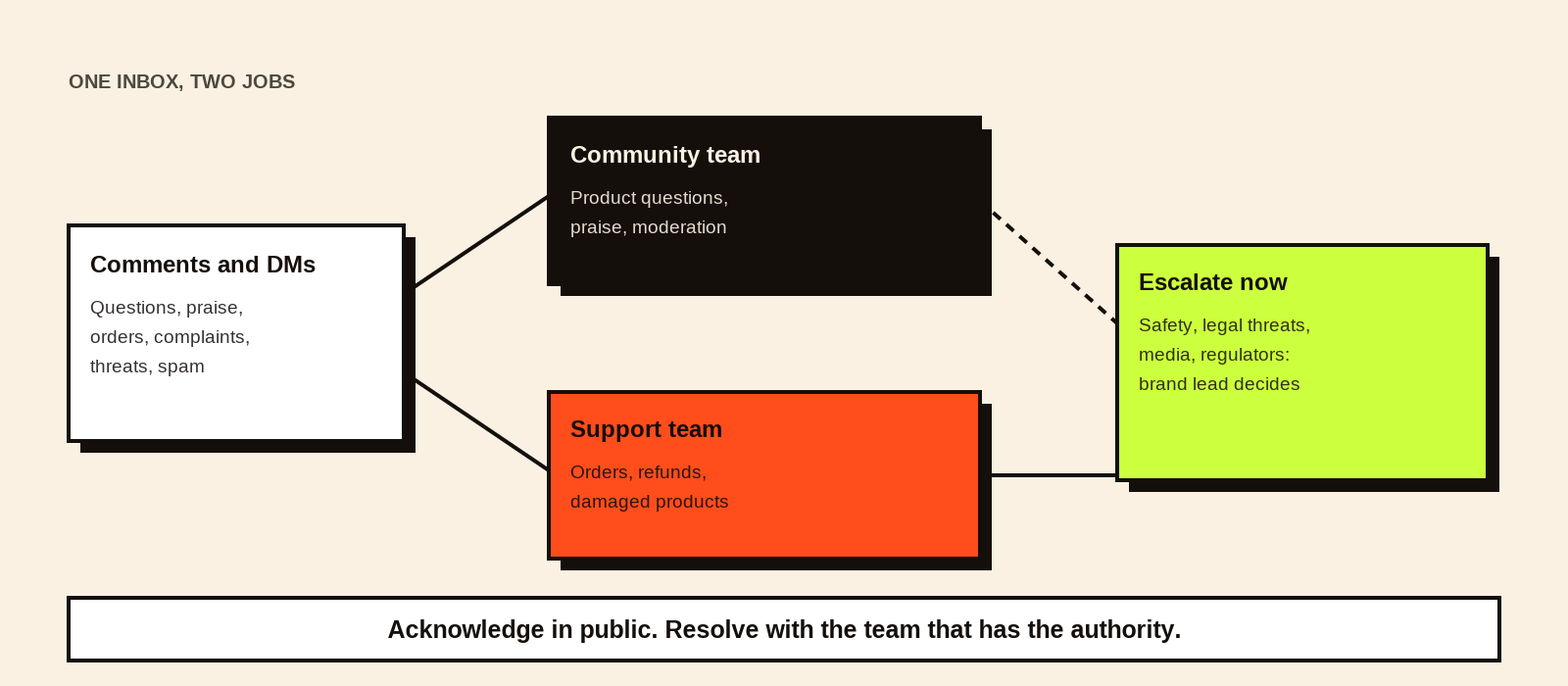
A new Reel is doing well. Under it, one person asks which shade suits oily skin, another says their order hasn't arrived in nine days, a third posts a photo of a damaged parcel, and someone in the DMs says they'll be speaking to a consumer forum. All four land in the same inbox, and the person replying is usually whoever runs the brand's Instagram. That's where the confusion between community management and customer support begins.
Quick answer
Community management keeps public conversations healthy: answering general questions, thanking people, steering discussion and enforcing your guidelines. Customer support resolves an individual's problem: orders, refunds, faults and complaints, usually with access to order systems. Draw the line at anything that needs account details, a decision about money, or legal or medical judgement. The social team acknowledges it publicly and hands it to support with a clear owner and timeline.
Two different jobs that share an inbox
Both jobs happen in comments and DMs, so brands often treat them as one. They need different skills, systems and authority. A community manager knows the brand voice and the content calendar. A support agent knows the returns policy and can look up an order or approve a replacement.
| Community management | Customer support | |
|---|---|---|
| Goal | Healthy, on-brand public conversation | Resolve one person's problem |
| Usual owner | Social media team or agency | Brand's support or customer experience team |
| Channels | Comments, mentions, Story replies, general DMs | DMs moved to support, email, phone, WhatsApp, helpdesk |
| Response expectation | Within agreed working hours, set in the scope | Set by your support policy, often with tracked tickets |
| Tools | Platform inboxes, scheduling and social inbox tools | Helpdesk or CRM, order management system |
| Skills | Brand voice, judgement, moderation, content knowledge | Policy knowledge, problem solving, system access |
| Metrics | Response coverage, sentiment trends, recurring questions | Resolution time, first-contact resolution, satisfaction |
If you work with an agency, check what you've actually bought. Kudozz's social media management, for example, includes comment monitoring, routine replies and escalation of sensitive queries within agreed hours, while customer support, complaint resolution and 24/7 moderation are separate requirements written into scope only if agreed. Our community management scope sets this out.
An escalation matrix for comments and DMs
The timelines below are what we'd recommend for a brand with a staffed support team during business hours. Adjust them to your capacity.
| Comment or DM type | Who handles | Response approach | Recommended timeline |
|---|---|---|---|
| Praise, tags, general reactions | Social team | Reply or like where it adds something; don't reply to everything | Same working day |
| Product questions (shade, size, usage) | Social team, using an approved FAQ | Answer publicly so others benefit | Same working day |
| Order status, delivery, payment | Support team | Social team acknowledges publicly, moves to DM or support channel | Acknowledge within working hours; support owns resolution |
| Refund, return or damaged product | Support team | Acknowledge, apologise for the experience, hand over with details | Acknowledge same day; support follows its policy |
| Product safety, allergic reaction, injury | Support plus brand lead; legal or quality if needed | Short, caring acknowledgement; no admission or diagnosis | Escalate immediately |
| Legal threats, consumer forum, regulator mentions | Brand lead and legal | Hold public reply until approved | Escalate immediately |
| Media or journalist enquiries | Brand lead or PR | Do not answer on social; route to PR contact | Escalate same day |
| Spam, scams, impersonation | Social team | Hide or delete, report, warn followers if widespread | As soon as seen |
| Abuse, hate speech, threats | Social team; brand lead if credible threat | Hide or delete, block, report; record evidence | As soon as seen |
When several escalations about the same issue arrive in a short time, you may have more than a support problem. That's the point to switch to your crisis process, covered in how to build a social media crisis response plan.
Sample responses for common scenarios
Hypothetical examples for a fictional skincare brand. Rewrite them in your voice and keep them in a shared response library.
- Product question: "Great question! For oily skin, most people go with the Gel version. If you're between shades, the Light Beige is the closer match for warm undertones. Happy to help in DMs if you want to share a photo."
- Late order (public): "So sorry it's taking this long. Could you DM us your order number? Our support team will check it and get back to you today."
- Damaged product: "That's not how it should arrive, and we're sorry. Please DM us your order number and a photo, and our support team will sort out the next step."
- Possible reaction: "We're sorry to hear this and want to understand what happened. Please stop using the product and DM us so our team can contact you directly."
- Unfair criticism: "We hear you. The price reflects the ingredients we use, and we know it isn't for everyone. If you'd like a smaller size to try first, the 30 ml is on our site."
- Competitor comparison: "We'll let you decide which suits you best. Here's what's in ours, and our team is around if you have questions."
- Legal threat: no public reply until the brand lead approves one. Internally: log it, screenshot it and escalate immediately.
- Spam or fake giveaway: hide the comment and post a short pinned note if it's widespread: "We only run giveaways from this account. We never ask for payment or card details."
Handover rules between the agency and your support team
Most failures happen at the handover, not in the reply. Agree these rules before the first post goes live.
- One named support contact and a backup, with the hours they cover.
- One channel for handovers: a shared helpdesk queue, a tagged inbox view or a dedicated chat group. Not personal WhatsApp.
- A handover note template: platform, link to the comment or DM, customer handle, issue type and what was already said publicly.
- Who replies after handover. Usually support takes over the DM; the social team doesn't keep a parallel thread going.
- A loop back. Support tells the social team when the case is closed, so a public thread can be updated if it's still visible.
- Out-of-hours wording agreed in advance, so a 10 pm complaint gets a holding reply that doesn't promise what nobody can deliver.
- Weekly review of escalations, to spot repeat issues.
Hide, delete or block: a moderation policy
Write down when the team hides, deletes or blocks. It protects the team from second-guessing and protects the brand from looking like it silences criticism. Platform behaviour matters here. At the time of writing, Facebook's help centre says a hidden comment on a Page stays visible to the person who wrote it and their friends, and Instagram's Hidden Words settings can filter comments with offensive terms automatically.
| Action | Use for | Don't use for |
|---|---|---|
| Reply and leave visible | Honest complaints, criticism, product questions | Personal data, abuse |
| Hide | Spam, off-topic promotion, comments containing personal details | Negative but fair feedback |
| Delete | Scams, hate speech, explicit content, doxxing | Complaints you'd rather not see |
| Block or restrict | Repeat abusers, bots, impersonators | Unhappy customers with a genuine issue |
| Report to the platform | Impersonation, threats, scams | Disagreements |
Screenshot anything that might matter later, such as a threat, before deleting it. Hiding a fair complaint usually costs more trust than answering it.
Data privacy when you move conversations to DMs
Moving a complaint to DMs is right because it keeps order numbers, phone numbers and addresses out of public view. It also means your social team is now handling personal data. India's Digital Personal Data Protection Act, 2023 and the DPDP Rules, notified in November 2025, are being phased in over eighteen months, according to the government's PIB backgrounder, and they rest on principles such as purpose limitation, data minimisation and security safeguards. Check your current obligations with counsel; in practice:
- Ask only for what support needs: usually an order number, not a full address and phone number.
- If someone posts personal details in a public comment, hide it and ask them to share in DMs instead.
- Don't copy customer details into spreadsheets, personal phones or chat groups outside the agreed handover channel.
- Give agency staff the minimum account access they need, and remove it when people leave.
- Agree in writing who deletes DM data and when, and how a customer request to delete their data is handled.
For the wider picture on audience and creator data, see influencer marketing data privacy in India.
A community guidelines template
Publish short guidelines on your website or in a highlight, and link to them when you remove something.
[Brand] community guidelines

We want this to be a useful, friendly place to talk about [category]. To keep it that way:

1. Be respectful. Disagree with us or each other, but no abuse, hate speech, threats or harassment.
2. Keep personal details private. Don't post phone numbers, addresses or order details in comments. DM us instead.
3. No spam or scams. We'll remove promotional links, fake giveaways and impersonation accounts.
4. Order and refund help: for anything about an order, DM us your order number or contact [support email / WhatsApp]. Our support team replies [support hours].
5. When we reply: we monitor comments and messages [days and hours]. Messages outside these hours are answered the next working day.
6. What we may remove: comments that break these rules may be hidden or deleted, and repeat offenders may be blocked or reported. We won't remove honest feedback because it's negative.
7. Health and safety: if you've had a reaction or a safety concern, stop using the product and contact [support channel] so we can follow up directly.

Last updated: [date]
Common mistakes
- Letting the social team promise refunds or replacements they can't authorise.
- Saying "we've sent you a DM" when nobody has.
- Deleting criticism, then being called out for it in screenshots.
- Answering medical, legal or safety questions in public comments without sign-off.
- No written hours, so customers expect instant replies at midnight.
- Treating comments on creators' campaign posts as the same job; those need their own plan.
If creators are part of your mix, the comment plan for their posts is set out in who owns the comments during influencer campaigns.
Where to start
Pull the last month of comments and DMs and sort them into the escalation matrix categories. You'll quickly see how much is community and how much is support. Then name owners, agree the handover channel and publish your guidelines.
Write the boundary into your agency agreement, and keep the response library in the same voice as your posts; the social media brand voice guide covers how.