Social Media Management for Clinics: How to Educate Patients and Build Trust Online
How a doctor-led clinic in India can run its social accounts under the NMC's October 2026 advertising guidelines: patient education, doctor details, appointments, privacy, reviews and a pre-publish approval checklist.
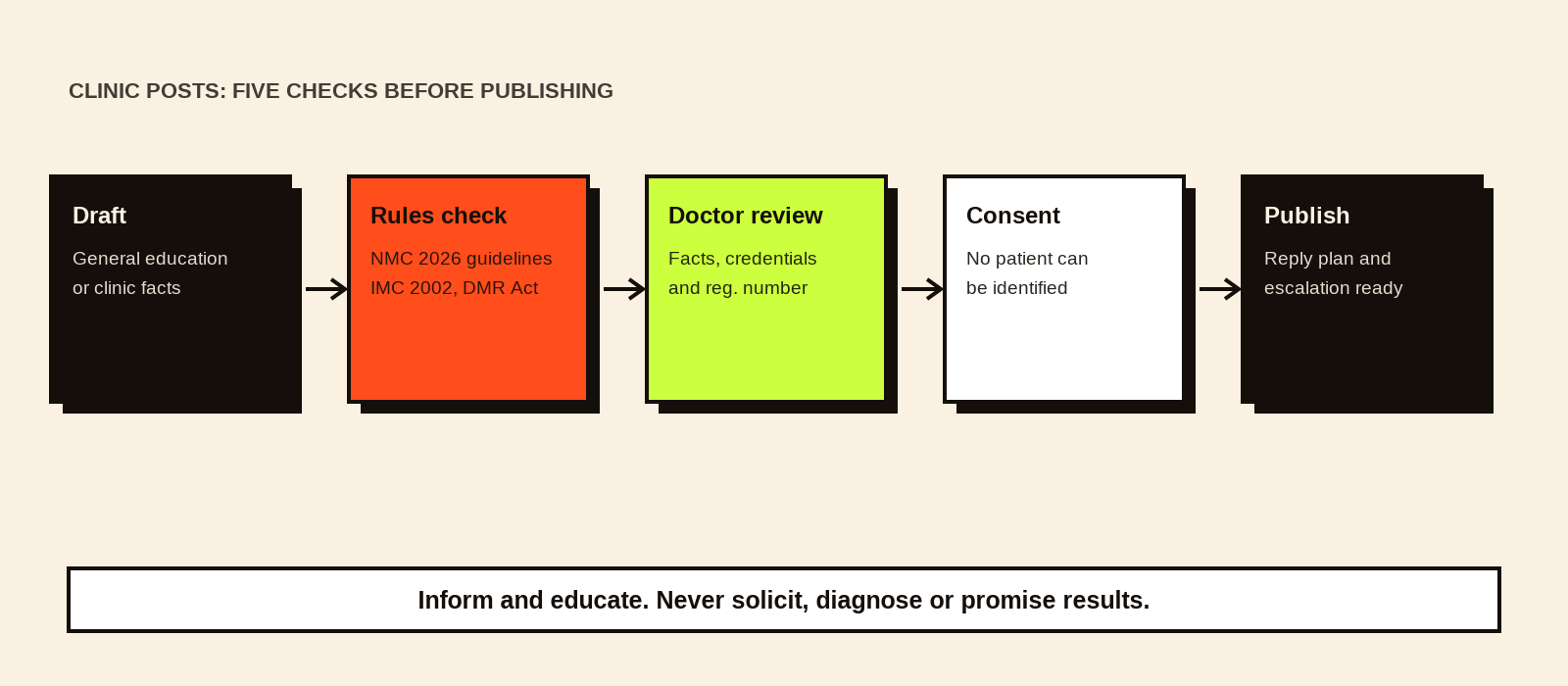
At 10 pm a patient's daughter messages your clinic's Instagram account: her father's sugar reading is high, should she give him an extra tablet? The same week, the receptionist suggests reposting a grateful patient's Google review, and a freelancer pitches a 'Best Diabetologist in the City' Reel. Each of these needs a different answer, and for doctors in India the rules behind those answers were rewritten in October 2026.
Quick answer
Social media management for clinics in India means publishing factual clinic information and general, doctor-reviewed health education, never personal advice or self-promotion. The National Medical Commission's guidelines of 6 October 2026 restrict soliciting patients, superlatives, success rates, before-and-after images and sharing patient testimonials, and ask doctors to show their qualifications and registration number on posts. The doctor approves every post; an agency plans, designs and publishes.
The rules that apply, as of November 2026
This is orientation, not legal advice. Your State Medical Council, professional body or legal team has the final word on any post you are unsure about.
| Rule | Status (checked November 2026) | What it means for a clinic's posts |
|---|---|---|
| NMC Guidelines on Ethical Advertising and Public Communication (No. R-13014/01/2024-Ethics) | Issued 6 October 2026; in force immediately. No clarification or withdrawal listed on the NMC site at the time of writing | Treats social, influencer, search, WhatsApp and AI-assisted promotion as advertising; allows factual information and education |
| Indian Medical Council (Professional Conduct, Etiquette and Ethics) Regulations, 2002 | The 2026 guidelines say they are to be read with these Regulations (clause 4.2) | Clause 6.1.1 calls soliciting patients unethical and limits announcements to set events, such as starting practice |
| NMC Registered Medical Practitioner (Professional Conduct) Regulations, 2023 | Dated 2 August 2023; kept in abeyance by an amendment dated 23 August 2023, still listed that way by the NMC | Don't base your policy on them; watch for any later notification |
| Drugs and Magic Remedies (Objectionable Advertisements) Act, 1954 | Administered by State Governments (Ministry of Health, March 2022) | No advertisement suggesting a drug for diagnosing, curing, treating or preventing the conditions in its Schedule |
| ASCI Code | Self-regulatory code for advertising | Claims must be capable of substantiation; special care in ads addressed to people with illness |
Sources: the NMC's guidelines of 6 October 2026, the 2002 Regulations and the NMC regulations page, the Ministry of Health's description of the 1954 Act (PIB, 25 March 2022), and the ASCI Code.
Two clauses matter for anyone who helps a clinic run its accounts. Clause 4.4 says publishing through an agency, influencer or platform does not absolve a doctor or clinic of responsibility for content it authorised or knowingly permitted. Clause 8.1(ii) lists engaging 'any third party for marketing medical services' among the practices doctors must avoid, while clause 8.1(viii) says the engagement of advertising and digital marketing agencies must not be structured so that payment is linked to procuring or referring individual patients. How those two clauses apply to outside help with factual and educational posting is a question to put to your State Medical Council or legal team before you sign anything.
The NMC rules cover registered medical practitioners and hospitals or medical institutions. Dentists and AYUSH practitioners answer to their own commissions and codes: our guide to marketing for dental clinics and oral-care brands covers the National Dental Commission's October 2026 advisory, though it is written about creator campaigns rather than a clinic's own accounts.
What a clinic can post
The useful test comes from the guidelines themselves: is this factual, verifiable information that helps a patient, or is it promoting the doctor's skill, results or reputation? The first kind is the backbone of a clinic feed.
| Content type | What it looks like | Where the line is |
|---|---|---|
| Patient education | General explainers on conditions, prevention, screening and when to see a doctor | Reviewed by the doctor; no diagnosis, no fear-based hooks, no promotion of the practice (clauses 5.1 and 8.1(i)) |
| Clinic information | Address, timings, how to book, languages spoken, accessibility, what to bring | Factual and verifiable. Any fees or packages must be stated transparently and not mislead |
| Doctor details | Name, recognised qualifications, specialty, registration number, consultation days | No 'best', 'No.1', 'top' or 'most trusted' claims, no achievement reels |
| Announcements | Starting practice, new address, temporary absence, resumption, change of practice type, declared charges | Keep to the events the 2002 Regulations (6.1.1) and the 2026 guidelines (8.2) list |
| Process FAQs | How to prepare for a test, insurance paperwork, follow-up booking | Process questions only; personal medical questions go to a consultation |
| Community awareness | Government health campaigns, national health days, public screening drives | Government programme campaigns are exempt (clause 7.3); your own camps must not become inducements |
Patient education that stays general
Start each education post from a question patients genuinely ask, write it for a general reader, and have the doctor who will put their name to it check every sentence. Avoid hooks that create anxiety ('this symptom could mean something serious'), because clause 8.1(i) bars fear-based marketing and creating unnecessary demand for tests or procedures. End with a plain line such as 'This is general information, not medical advice. Please consult a doctor about your own situation.'
Doctor introductions
Under the explanations to clause 3.2, a doctor's own electronic posts should disclose their name, qualifications, registration status and SMR or NMR registration number, and a clinical establishment's posts should name the doctors involved with the same details. Clause 1.4.2 of the 2002 Regulations allows only recognised qualifications as suffixes, so copy credentials from the registration certificate. Clause 9.2 bars using a doctor's photograph where it amounts to self-advertisement or promotional publicity, so keep introductions factual and directory-style, and check any photo-led format with your adviser first.
Appointments and clinic information
Timings, holiday closures, booking links, directions and 'what to expect at your first visit' posts are low risk and genuinely useful, as long as they are kept current. Keep offers out: clause 8.1(x) bars discounts, limited-period offers, contests, coupons and free procedures used in a way likely to encourage unnecessary consultations or tests.
Reviews, testimonials and patient stories
This is the biggest change for clinics used to general marketing advice. Explanation V to clause 3.2 bars doctors and medical institutions from soliciting, buying or manipulating fake, paid or misleading reviews, ratings or testimonials, and says a doctor shall not request or share patient testimonials, recommendations or reviews for professional promotion on social media. Clause 8.1(v) rules out promotional case reports, surgical results, before-and-after photographs, celebrity patients and success stories, except strictly for scientific or educational purposes with anonymised patient consent. Clause 6.2 says consent alone does not make a prohibited testimonial acceptable.
- Don't repost reviews as social posts or run 'share your experience' campaigns.
- When replying to a public review, don't confirm the reviewer is a patient or discuss their care.
- Never buy followers, likes, reviews or comments, or manipulate search rankings (clause 8.1(xii)).
- Never use AI to create a patient's image, voice, testimonial or outcome (clause 7.2(b)).
- Health creators must state relevant qualifications upfront under ASCI's influencer guidelines (Addendum II, 6 March 2025).
Our guide to influencer marketing for healthcare brands covers creator campaigns, which are separate from the clinic's own feed.
Patient privacy and consent
Clause 6.1 of the 2026 guidelines says patient information, photographs, videos, records, clinical images and other identifiable details shall not be used for advertising unless the law permits it and the necessary consent and safeguards are in place. Where consent is legally required, clause 6.3 says it must be specific, informed, voluntary, documented and capable of verification. Clause 7.4 says doctors and clinical establishments shall not share patient data, such as names, faces or anomalies, that can identify someone publicly. The 2002 Regulations already required confidentiality (clauses 2.2 and 7.14) and barred publishing patient photographs or case reports in an identifiable way without permission (clause 7.17).
Health information is also personal data. The Digital Personal Data Protection Act, 2023 governs it, and the DPDP Rules were notified on 14 November 2025 with an eighteen-month phased compliance period, according to the PIB backgrounder of 17 November 2025. Clause 7.6 of the NMC guidelines says advertising that involves personal data must comply with the IT Act, the DPDP Act and the 2025 Rules. Ask your legal team which obligations already apply to your clinic.
- Shoot before opening hours or where no patient can be seen or heard.
- Keep screens, files, prescriptions and appointment boards out of every frame.
- Get written consent from staff who appear, and let them withdraw it.
- Don't feature identifiable patients in promotional content at all.
Comments and DMs: inform, never diagnose
Whoever manages the inbox must never diagnose, interpret reports, suggest medicines or change doses, even when the answer seems obvious. Route every clinical question to a consultation, keep personal details out of public replies, and escalate urgent symptoms: tell the person to seek emergency care now, and alert the doctor. Our guide to community management vs customer support explains how to split routine replies from issues that need the clinic team.
Thank you for asking. We can't advise on individual health questions over social media, because the doctor needs to understand your history first. Please call the clinic on [number] or book a consultation at [link]. If the symptoms are severe or sudden, please go to the nearest emergency department now.
Choosing platforms
Instagram and Facebook suit short education and updates for local patients, YouTube suits longer explainers people search for, and a phone or WhatsApp line handles bookings. Pick channels you can moderate daily. Our guide to choosing social media platforms by business model covers the trade-offs.
Who approves, and what an agency does
The doctor, or a named medical lead, approves every post, caption, reply template and Story before it goes live. Legal review is needed for anything new: a fee announcement, a health camp, a creator collaboration or a new format. An agency can plan, draft, design, edit footage the clinic supplies, schedule and moderate within an agreed scope. It does not replace the doctor's clinical judgement or legal advice, and its fee should never be tied to patients or bookings (clause 8.1(viii)). Our guide to the social media approval process covers stages and turnaround.
AI needs its own rule. Clause 7.2 prohibits AI-generated promotional campaigns for commercial interest and says any conforming AI-generated promotional content must carry a source mark stating it is AI-generated. A human should write and check every final version, and patient information never goes into an AI tool without legal sign-off.
Pre-publish medical content approval checklist
- Factual and verifiable, not promoting a doctor's skill, results or reputation.
- Health statements sourced, and the final version read by the doctor.
- General education with a 'not medical advice' line, not individual advice.
- Doctor's name, recognised qualifications, registration status and SMR/NMR number shown.
- No best, No.1, top, leading, guaranteed, painless, miracle or 100%.
- No success rates, patient numbers, before-and-after images or patient stories.
- No discounts, contests, free procedures or other inducements.
- No medicine reference suggesting treatment of a condition in the 1954 Act's Schedule.
- Documented consent for everyone in frame; no patient identifiable.
- AI-generated material marked, and none of it depicting patients.
- Reply plan ready, including the escalation route for medical questions.
Post ID and date:
Format and platform:
Drafted by:
Health facts checked against:
Doctor reviewer (name, registration no.):
Consent on file for people shown (Y/N, reference):
Legal or compliance review needed (Y/N, outcome):
Approved by and date:
Scheduled for:
Common mistakes
- Copying generic advice about testimonials and before-and-after posts into a clinic feed.
- Letting the receptionist or agency answer clinical questions in DMs.
- Listing credentials from memory instead of the registration certificate.
- Running 'free check-up this week only' posts.
- Paying a marketing partner per booking or per lead.
Where to start
Start with a correct profile with registration details, a timings and booking post, and a short series of doctor-reviewed answers to common patient questions. Agree the checklist and the medical-question reply before the first post. If you run a multi-department hospital rather than a clinic, our guide to hospital social media strategy covers governance at that scale.
Outside support such as Kudozz's covers planning, copy, design, publishing and community management within an agreed scope; for a clinic, all of that sits under the doctor's approval and does not replace medical or legal review.