How to Choose the Right Social Media Platforms Based on Your Business Model
A practical way to pick social media platforms by how your business sells: a platform matrix for D2C, B2B, local services, retail, education and high-consideration purchases, what each platform demands, and when to add or drop one.
A skincare founder hears that LinkedIn builds authority, a friend says Pinterest drives sales, and the intern wants to start a YouTube channel. Meanwhile the Instagram account, the one place customers actually ask questions, hasn't posted in three weeks. Most businesses don't struggle on social media because they chose the wrong platform. They struggle because they chose too many, for reasons that had nothing to do with how they sell.
Quick answer
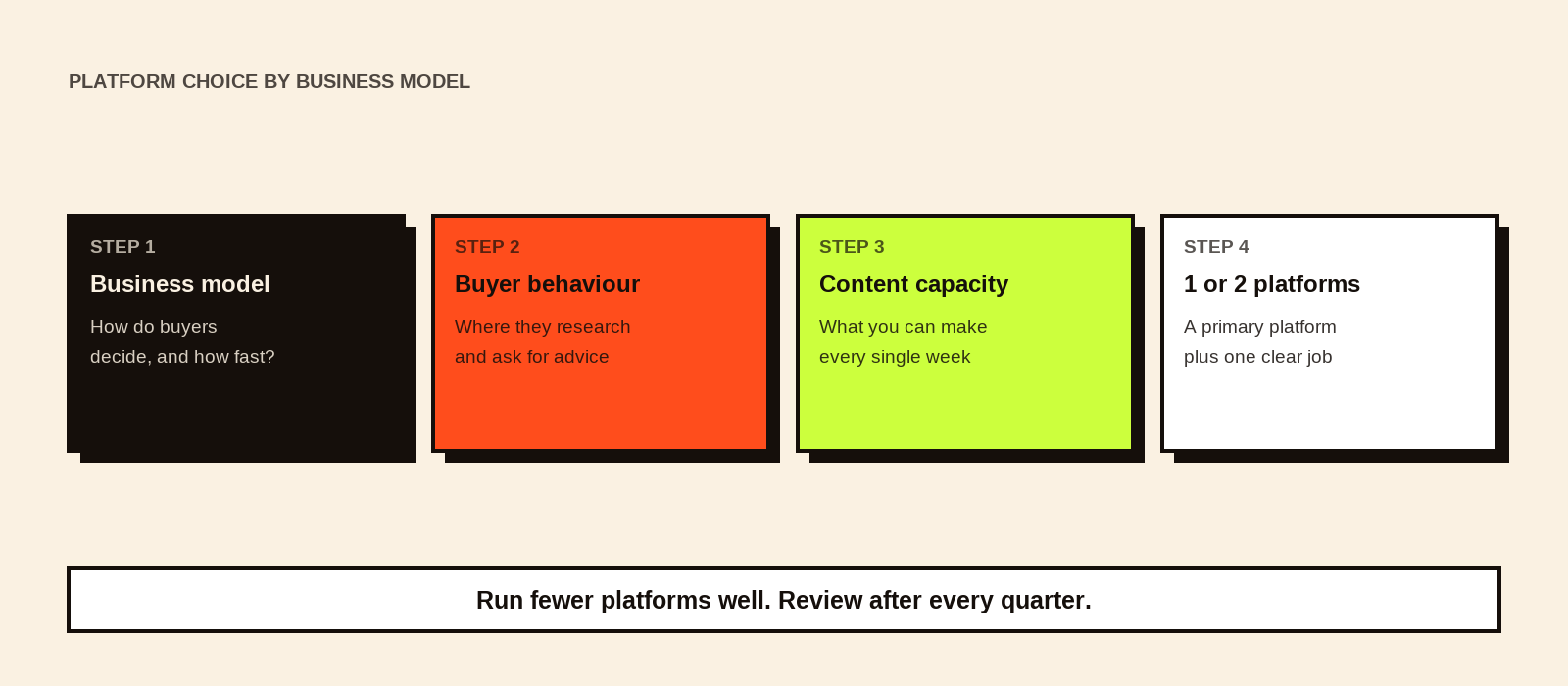
Choose platforms by working back from where your buyers make decisions, the content you can produce every week, and the job each platform must do. Most Indian consumer brands start with Instagram plus one more; B2B and SaaS companies start with LinkedIn; local services pair Instagram or Facebook with a Google Business Profile. Run one or two platforms well, review after a quarter, and add another only when the first ones are consistent.
Start with how you sell, not where everyone else is
Platform choice is usually framed as audience size: where are the most people? Almost every platform has your customers on it somewhere. The better question is where they are in a buying mood, and what they need to see before they buy.
A ₹499 snack is bought on impulse after a short video. A ₹15 lakh software contract is approved by three people who read, compare and ask peers over several months. A dental clinic is chosen by someone within a few kilometres who checks reviews and photos of the clinic. These are different decisions, and they happen in different places. Your business model tells you how long the decision takes, who makes it and what proof they need, and that narrows the platform list faster than any audience chart.
A platform selection matrix by business model
Use this as a starting point, not a rule. It reflects common practice for Indian businesses, and your own audience research or account data should override it.
| Business model | Usually start with | Add when ready | Usually lower priority | Why |
|---|---|---|---|---|
| D2C and e-commerce | YouTube for Shorts, reviews and how-tos; Pinterest for fashion, home, food and gifting | X, unless your buyers follow news or tech | Discovery, product education and creator content sit naturally on Instagram; YouTube catches people searching before they buy | |
| B2B and SaaS | LinkedIn, with the company page and one or two leadership profiles | YouTube for demos, webinars and explainers | Snapchat, Pinterest | Buyers research, compare and check credibility; expertise matters more than reach |
| Local services (clinics, salons, restaurants, gyms) | Instagram or Facebook, plus a Google Business Profile | WhatsApp Business for enquiries and repeat customers | LinkedIn, X | People choose by distance, reviews and seeing the place; most actions happen nearby |
| Multi-location retail | One strong Instagram brand account; Facebook where local communities are active | Location-level pages and store content, once you can run them | A separate account per store before anyone owns them | You need brand consistency plus a controlled way to show local stock, offers and events |
| Education (schools, coaching, edtech, colleges) | Instagram and YouTube | LinkedIn for higher education and professional courses; Facebook where parents decide | Students watch explainers and campus life; parents and working learners research for longer | |
| High-consideration purchases (real estate, cars, premium home, jewellery) | YouTube and Instagram | Pinterest for home and wedding categories; LinkedIn for premium B2B services | Platforms that reward daily trend posts you can't sustain | Long research cycles reward walkthroughs, comparisons and proof that stays findable |
Two notes on the matrix. First, a Google Business Profile isn't a social network, but for local businesses it's often where the decision ends, so it belongs in the same plan. Second, the matrix is about your own brand accounts. If you're choosing platforms for creator campaigns, the trade-offs are different, and our comparison of Instagram, YouTube and TikTok for creator campaigns covers that separately.
What each platform demands in content and time
The cost of a platform isn't the subscription or the ad budget. It's the content it needs every week and the people who have to be present to run it. Before you add a platform, check that you can feed it.
| Platform | What it tends to reward | Content demand | Hidden time cost |
|---|---|---|---|
| Reels, carousels, Stories and a recognisable look | High: short video plus static posts and Stories | Replying to comments and DMs, which buyers expect to be quick | |
| Community, local groups, events and video | Moderate; some content can be adapted from Instagram | Moderating comments and answering detailed questions | |
| A clear point of view, expertise and people-led posts | Moderate: fewer, stronger posts | Founder or leadership time to approve or shape posts in their own voice | |
| YouTube | Searchable videos, Shorts and series | High per video, lower frequency | Scripting, editing, titles, descriptions and thumbnails |
| Evergreen visual pins tied to plans and purchases | Moderate and easy to batch | Keeping pins linked to live product or content pages | |
| X | Fast, conversational, news-led posts | High frequency, often real time | Someone has to be present when conversations happen |
| Snapchat | Youth-focused, native short content | Moderate to high | Formats that rarely reuse well elsewhere |
Repurposing helps, but it doesn't make a platform free. A Reel can become a YouTube Short with little extra work, while the same idea on LinkedIn usually needs a different angle and a different voice. Our guide to repurposing content across platforms without repeating the same post explains where reuse works and where it falls flat.
Audience questions to answer before you choose
- Who makes the buying decision, and who influences it? A parent, a procurement head, a couple planning a wedding?
- Where do they go when they're researching, not just scrolling? Search, YouTube, LinkedIn, WhatsApp groups, marketplaces?
- Which languages do they consume content in? A Hindi or Tamil-first audience changes both platform and format.
- Where do your existing customers already tag you, comment or message you?
- Which platforms do your competitors invest in, and where is there room to be noticeably better?
- Where does your website or enquiry data show social traffic coming from today?
If you already have accounts, an audit answers several of these from your own data. Our guide to running a social media audit before changing your strategy walks through it.
Platform availability: what's not an option in India
Many global guides put TikTok at the top of the list. In India it isn't available. The Ministry of Electronics and Information Technology blocked TikTok and 58 other apps under Section 69A of the IT Act on 29 June 2020, as set out in the PIB press release of that date. In August 2025, after reports that parts of TikTok's website were loading in India, the government clarified that no order had been issued to lift the ban (All India Radio News, 23 August 2025). At the time of writing (November 2026) we have found no official notice reversing it.
If you're outside India
If you sell in markets where TikTok is available, such as the UK, Australia or the UAE, it belongs in the evaluation alongside Instagram and YouTube for consumer brands, and the same matrix logic applies. Check current availability and any local rules on the platform before planning around it, because access and features vary by country.
How many platforms should you start with?
For most businesses, one or two. One primary platform where you put most of your effort, and at most one secondary platform with a narrower job. A third platform makes sense only once the first two are running to a consistent rhythm, approvals are quick and you have content left over.
Every platform needs its own planning, formats, captions, community time and reporting. Spread a fixed team across four platforms and each gets a thin, irregular presence, which can be worse than none: a dormant account suggests the business may be dormant too.
A decision checklist
- We can name the job this platform does for us: discovery, education, credibility, enquiries or community.
- Our buyers or their influencers use it while researching or deciding, not only for entertainment.
- We can produce the formats it rewards every week for at least three months.
- Someone owns replies and messages on it within an agreed response window.
- We know which one or two metrics will tell us whether it's working.
- It's available in the markets we sell in, and our content complies with its rules.
- Adding it won't reduce quality on the platform that already works.
If you can't tick at least five, wait. For the metrics question, our guide to social media KPIs by business goal shows what to measure for each kind of platform job.
When to add or drop a platform
Signs it's time to add one
- Your primary platform has run consistently for at least a quarter and approvals no longer slow it down.
- Customers keep asking for something your current platform can't deliver well, such as detailed demos or long explanations.
- You have a content source that suits the new platform, such as founder expertise for LinkedIn or recorded demos for YouTube.
- You're entering a market or audience segment that clearly uses another platform.
Signs it's time to drop or pause one
- After two quarters of consistent posting, it isn't moving the metric you gave it, and you've already changed format and content once.
- It needs time your team keeps taking from a platform that does work.
- The audience you reach there isn't the audience that buys.
Pausing is fine. Pin a post that points people to where you're active, keep the handle so nobody else takes it, and check messages occasionally. Brands with several stores or regions face extra questions here, such as whether each location needs its own page, which our guide to managing social media for multiple locations covers.
Common mistakes
- Opening accounts on every platform at once to 'claim the handle', then leaving most of them empty.
- Posting the identical asset everywhere, so no platform gets content made for it.
- Choosing LinkedIn for a B2B brand but never involving the founder or leaders whose voice the audience actually follows.
- Judging a new platform after four weeks, before it has had a fair test.
- Planning around a platform that isn't available in your market, often because a global guide said it was essential.
Practical recommendations
- Write one sentence per platform: 'We use this platform to…' If you can't finish it, don't open it yet.
- Put most of your effort into the primary platform, and give the secondary one a narrow, measurable job.
- Set a review date, usually after one quarter, to decide whether to keep, change or add.
- Plan formats per platform from the start, so repurposing is a choice, not an afterthought.
- Keep handles consistent across platforms even where you aren't active.
If you're weighing up outside help, platform selection is usually the first output of an engagement; this is how we approach platform choice in a managed social media service, including which platforms we plan for and why most brands need fewer than they expect.
Where to start
Start with how your customers decide, not with which platform is trending. Pick one primary platform that matches that decision and one secondary platform with a clear job, make sure you can feed both every week, and review after a quarter.
The right platform mix is the one you can run consistently. Adding a platform is easy; running it well for a year is the real commitment.