How to Use Influencer Campaign Insights to Improve Your Next Product Launch
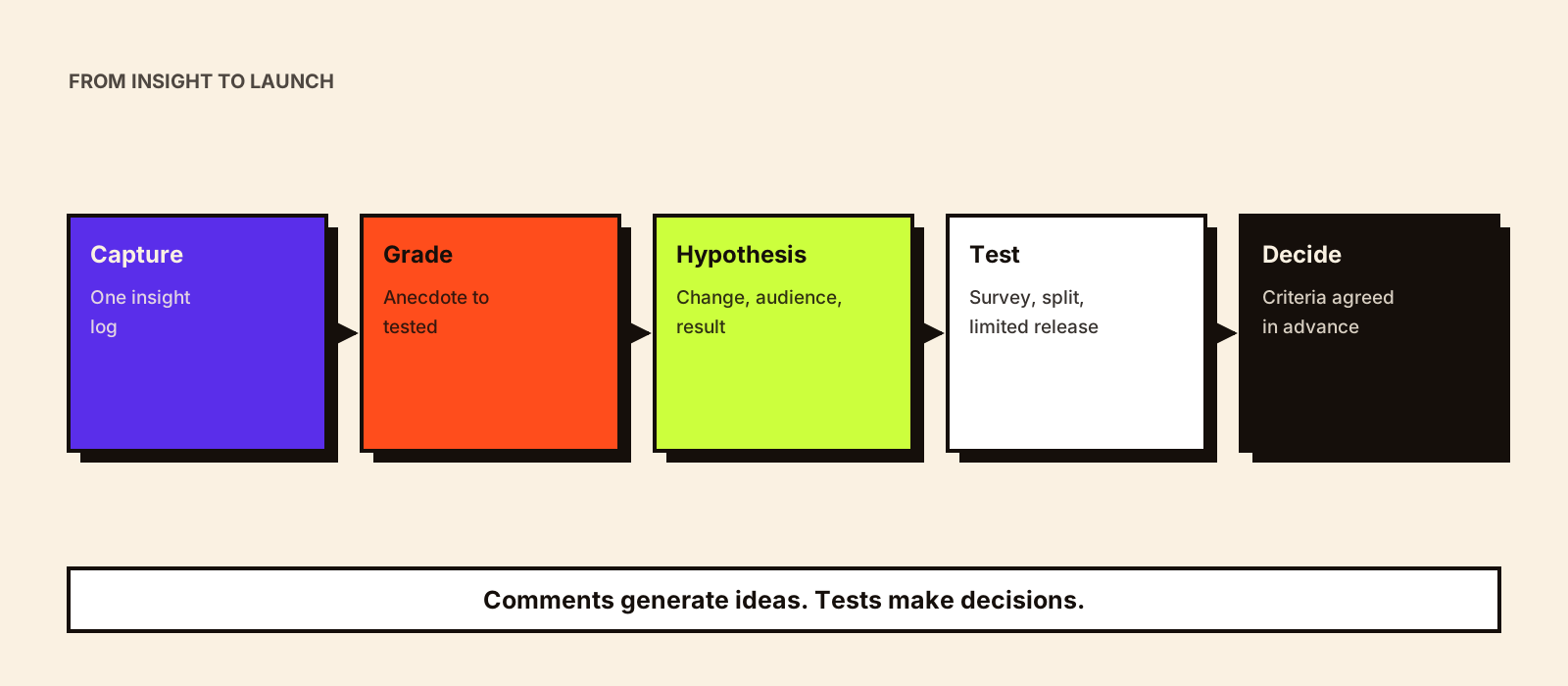
A five-step workflow for product and marketing teams: capture insights from creator campaigns, grade the evidence behind each one, turn strong insights into product or messaging hypotheses, test them before the next launch, and decide in advance how the business will judge the result, without treating comments as a representative survey.
Creator campaigns produce a lot of signal: thousands of comments, questions in DMs, which hooks held attention, which creators' audiences bought, and what creators themselves noticed using the product. Most of it ends up in a report and is never used. This guide is for product, brand and growth teams who want those signals to shape the next launch, and it shows how to do that without mistaking comment sections for market research.
Quick answer
To use influencer campaign insights for your next launch, capture signals in one log, grade each insight by the strength of its evidence (one comment is not a finding), turn the strong ones into specific product or messaging hypotheses, test them before committing (a survey, a small creator test, a landing-page split), and agree in advance what result will change the decision. Creator comments show what some engaged people say; they are not a representative sample of your market.
Step 1: Capture the signals
| Source | What it can tell you |
|---|---|
| Comments and DMs | Questions, objections, words people use, unmet needs |
| Creator debriefs | How the product performed in real use; what audiences asked them |
| Content performance | Which hooks, benefits and formats held attention |
| Conversion data | Which messages, creators and audiences led to purchases |
| Customer service and returns | Problems after purchase |
| Search and site data | What people searched for after seeing content |
Keep one insight log with the date, source, quote or data point, and how many times it appeared. Structured creator debriefs are covered in creator feedback loops, and comment analysis in influencer sentiment analysis.
Step 2: Grade the evidence
| Grade | Evidence | Example | Use it to |
|---|---|---|---|
| Anecdote | A few comments or one creator's opinion | 'Three people asked for a fragrance-free version' | Generate ideas only |
| Pattern | Repeated across creators, audiences and markets | 'Fragrance questions appear under most videos in both the UAE and Saudi Arabia' | Prioritize for testing |
| Behavioural | Shown in clicks, conversions or returns | 'Videos leading with texture convert better than those leading with ingredients' | Form a strong hypothesis |
| Tested | Confirmed in a controlled test or representative survey | 'A survey of target buyers shows a clear majority would consider a fragrance-free version' | Make decisions |
- Commenters are self-selected and often fans or critics, not typical buyers
- Creator audiences differ from your target market
- Loud complaints can come from very few people
- Count how often something appears, and in which markets and languages
Step 3: Write a hypothesis
Turn a pattern or behavioral insight into a hypothesis that names the change, the audience and the measurable result.
Because [insight and its evidence grade],
we believe that [product or messaging change]
for [audience and market]
will [measurable result],
which we will test by [method] and judge by [criterion] by [date].
| Type | Example hypothesis |
|---|---|
| Messaging | Leading with 'works in humid weather' will raise click-through among Gulf audiences compared with 'lightweight' |
| Product | A fragrance-free variant will be bought by at least X% of current non-buyers in a survey of target buyers |
| Pack or price | A travel size will increase first-time trial in quick-commerce apps |
| Creator mix | Home-cook creators will deliver lower cost per order than lifestyle creators for this product |
Step 4: Test before you commit
| Method | Good for | Limitation |
|---|---|---|
| Representative survey | Product preferences and willingness to buy | Stated intent overstates real buying |
| Small creator test | Messages and creator types | Small samples; other factors vary |
| Landing-page or ad split test | Messaging and offers | Tests reaction, not long-term behavior |
| Limited release or drop | Real demand for a variant | Costs production; see our product drops guide |
| Seeding with structured feedback | Product usability | Small, engaged group |
Test design is covered in creator campaign testing, and limited releases in creator-led product drops in the GCC.
Step 5: Decide how you will judge it
- Agree the success criterion before the test, with product, marketing and finance
- Name who decides and when
- Decide what happens if results are mixed: adjust and retest, or drop
- Record the decision and the evidence in the insight log
- Feed the result into the next campaign brief
A worked example
Hypothetical, for illustration only. A skincare brand runs creator campaigns in the UAE and Saudi Arabia. The insight log shows fragrance questions under most videos in both markets (pattern), and returns data shows 'scent' as a top return reason (behavioral). The team hypothesises that a fragrance-free variant would win non-buyers, tests it with a survey of target buyers in both markets and a small seeding round, and agrees in advance that it will proceed if the survey clears a set threshold and seeded creators rate it at least as highly as the original. The survey clears the threshold; the variant goes into the next launch plan.
GCC notes
- Log insights by country and language; Arabic and English comments often raise different points
- Separate national and expatriate segments where your product serves both
- Ramadan and summer change behavior; compare like with like
- Use market-level reporting so one country's insight isn't applied to all; see GCC influencer campaign reporting
Market-level reporting is covered in GCC influencer campaign reporting, and the end-of-campaign review in creator campaign post-mortems.
Common mistakes
- Changing the product because of a handful of comments
- Treating stated intent in a survey as guaranteed sales
- No success criterion before testing
- Insights stuck in a campaign report that product teams never read
- Applying one market's insight to every market
Conclusion
Creator campaigns are an early, inexpensive window into how people react to a product. Used with discipline (capture, grade, hypothesise, test, decide), they can improve the next launch. Used without it, they amplify the loudest voices. Build the insight log into every campaign, and give product teams a seat at the debrief.