Influencer Gifting Strategy: How Brands Can Build Relationships With Creators
How to use gifting as a relationship gesture rather than a free-content tactic: gifting vs paid collaboration vs affiliate vs seeding, when gifting makes sense, what to send, the note, disclosure, follow-up and turning gifts into partnerships.
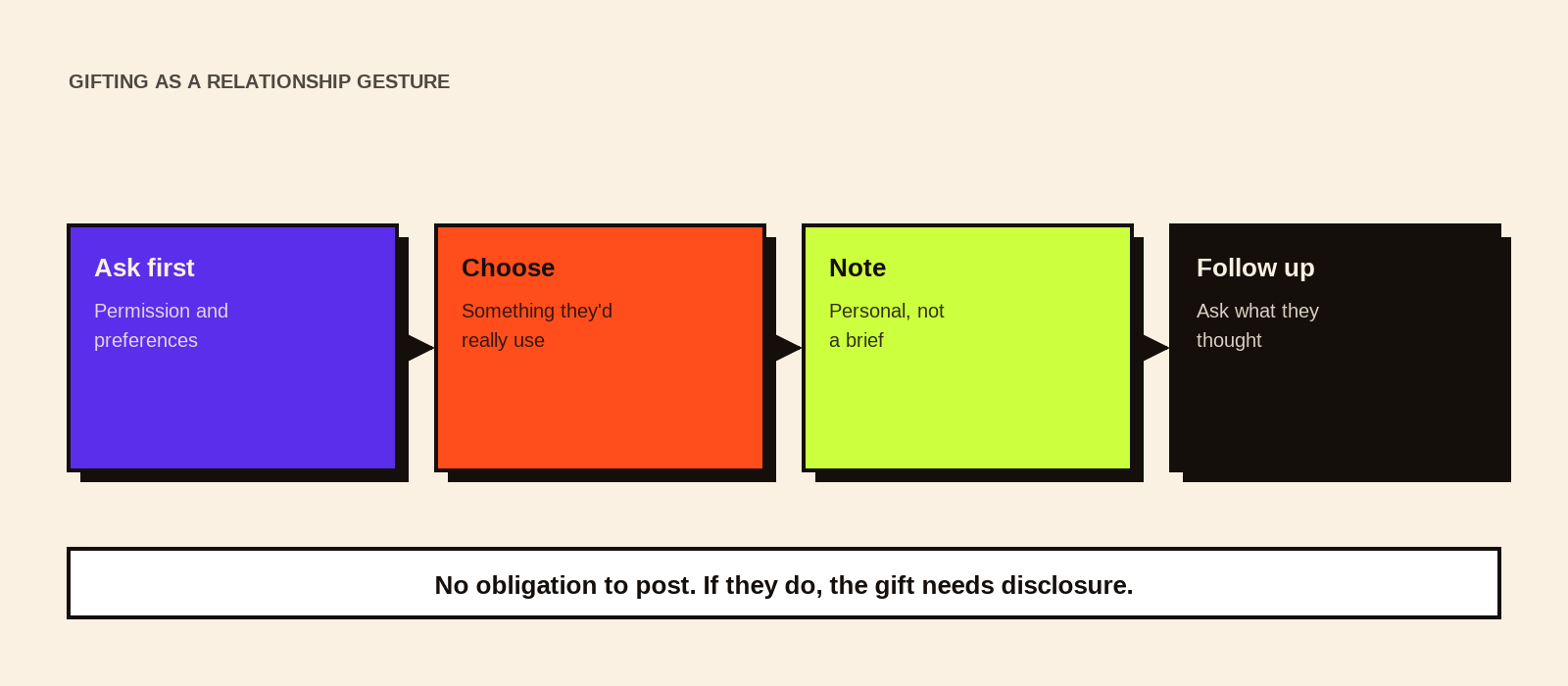
Many brands treat gifting as a cheaper way to get posts: send a box, hope for a Reel. Creators know this, and many now receive more unsolicited products than they can use. Gifting works far better when it's what the word suggests, a gesture to someone you'd like a relationship with, with no expectation attached.
Quick answer
Influencer gifting means sending products to creators with no obligation to post, as a way to introduce your brand, thank existing partners or start a relationship. It is different from a paid collaboration (deliverables for a fee), an affiliate partnership (commission on sales) and product seeding (sending products to many creators to see who responds). Gift thoughtfully to creators who'd genuinely use the product, ask permission first where you can, include a personal note, make clear there's no obligation, and remember that if a creator does post, the gift is a material connection that needs disclosure.
Gifting vs paid vs affiliate vs seeding
| Model | What the creator gets | What the brand gets | Obligation to post |
|---|---|---|---|
| Gifting | Product, as a gesture | Goodwill, possible organic mention, relationship start | None |
| Product seeding | Product, sent to many creators | Discovery of who genuinely likes it; some organic content | None |
| Paid collaboration | Fee (and usually product) | Agreed deliverables, timing and rights | Yes, per contract |
| Affiliate partnership | Commission on sales (sometimes plus product) | Performance-linked promotion | Usually not fixed; driven by incentive |
| Gifted collaboration (barter) | Product in exchange for agreed content | Agreed content without a fee | Yes, by agreement; must be fair |
The last row is where confusion and resentment happen. If you expect content, say so upfront and make the value fair; don't call it a gift. Product seeding at scale is covered in influencer product seeding, and choosing between these models for Instagram in instagram gifting vs paid collaboration.
When gifting makes sense
- Introducing your brand to a creator you'd like to work with later, before any ask.
- Thanking creators after a campaign or on a milestone.
- Sharing new launches with existing partners and ambassadors first.
- Festive gifting to creators you work with (Diwali, Eid, Christmas), as you would with other partners.
- Letting creators try a product before you discuss a paid collaboration.
Gifting is not a substitute for paying creators for work. If you need specific content, on a deadline, with rights, that's a paid collaboration.
Ask before you send
Hi [name], I'm [your name] from [brand]. We make [product] and I think you might genuinely like [specific product] given [specific reason]. Could we send you one? There's absolutely no obligation to post. If you'd rather not receive products, no problem at all.
Asking first respects creators who get too many products, confirms the address and size or shade, avoids waste and starts a conversation instead of a delivery.
If creators ask you for free product and you can't say yes, decline kindly and point them to your programme; templates are in how brands can decline influencer requests.
What to send and how
- Something they'd actually use, chosen for them, not a generic PR box.
- Correct sizes, shades, dietary or skin preferences, asked in advance.
- Sensible packaging: memorable but not wasteful.
- A short handwritten or personal note.
- How to reach you, and nothing that reads like a brief.
Hi [name], thanks for letting us send this. We thought of you because [specific reason]. No need to post anything; we'd just love to know what you think whenever you've tried it. [Your name], [brand] · [contact]
Disclosure
Under ASCI's influencer guidelines, free products, including unsolicited gifts, count as a material connection. If a creator posts about a gifted product, the post needs a clear upfront disclosure, such as the 'Free gift' label listed in the guidelines, even if their opinion is entirely their own. Mention this politely in your follow-up, especially to smaller creators who may be new to brand relationships. Influencer marketing compliance covers disclosure in detail.
Follow up without pressure
- Check it arrived safely a few days after delivery.
- Ask for their honest opinion, not for a post.
- If they post, thank them, and ask permission before resharing.
- If they don't, that's fine. Don't chase.
- Note their feedback; it's useful product input.
From gift to partnership
Creators who genuinely like a gifted product and mention it organically are strong candidates for paid work. Approach them with a proper offer that references their honest response. Never treat an organic post as a reason to expect free work next time. Repeat influencer collaborations covers the next steps.
Running gifting and paid collaborations together
Many programs use both: gifts to discover creators and keep relationships warm, and paid collaborations for content the campaign depends on. Problems start when the two blur, for example when a gifted creator is asked for specific deliverables, or a paid creator sees a gifted creator get the same product with fewer demands. Keep the difference explicit.
| Gifting | Paid collaboration | |
|---|---|---|
| What you can ask for | Nothing guaranteed; an invitation to try the product | Agreed deliverables, dates, usage rights |
| Agreement | A short note stating there's no obligation | A written contract |
| Brief | Product information and disclosure guidance only | Full brief, approved claims and approvals |
| Disclosure | Required if the creator posts | Required |
| Usage rights | None, unless separately agreed and paid | As agreed in the contract |
| Role in the plan | Discovery, goodwill, extra organic coverage | The content the campaign relies on |
- Never plan a launch around gifted posts; schedule paid creators for the dates that matter and treat gifted coverage as a bonus.
- If you start requesting dates, scripts or specific deliverables from a gifted creator, it has become paid work: agree a fee and a contract.
- Keep one tracker with each creator's status (gifted, paid, both) so nobody receives a paid brief by mistake or is chased for content they never promised.
- Sequence them deliberately: a gifting wave before launch can show who genuinely likes the product, and those creators are natural candidates for the paid wave.
- Send the same product information and disclosure guidance to both groups, so messages stay consistent.
- Don't ask for usage rights on gifted content without paying for them.
Disclosure rules differ slightly by market. In India, ASCI treats free products as a material connection. In the UK, the ASA and CMA influencers' guide expects posts about gifts to be disclosed. In Australia, the ACCC's guidance for influencers covers gifted products too. Choosing between gifting and payment for a given creator is covered in Instagram gifting vs paid collaborations.
Gifting in India: practical notes
- Confirm delivery coverage for the creator's pin code, especially for tier 2 and tier 3 towns.
- Plan festive gifting early; courier networks are busy before Diwali.
- Perishables and temperature-sensitive products need careful logistics.
- Regional creators appreciate notes and packaging in their language.
- Keep a record of gifts sent; high-value gifts may have tax implications for creators.
Gifting occasions that build relationships
| Occasion | Who | Why it works |
|---|---|---|
| New launch, before release | Existing partners and ambassadors | Makes them feel like insiders |
| After a successful campaign | Creators who delivered | Thanks without asking for anything |
| Festive season | Creators you work with regularly | Treats them as partners, like any other business relationship |
| Creator milestone | Partners reaching a personal or channel milestone | Shows you're paying attention |
| Before a paid conversation | Prospective partners | Lets them try the product honestly first |
How to tell if gifting is working
Gifting is a relationship investment, so measure it that way: how many gifted creators reply, share honest feedback, later accept paid work, or mention the product organically over time. Don't judge it by posts per box; if that's the goal, you need a paid collaboration or a seeding programme with clear expectations.
Gifting checklist
□ Creator would genuinely use this
□ Permission asked; address, size, shade or preferences confirmed
□ Delivery to their pin code confirmed
□ Personal note written; no brief, no caption suggestions
□ 'No obligation' stated clearly
□ Disclosure mentioned gently for if they post
□ Gift logged in the creator record
Common mistakes
- Calling it a gift but expecting a post.
- Sending unsolicited boxes to people who never asked.
- Generic PR boxes with no personal reason.
- Chasing creators who didn't post.
- Forgetting disclosure guidance.
Conclusion
Gifting works when it's genuine: chosen for the creator, sent with permission, accompanied by a personal note, free of obligation and followed up kindly. It opens relationships that can grow into paid partnerships, but sending a product never guarantees coverage, and it shouldn't. For sending products to many creators systematically, see influencer product seeding.