How to Use Creators to Drive Upgrades, Cross-Sells and Repeat Purchases From Existing Customers
Most creator campaigns chase new customers, but people who already bought from you are often easier to sell to. How to use creator content for onboarding, upgrades, complementary products and refills, where to show it, how to brief it and how to prove it added revenue.
Your existing customers already trust you enough to have paid once. Yet most creator budgets go on reaching strangers, while the people who bought last month get a discount email and a generic newsletter. Creator content can do something those emails can't: show a real person getting more out of the product, then naturally reaching for the next thing.
Quick answer
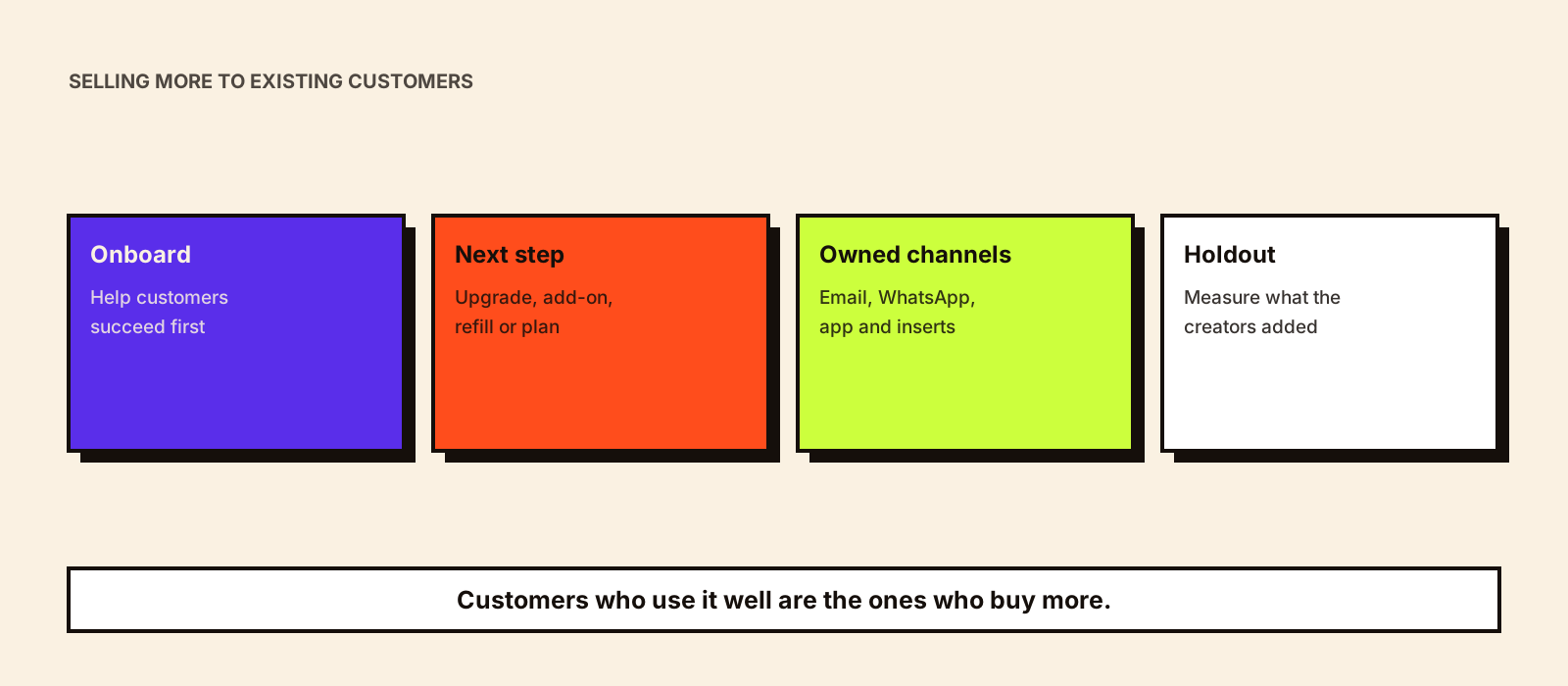
To sell more to existing customers with creators, start with post-purchase education (customers who use a product well are the ones who buy more), then brief creators on specific expansion moves: upgrading to a better tier, adding a complementary product, refilling or replenishing, or moving to an annual plan. Deliver the content mainly through channels you own, such as order emails, WhatsApp, in-app screens and product inserts, plus ads to customer audiences where you have consent. Measure with a holdout group of customers who don't see the content, so you can see what the creators added rather than what would have happened anyway.
How this differs from retention and acquisition
| Goal | Question it answers | Main metric |
|---|---|---|
| Acquisition | Will new people buy? | Cost per new customer |
| Retention | Will customers stay and come back? | Repeat rate, churn |
| Expansion (this guide) | Will customers buy more, or better? | Upgrade or attach rate, revenue per customer |
Retention and expansion overlap, and influencer marketing for customer retention covers keeping customers and turning them into advocates. This guide focuses on the commercial step after that: the second product, the upgrade and the refill.
Start with post-purchase education
A customer who struggled with setup, never found the best feature or used the product wrongly is unlikely to buy your next product. Creator onboarding content fixes the first-week experience and makes the next sale easier. It also tends to reduce support tickets and returns; see how creator content can help reduce returns.
- Setup and first use, filmed in a real home or workplace rather than a studio.
- The three features most customers miss, shown in a normal routine.
- Common mistakes and how to avoid them.
- Care, cleaning, storage or maintenance.
- 'Week two' content: what changes once the novelty wears off.
Expansion moves creators can support
| Move | Example | Content that works | Creator fit |
|---|---|---|---|
| Upgrade | Basic plan to premium; entry model to pro | What changed when I upgraded, and who doesn't need to | Power users, reviewers who've used both |
| Complementary product | Camera to lens; skincare serum to sunscreen | How the two work together in one routine | Creators already using the first product |
| Refill or replenishment | Water purifier filters; pet food; coffee | The reminder moment and what happens if you leave it | Everyday creators, routine content |
| Bundle | Starter kit to full regime | Building a routine step by step | Routine-led creators |
| Annual or longer plan | Monthly to annual subscription | What a year of use looks like | Long-term users, diaries |
| New use case | Kitchen appliance used for a second cuisine | Recipes or tasks customers haven't tried | Specialists in that use case |
Choosing creators for existing customers
The best creators for expansion content are often people your customers already know from the first purchase, or customers who create content themselves. Continuity matters: if a creator persuaded someone to buy, the same creator showing the next step feels like a natural follow-up. For specialist upgrades, add creators who can compare tiers honestly. Kudozz's ambassador programmes service is built for exactly this kind of ongoing, multi-stage creator relationship.
Where to show the content
Expansion content mostly runs in channels you already control, because that's where existing customers are. Make sure your content rights cover these uses before you brief.
| Channel | Moment | Format |
|---|---|---|
| Order confirmation and delivery emails | Just after purchase | Short setup video or GIF linking to the full version |
| WhatsApp or SMS (opted-in customers) | First week; refill reminders | Vertical clip with one clear action |
| In-app or account dashboard | When a customer hits a limit or milestone | Upgrade explainer |
| Product inserts with a QR code | Unboxing | Setup and 'get more from it' videos |
| Paid social to customer lists | Weeks or months later | Cross-sell and upgrade ads using creator content |
| Product pages of the next product | When customers browse | Creator demonstrating the pairing |
Using creator content in email is covered in more depth in using influencer content in email marketing. Uploading customer lists for ad targeting involves personal data, so check consent and your obligations under India's data protection law; see influencer marketing data privacy.
Offers: don't discount what customers would buy anyway
Existing customers are already more likely to buy again, so a generous discount often gives away margin on purchases that would have happened regardless. Try useful content and convenience first: auto-replenishment, a bundle that saves effort, early access to a new product, or a loyalty perk. Keep discounts for moves customers resist, such as a first upgrade, and test them against a no-discount version.
Audience: existing customers who bought [product] in the last [90] days
Move: [upgrade / cross-sell / refill / annual plan]
One message: [e.g. 'The serum works better with daily SPF; here's my routine']
Must show: [real use, both products together, honest who-it's-not-for]
Must not: [claims beyond the claims sheet, pressure language, fake scarcity]
Formats: [1 x 45-60 s vertical video, 2 x 15 s cut-downs for WhatsApp and email]
Distribution: [order emails, WhatsApp opt-in list, customer-audience ads]
Rights needed: [owned channels and paid use, 6 months]
Measurement: [attach rate vs holdout over 60 days]
Measuring what creators added
Existing customers buy again without any campaign, so attribution through codes alone overstates the effect. The cleanest approach is a holdout: randomly keep a share of eligible customers (for example 10 to 20 percent) out of the creator content, then compare upgrade, attach or repeat rates between the two groups over the same period.
- Attach or upgrade rate: share of customers who bought the next product or tier.
- Revenue per customer over 60 to 90 days, against the holdout.
- Time to second purchase.
- Support tickets and returns, for onboarding content.
- Margin after any discount, not just revenue.
To compare the long-term value of customers different creators bring in, see measuring customer quality from influencer campaigns.
An illustrative example
Hypothetical: a water purifier brand has thousands of customers due for a filter change. It commissions three creators who already own the purifier to film the change, what the indicator light means and why leaving it late matters. The clips go into a WhatsApp reminder to opted-in customers, with 15 percent held out. Over 60 days, the brand compares filter orders between the two groups and finds the creator version beats its plain text reminder. It then tests one more creator video promoting an annual maintenance plan. All figures and outcomes are illustrative.
Common mistakes
- Selling the next product before customers have succeeded with the first.
- Running expansion content only on public social, where most viewers aren't customers.
- Discounting purchases customers would have made anyway.
- Measuring only code redemptions, with no holdout.
- Forgetting that owned-channel and ad use of creator content needs the right licence.
- Using new creators with no link to the first purchase when the original creator was available.
Conclusion
Creator content for existing customers is under-used because it doesn't look like a campaign: it lives in emails, WhatsApp messages and product inserts rather than on a creator's feed. But it reaches people who already trust you, at the moment they're ready for the next step. Start with onboarding, brief one expansion move at a time, deliver it in owned channels and measure against a holdout.