How to Plan Influencer Campaigns When Stock or Supply Is Limited
Creator demand is lumpy and hard to predict, which makes it risky when stock is tight. How to size a campaign to what you can actually ship, stagger creators against inventory, handle sell-outs honestly and avoid paying for posts that send people to an empty page.
A creator post that works too well can be as damaging as one that flops. If the product sells out on day two, the remaining creators send their audiences to an out-of-stock page, paid boosts keep spending, and the brand ends up with annoyed customers and a report full of traffic that couldn't buy anything.
Quick answer
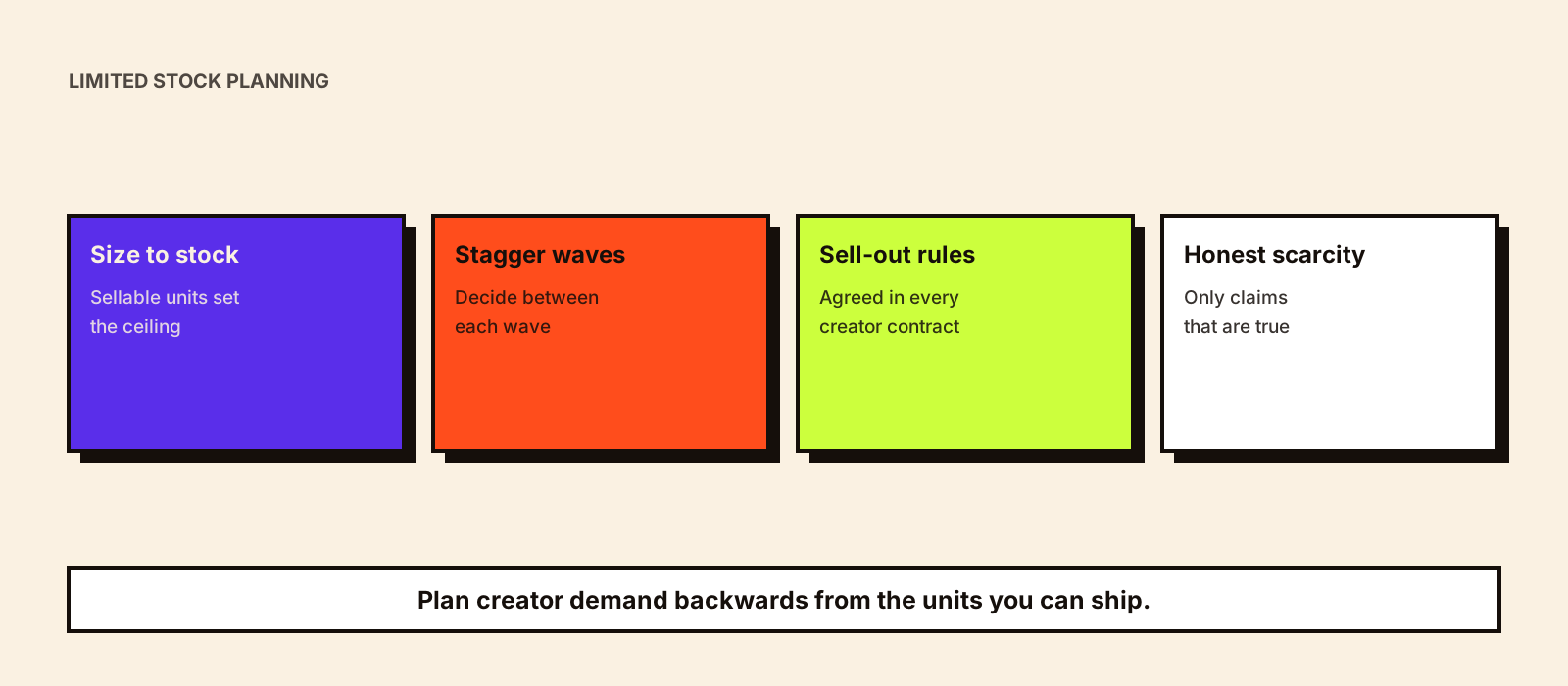
When stock is limited, plan the campaign backwards from the units you can ship. Estimate a cautious and an optimistic demand range from your own past campaigns, keep the optimistic case within available stock (or hold a reserve), and stagger creator go-lives in waves so you can pause the later waves if stock runs low. Agree in each creator contract what happens if the product sells out, set up a waitlist or back-in-stock alert, and never claim scarcity you can't back up.
Which situation are you in?
| Situation | Typical example | Main risk | Plan for |
|---|---|---|---|
| Planned limited edition | A collaboration drop or festive edition with a fixed run | Selling out before most creators post | Short, tightly coordinated launch window and a waitlist |
| Constrained supply | A new product with slow manufacturing or imported stock | Demand outrunning restock lead times | Waves sized to each incoming batch |
| Uneven distribution | Stock in some cities, stores or marketplaces but not others | Creators driving people to places with nothing on the shelf | Creators and regions matched to where stock is |
| Unplanned shortage | A supplier delay after creators are booked | Paying for posts that can't convert | Postpone, swap the product, or change the call to action |
Step 1: Turn stock into a demand ceiling
Start from sellable units, not total units. Take away stock committed to other channels, marketplace and retail allocations, a safety buffer for normal sales and replacements, and anything reserved for creator seeding. What's left is what the campaign can sell.
Then estimate demand as a range. If you've run creator campaigns before, use your own figures for orders per creator or per thousand views. If you haven't, treat any estimate as a guess and plan the first wave small. Influencer marketing ROI forecasting walks through building that range; the point here is to compare its optimistic end with your ceiling.
| Line (hypothetical D2C brand) | Units |
|---|---|
| Stock arriving before launch | 3,000 |
| Less marketplace allocation | –800 |
| Less buffer for regular sales and replacements | –400 |
| Less seeding units for creators | –40 |
| Sellable through the campaign | 1,760 |
| Cautious demand estimate (all creators) | 900 |
| Optimistic demand estimate (all creators) | 2,400 |
Illustrative figures. Here the optimistic case is above the ceiling, so the brand either holds back some creators until the next batch lands or accepts a sell-out and prepares for it properly.
Step 2: Stagger creators in waves
Waves are the most useful tool you have. Instead of every creator posting the same day, split them into two or three groups. The first wave tells you the real demand rate; the later waves can go ahead, be delayed until restock, or switch to a different product. Build these dates into your influencer campaign calendar from the start, with the decision points marked.
- Wave 1: a smaller group, ideally a mix of creator sizes, to measure demand. Keep paid boosting off or low.
- Decision point: compare orders and stock remaining with your range. Decide go, delay or switch for wave 2.
- Wave 2: the larger group, timed to land when stock is confirmed. Turn on paid amplification for the best wave 1 content only if stock allows.
- Wave 3 (optional): restock or 'back in stock' content, ideally from creators whose audiences missed out first time.
A fixed launch date with one coordinated drop is different: everyone posts together on purpose. That works for planned limited editions, but only with a waitlist and clear stock messaging. How to plan a creator-led product launch covers the launch-day coordination itself.
Step 3: Put sell-out rules into the contract
Creators plan their own calendars, so last-minute changes cost them money. Agree up front what happens if stock runs out, and pay fairly for flexibility you ask for.
Go-live window: [date range], with the exact date confirmed by the brand at least [X] days in advance.
Stock-related postponement: the brand may move the go-live date once, by up to [X] weeks, if stock is unavailable. Fee unchanged; [rescheduling fee, if any].
Sell-out after posting: the creator will update the caption, pinned comment or Story to point to [waitlist / alternative product / restock date] within [X] hours of the brand's request.
No scarcity claims: the creator will not say 'only a few left', 'last chance' or similar unless the brand provides the wording and confirms it is true at the time of posting.
Cancellation because of stock: [kill fee or percentage], and content already produced remains [usable / not usable] by the brand.
If the shortage is serious enough to cancel, the professional way to handle it is set out in influencer campaign cancellation.
Step 4: Prepare the page for a sell-out
- Replace the buy button with a waitlist or back-in-stock alert, rather than a dead 'sold out' label.
- Show an honest restock estimate if you have one, and say so when you don't.
- Suggest a genuine alternative product on the same page.
- Pause or redirect paid creator ads the same day; check partnership and Spark-style ads, which keep spending even when organic posts slow down.
- Tell customer service and the creators what to say when people ask.
Waitlist sign-ups are also useful data: they show you real demand you couldn't serve, which helps size the next production run and the next wave.
Step 5: Keep scarcity claims honest
Limited stock is a legitimate reason to buy soon, but only if it's true. In India, the Central Consumer Protection Authority's Guidelines for Prevention and Regulation of Dark Patterns, 2023 list false urgency, falsely stating or implying urgency or scarcity, as a practice to avoid. Keep 'limited edition' or 'only 500 made' claims factual, give creators the exact wording, and update or remove it when it stops being true. This is general information, not legal advice.
When stock sits in stores and marketplaces
If customers buy through retailers, distributors, marketplaces or quick commerce, your own stock count isn't enough. Check availability where creators will send people, city by city if needed, and only activate creators in places where the product is on the shelf. Influencer marketing for brands sold through distributors and retailers covers this in detail.
Getting stock, creators and launch dates to line up is a large part of what Kudozz's product launch campaign service handles, especially when manufacturing dates move.
Measuring a stock-constrained campaign
Sales are capped by stock, so judging the campaign only on orders understates it. Report orders and revenue, but also waitlist sign-ups, back-in-stock alerts, branded search and the date stock ran out. Compare creators on what they achieved while stock was available; a creator who posted after the sell-out shouldn't be judged on orders they couldn't have generated.
Common mistakes
- Booking every creator for the same week when stock might not last that long.
- Counting total warehouse stock instead of units actually available to the campaign.
- Leaving paid boosts running after the product sells out.
- Letting creators improvise urgency language that isn't true.
- Judging late-wave creators on sales they couldn't make because stock had run out.
- Postponing creators repeatedly without compensating them for the disruption.
Conclusion
Limited stock doesn't rule out influencer marketing; it changes how you schedule it. Work out how many units the campaign can really sell, release creators in waves with decision points between them, agree sell-out rules before anyone posts, and keep scarcity claims true. Then measure the demand you created, not just the demand you could fulfil.