Instagram Content Strategy for Dentists: What to Share Without Making Every Post Promotional
Twenty responsible Instagram ideas for dentists, grouped by format, with a guardrail for each, plus a simple way to keep most posts educational, professional boundaries online and consent rules for anyone in frame.
You finish your last patient at 8 pm, open Instagram and see another dentist's Reel: a patient's smile, a dramatic reveal, 'DM to book'. It has thousands of views. You want a presence too, but the National Dental Commission has just warned dentists about exactly that kind of post. The good news is that the most useful dental content was never the reveal. It was the explanation.
Quick answer
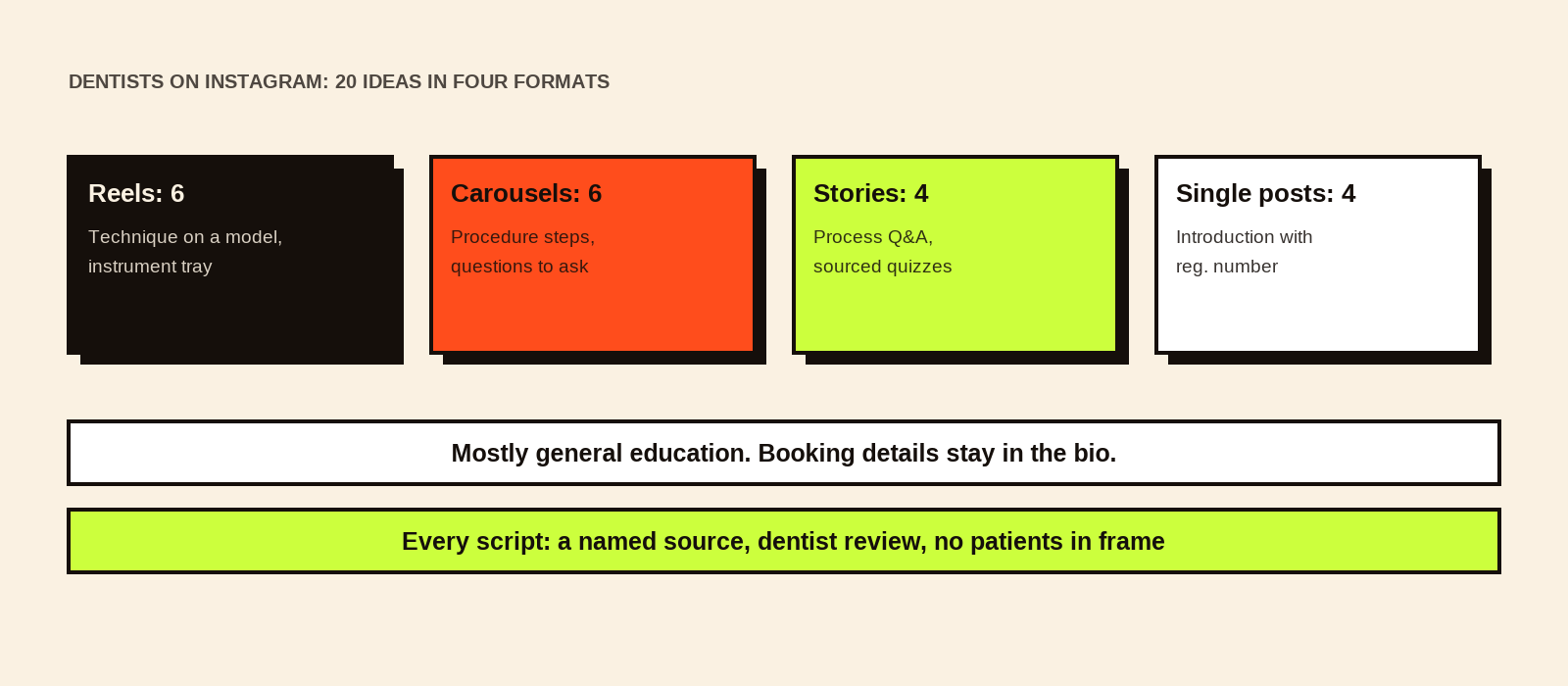
Dentists in India can build a strong Instagram presence with general, reviewed education: how oral care works, what procedures involve, how to prepare for a visit and what to ask a dentist. Keep most posts educational, put practice information in a few clear places, and leave out patient footage, testimonials, before-and-after images, superlatives and product endorsements. Below are 20 ideas grouped by format, each with its guardrail.
The rules in three lines
The National Dental Commission's advisory of 14 October 2026 cites clauses 8.1 to 8.3 of the Revised Dentists (Code of Ethics) Regulations, 2014 and warns against filming consultations and procedures, testimonials, before-and-after photos, misleading claims, inaccurate health information and self-aggrandising publicity. The code also bars superiority claims, specialist titles without a recognised qualification and public product endorsements. Our guide to social media marketing for dental clinics sets out the rules, sources and grey areas in full.
Keep the feed mostly educational
There is no official ratio, and you shouldn't trust anyone who quotes one as a benchmark. A practical approach: decide that most of what you post teaches something general, a smaller share explains process, and practice information lives in a few fixed places rather than in every caption. Review the balance monthly by tagging each post with one of the types below.
| Type | Purpose | Where it lives | Watch for |
|---|---|---|---|
| General education | Help anyone understand oral health | Most feed posts and Reels | Keep it general; cite the source; no booking prompt |
| Process explainers | Reduce fear of the unknown | Carousels and highlights | Describe steps, not results |
| Practice information | Help people find and book you | Bio, pinned post, one highlight | No superlatives, offers or patient stories |
| Announcements | Starting practice, new address, absence, resumption, new equipment | Occasional single posts | Plain wording, no 'best' or 'first' (clause 8.2.7) |
Clause 8.1.8 calls 'surrogate advertisements in the garb of educating the public' unethical and says public information should not carry the dentist's or clinic's contact details to attract patients. It was written for TV and magazines, so how it applies to Instagram is not settled; a cautious approach keeps phone numbers and 'DM to book' out of educational captions.
20 responsible Instagram ideas, grouped by format
Every idea assumes the dentist writes or checks the script, health facts come from an authoritative source such as the Ministry of Health, WHO or a recognised dental association, and the post ends with a line saying it is general information and viewers should ask their own dentist.
Reels (6)
| # | Idea | What it shows | Guardrail |
|---|---|---|---|
| 1 | Brushing technique on a model | Angles, timing and pressure on a teaching model or diagram | No patient mouth on camera |
| 2 | Flossing in 30 seconds | Hands and floss on a model | General technique, not personal advice |
| 3 | What is in my instrument tray | Each instrument named and its purpose explained | Describe, don't claim superiority |
| 4 | Myth or fact, sourced | One common belief, then what an authoritative source says, with the source on screen | Only with a named source and dentist review |
| 5 | Toothbrush wear check | Old vs new bristles, when people usually replace them, per the source you cite | No brand names or endorsements |
| 6 | A day at the clinic before patients arrive | Set-up, cleaning routine, team huddle | Empty clinic, staff consent |
Carousels (6)
| # | Idea | What it shows | Guardrail |
|---|---|---|---|
| 7 | What a root canal involves, step by step | Diagrams of each stage in plain language | No outcome or pain promises |
| 8 | Questions to ask before any dental procedure | A checklist patients can screenshot | Neutral, not a sales pitch |
| 9 | Children's first dental visit: what parents can expect | Process, what to bring, how to prepare a child | No identifiable children |
| 10 | Glossary of dental words | Plaque, tartar, cavity, crown, bridge explained | Definitions checked by the dentist |
| 11 | How to read an aftercare sheet | Sections of a typical sheet and why they matter | 'Follow your own dentist's instructions' |
| 12 | Oral care for people with braces or aligners | General cleaning tips | No product recommendations |
Stories (4)
| # | Idea | What it shows | Guardrail |
|---|---|---|---|
| 13 | Question box: process questions only | Answer how-things-work questions | Clinical questions get the saved reply, not an answer |
| 14 | Quiz: true or false on oral care | Interactive check with sourced answers | Answers reviewed in advance |
| 15 | Schedule and availability updates | Holiday hours, absence, resumption | These are permitted announcements; keep them plain |
| 16 | Behind the scenes of a CDE session | What you learnt at a continuing dental education event | Focus on learning, not on honours |
Single posts (4)
| # | Idea | What it shows | Guardrail |
|---|---|---|---|
| 17 | Professional introduction | Name, recognised qualifications, registration number, areas of practice | Only recognised degrees; specialty only if recognised (clause 8.3.3) |
| 18 | Public health observance | A national or global oral-health day, citing the official campaign | Link the official source; no clinic offer attached |
| 19 | Why I explain before I treat | A short note on informed decisions | No cases, no results |
| 20 | Reading recommendation | A public resource from a health ministry or dental association | No commercial product or paid link |
Writing captions that stay general
A caption structure that works for most educational posts: one clear question, a plain answer, the source, and a closing line that sends personal questions to a dentist. Keep hooks factual. 'Why does my dentist ask about my medicines?' is a good hook; 'This sign means your tooth is dying' frightens people and drifts into diagnosis.
[Question patients often ask, in their words]

[Two to four short sentences answering it in general terms]

Source: [Ministry of Health / WHO / recognised dental association, with page title]

This is general information, not advice for your situation. Please ask your own dentist about your teeth.

Dr [Name], [recognised qualifications], Reg. No. [State Dental Council number]
Our guide to turning customer questions into social content covers how to collect questions without asking for anyone's personal details.
Professional boundaries online
- Patients who follow you: you don't have to follow back, and a personal account is a better place for personal life.
- DMs: answer process questions; send clinical questions to an appointment with the saved reply, and never ask for photos of teeth.
- Other dentists' work: don't critique or compare in public; clause 8.2.8 treats claims of superiority over others as unethical.
- Brand offers: clause 8.15.5 says a dentist shall not publicly endorse a drug or industry product, and clause 8.1.6 bars lending your name to toothpaste, brushes or mouthwash. Decline paid product posts.
- Creator collaborations: a creator paid by a practice is promoting it; our guide to dental and oral-care influencer marketing explains the limits.
- AI tools: if you use AI to draft, check every fact yourself, and never use AI to create patient faces, smiles or testimonials. ASCI's guidelines on synthetically generated content (17 September 2026) prohibit AI-fabricated testimonials and misleading before-and-after visuals in advertising.
Sources: ASCI's guidelines page, and the brand-side limits in dental and oral-care influencer marketing.
Consent when anyone else is in the frame
Patients stay off camera for promotional content, whatever they agree to: the October 2026 advisory names testimonials and broadcasting procedures as concerns, and clause 4.2 of the code protects patient confidences. For your team, use written consent that names the post and the platform, and let people withdraw. Never show identifiable children; under the Digital Personal Data Protection Act, 2023 children's data needs verifiable parental consent, with the Rules being phased in.
A routine that fits a working dentist
- Once a month (one hour): pick eight to twelve ideas from the list, note the source for each, and approve scripts.
- Once a fortnight (one hour): film two or three Reels on a model or diagram before clinic hours.
- Twice a week (ten minutes): check DMs and comments, use the saved reply, and flag anything urgent.
- Monthly review: count posts by type, read the questions people asked, and drop formats that drew clinical questions you can't answer publicly.
Pick five ideas and start
Start with your professional introduction (idea 17), one technique Reel (idea 1), one process carousel (idea 7), the questions checklist (idea 8) and a Story question box (idea 13). That is a fortnight of useful, low-risk content, and it shows you which topics your audience actually wants.
If you would rather hand over the planning and editing, our social media management scope covers scripting support, design, Reels editing from footage you supply and scheduling, with every post approved by you and your regulator's guidance taking priority.