Social Media Marketing for Dental Clinics: Building Patient Trust Through Useful Content
How a dental clinic in India can run its own social accounts under the National Dental Commission's October 2026 advisory and the 2014 dental code of ethics: the patient journey, team introductions, appointment replies, consent, approvals and a four-week content calendar.
A patient with a throbbing molar searches for a dentist near her office at 9 pm. She finds your clinic's Instagram: three festival greetings, a stock photo of a smiling model and a 'Flat 20% off on smile makeovers' graphic. She can't tell who the dentists are, whether you open on Saturday or what happens at a first visit, so she books elsewhere. Meanwhile that discount post may be the one thing on your feed your dental regulator would object to.
Quick answer
Social media marketing for dental clinics in India works best as a factual, useful feed: who your dentists are and what they are qualified in, how a first visit and an appointment work, how instruments are cleaned, timings, location and general oral-health information. The National Dental Commission's advisory of 14 October 2026 warns against filmed procedures, patient testimonials, before-and-after photos, misleading treatment claims and self-aggrandising publicity. A dentist approves every post before it goes live.
Who regulates dental advertising now
Dentistry changed regulators in 2026. The National Dental Commission Act, 2023 came into force on 19 March 2026, the Dentists Act, 1948 was repealed and the Dental Council of India was dissolved from the same date, according to the Ministry of Health's PIB release of 20 March 2026. The Commission's Ethics and Dental Registration Board governs professional conduct and registration. This is orientation, not legal advice: your State Dental Council has the final word on any post you are unsure about.
| Instrument | Status (checked November 2026) | What it means for a clinic's posts |
|---|---|---|
| National Dental Commission Act, 2023 (No. 21 of 2023) | In force from 19 March 2026. Section 59(3) keeps existing State Dental Councils operating until new ones are set up; section 29(4) has them act on misconduct under the Commission's regulations | Complaints about your posts would normally go to your State Dental Council, with appeals to the Ethics and Dental Registration Board |
| Revised Dentists (Code of Ethics) Regulations, 2014 | Notified 27 June 2014. Cited as the operative code in the NDC's October 2026 advisory; section 59(2) of the Act keeps earlier regulations operating until replaced | Clauses 8.1 (advertisement), 8.2 (soliciting) and 8.3 (publicity and signage) set the limits for clinic content |
| NDC advisory, File No. 2/Advisory/EDRB/NDC/2026/M-2672 | Dated 14 October 2026, addressed to all registered dental practitioners, in effect immediately | Warns against recording and broadcasting consultations and procedures, testimonials, before-and-after photos, misleading claims, inaccurate health information and self-aggrandising publicity |
| NDC advisory on the domain of ethical practice, F.No. NDC/EDRB/SCD-G/2026-27/M-1030 | Dated 29 June 2026, addressed to State Dental Councils | Dentists should practise within the domain of their qualification, so describe each dentist's services accordingly |
Sources: the National Dental Commission Act, 2023, the 2014 Regulations, the NDC advisory of 14 October 2026 and the NDC advisory on the domain of practice. Watch the NDC website for new ethics regulations made under the 2023 Act, which may replace the 2014 code.
What the 2014 code allows, and what it rules out
Clause 8.1 says a dentist or group of dentists may advertise provided they maintain decorum. The code then lists what crosses the line.
| Generally fine (keep it factual) | Treated as unethical by the code | Clause |
|---|---|---|
| Announcing that you have started practice, moved, changed type of practice, or are away and resuming | Announcements that boast of skill, achievements or honours | 8.2.1 to 8.2.6; 8.2 |
| New equipment or services, described plainly | Calling them the 'best' or 'first', especially if others already offer them | 8.2.7 |
| Factual online information, including treatment facilities and fees on a website | Claims to superiority or special skills; statements that are not factual | 8.2.8, 8.2.9 |
| Recognised qualifications after a dentist's name | Specialist claims without a recognised specialty qualification; non-academic abbreviations | 8.3.3, 8.9.3 |
| General education reviewed by the dentist | 'Surrogate advertising' dressed up as public education, carrying clinic contact details to attract patients | 8.1.8 |
| Treatment information patients need | Boasting of cases, operations or cures, or publishing reports of them | 8.2 |
| Plain clinic information | Inducements, rebates and false benefits; agents or canvassers paid to bring in patients | 8.1.3, 8.1.4 |
| Discussing oral care in general terms | Publicly endorsing a drug or industry product, or lending your name to toothpaste or mouthwash | 8.15.5, 8.1.6 |
Two grey areas need your State Dental Council's view before you act. First, clause 8.2.9 explicitly allows fees on websites; it does not say the same for social posts, so check before posting fee lists. Second, clause 8.1.8 was written with TV and magazines in mind, and how it applies to an educational Reel on an account whose profile carries your phone number is not settled. A cautious reading keeps booking prompts out of educational posts.
The patient journey your feed should explain
Much dental anxiety is about the unknown: what will happen, what it will cost, how long it will take. Map your content to the journey a new patient actually goes through.
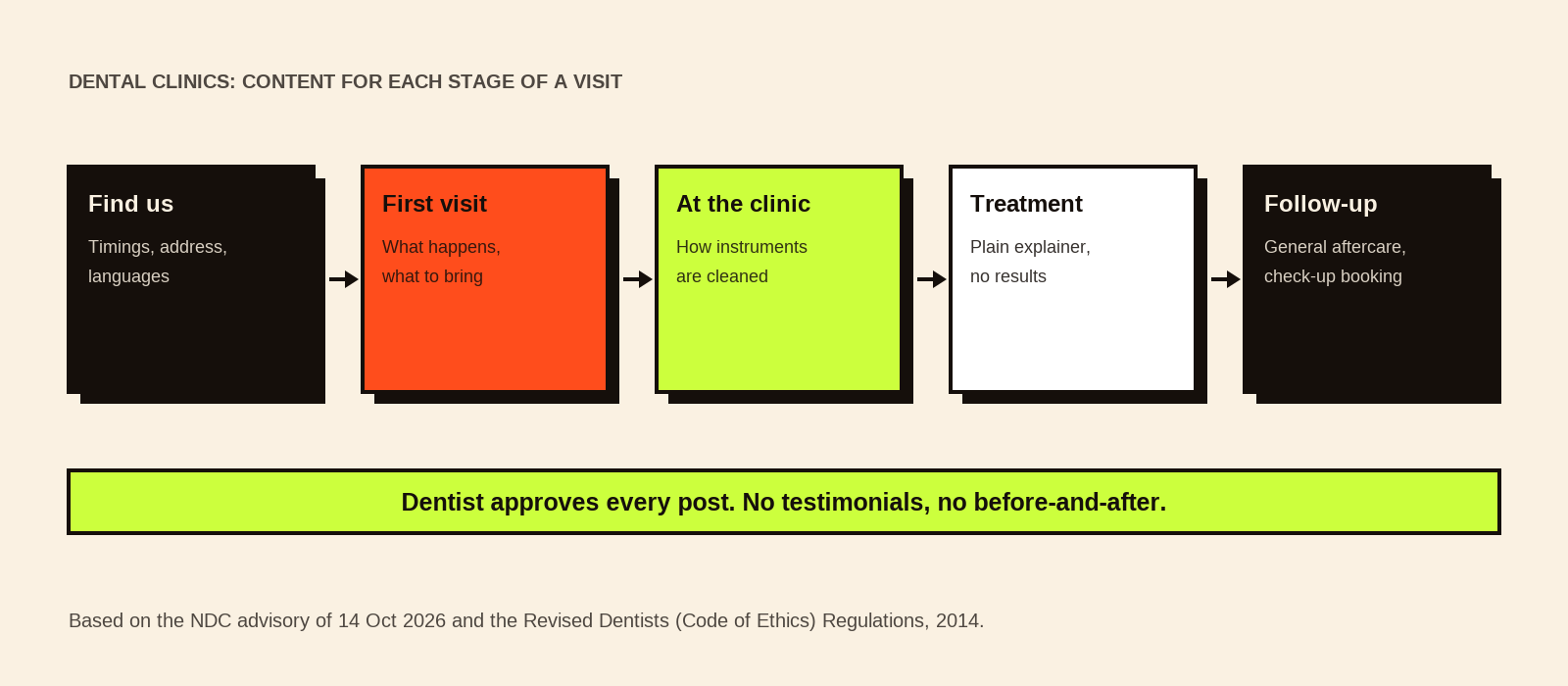
| Stage | What the patient wants to know | Content that answers it | Keep it within the line |
|---|---|---|---|
| Finding you | Where, when, who, which languages | Pinned post with address, timings, parking, accessibility, languages spoken | No 'best dental clinic in [area]' |
| Deciding to book | What happens at a first visit | Carousel: arrival, paperwork, history questions, examination, discussing options | Describe the process, never promise outcomes |
| Before the visit | What to bring, how long it takes | Story highlight: documents, previous X-rays, medicine list, arrival time | Process only, no clinical advice |
| At the clinic | Is it clean, is it safe | Short video of how instruments are cleaned and packed, narrated by your team | Show what you do; no 'safest' or 'most hygienic' |
| Treatment options | What does this procedure involve | Plain-language explainer of a procedure, reviewed by the treating dentist | No results, no patient footage, no implied guarantee |
| After the visit | Aftercare, follow-ups | General aftercare reminder that tells people to follow their own dentist's instructions | Individual instructions belong in the clinic, not the feed |
| Coming back | When is my check-up | Reminder about booking check-ups, with the interval left to the dentist | Don't state recall intervals as fact for everyone |
Explaining sterilisation factually
Infection control is a fair thing to explain because patients worry about it. Film the actual steps your clinic follows, have the dentist check the script, and describe them without comparison. 'Every instrument is cleaned, packed and sterilised before use, here is how' is information. 'The only clinic in the city with hospital-grade sterilisation' is a superiority claim the code treats as unethical, and probably one you can't substantiate either.
Introducing your dentists and team
Patients want to know who will treat them. Clause 3.4.1 of the 2014 code requires every dental practitioner to display their State Dental Council registration number in the clinic and on prescriptions, certificates and receipts, and clause 3.4.2 limits suffixes to recognised qualifications. Apply the same discipline online: copy degrees exactly from certificates, add the registration number, and list only the specialty a dentist is recognised in (clause 8.3.3).
- Keep introductions directory-style: name, recognised qualifications, registration number, the services they provide, consultation days and languages.
- Match each dentist's listed services to their qualification, in line with the NDC's June 2026 advisory on the domain of practice.
- Skip awards, rankings, 'years of excellence' counts and lists of famous patients; clause 8.2 bars publicity that invites attention to skill, achievements or honours.
- Introduce the whole team, including hygienists, assistants and front desk, with their written consent.
- Clause 8.3.1 treats a self-photograph on letterheads or signboards as self-advertisement. How that applies to a team photo on Instagram is not spelt out, so check photo-led formats with your State Dental Council first.
Appointment communication in DMs, WhatsApp and comments
Social inboxes are where people ask 'how much for a root canal?' and 'is this swelling serious?'. Whoever answers must never diagnose, quote a treatment plan from a photo or suggest medicines. Give process information, route clinical questions to an appointment, and tell anyone with severe pain, swelling or bleeding to seek urgent care. Our guide to community management vs customer support covers how to split routine replies from issues the clinic team must handle.
Thank you for reaching out. We can't assess teeth or suggest treatment over messages, because the dentist needs to examine you first. Treatment and cost depend on that examination. You can book a consultation by calling [number] or at [booking link]. If you have severe pain, swelling or bleeding, please seek urgent dental or medical care now.
Don't ask people to post their symptoms or photos of their teeth in comments, and move anyone who shares health details to a private channel. For the profile itself (bio, contact buttons, highlights), see our guide to turning Instagram profile visitors into enquiries.
Consent, privacy and the approval loop
Clause 4.2 of the 2014 code says confidences entrusted by patients must never be revealed unless the law requires it, and the October 2026 advisory asks dentists to uphold patient dignity and confidentiality. Treat patients as off-camera by default: no filmed consultations or procedures, no testimonials, no before-and-after images, no 'smile reveal' Reels. Patient information is also personal data under the Digital Personal Data Protection Act, 2023, and the DPDP Rules notified in November 2025 are being phased in over eighteen months, according to the PIB backgrounder of 17 November 2025. Ask your legal adviser which obligations already apply.
- Shoot before opening or in an empty operatory; keep screens, X-rays, files and appointment books out of frame.
- Get written consent from every staff member who appears, and let them withdraw it.
- Never feature an identifiable child; parental consent rules for children's data are part of the DPDP framework being phased in.
- A named dentist approves every post, caption, reply template and Story; anything new (a fee post, a school awareness talk, a brand collaboration) also goes to your adviser.
- Keep an approval record per post: what it says, which source the health facts came from, who approved it and when.
Outside help needs care. Clause 8.1.4 calls employing an agent or canvasser to obtain patients in a commercial manner unethical, and clause 8.6.1 bars commissions for procuring patients. An agency that plans, designs and schedules factual content is a different arrangement, but ask your State Dental Council before engaging one, and never tie its fee to patients, leads or bookings. The same tension exists for doctors, as our guide to social media management for clinics explains. Our guide to the social media approval process covers stages and turnaround.
Sample dental clinic content calendar
Three posts a week plus Stories is manageable for most single-site clinics. The calendar below is a starting structure; replace topics with the questions your front desk hears most, and have the dentist approve the month in one sitting. Our monthly social media content calendar guide covers the fields and planning meeting.
| Week | Post 1 (clinic information) | Post 2 (general education) | Post 3 (process or team) | Stories |
|---|---|---|---|---|
| 1 | Pinned: timings, address, languages, how to book | Carousel: how to brush and floss, sourced and reviewed by the dentist | Meet the team: front desk and what they help with | Holiday or schedule updates; Q&A box for process questions |
| 2 | What happens at a first visit | Reel: what a scale and polish involves, explained without patient footage | How instruments are cleaned and packed | Reminder of what to bring to an appointment |
| 3 | New equipment or service, described plainly with no 'best' or 'first' | Carousel: questions to ask your dentist before a procedure | Dentist introduction: qualifications, registration number, consultation days | Poll on topics people want explained next |
| 4 | Accessibility and parking information | General oral-health awareness tied to a public health observance, citing the official source | Aftercare explained in general terms with 'follow your own dentist's instructions' | Answers to process questions from the month |
Mistakes that put dental feeds at risk
- Discount countdowns or 'free check-up' offers that read as inducements.
- 'Smile makeover' Reels, before-and-after sliders or reposted patient reviews.
- Filming a procedure 'for awareness'.
- Calling a general dentist an 'implant specialist' or 'orthodontist' without the recognised qualification.
- Paying a marketer per booking or per new patient.
Where to start
Fix the basics first: a correct profile, dentist details with registration numbers, a first-visit explainer and a saved reply for clinical questions. Then run the four-week calendar and review it with your dentist each month. If you are a dentist building your own educational presence, our 20 responsible Instagram ideas for dentists picks up from here, and our guide to dental and oral-care influencer marketing covers creator campaigns.
A managed social media service such as Kudozz's can handle planning, copy, design and publishing within an agreed scope; for a dental clinic all of it stays under the dentist's approval and does not replace advice from your State Dental Council or legal adviser.