Instagram Content Strategy for Yoga Studios: Building a Community Beyond Class Promotions
How yoga studios can use Instagram to build community rather than repeat the timetable: teacher introductions with real credentials, beginner content, events, careful wording and a monthly calendar.
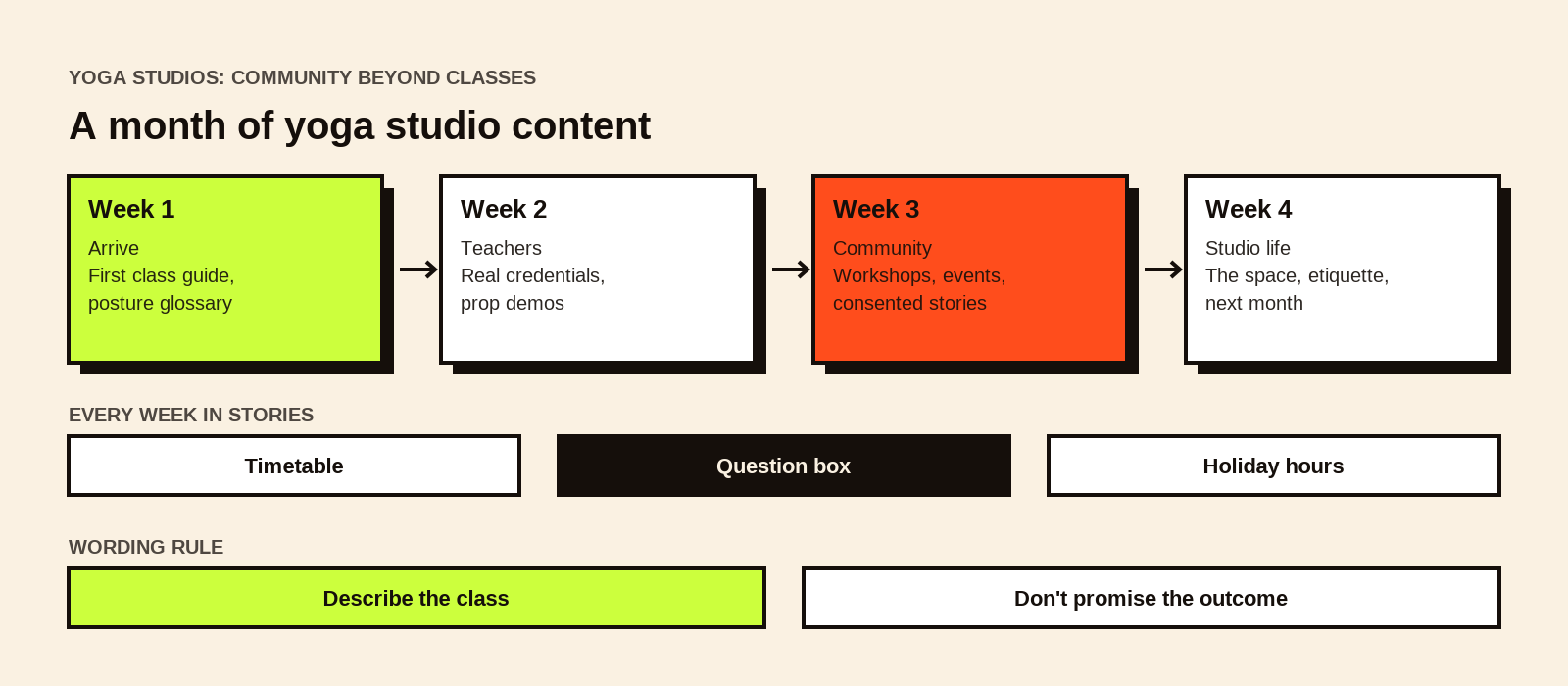
Many yoga studio grids are a timetable on repeat: 'Hatha, 7 am, Monday'. Someone who has never attended can't tell what happens in a Hatha class, whether they'll be the only beginner, who teaches it or what the studio feels like on a Sunday morning. The studio's real community, the regulars who stay back to chat and the teacher who knows everyone by name, never appears online.
Quick answer
Instagram marketing for yoga studios works best when the feed shows teaching and community, not only the timetable. Introduce teachers with their real training, explain classes in plain words for beginners, share workshops and gatherings, and plan a monthly calendar that mixes these with class updates. Describe what happens in a class rather than promising health or mental-health benefits, and ask before featuring any student.
From timetable to community: what changes
Class updates still matter. They just shouldn't be the whole feed. Compare the two approaches:
| Class-promotion feed | Community feed | |
|---|---|---|
| Who speaks | The studio | Teachers, students who agree to it, guest teachers |
| What's shown | Class names, times, offers | What happens in class, the space, the people |
| Beginner's question answered | 'When is class?' | 'Can I do this? What will it be like?' |
| Reason to follow | Discounts | Learning something each week, gatherings, belonging |
| What you count | Likes | First-class bookings, return visits, workshop sign-ups |
For the general fitness content mix and member-story rules, see our guide to social media strategy for fitness brands. This article covers what is particular to yoga studios.
Describe the class, don't promise the outcome
Yoga captions slip into health claims easily: 'cures back pain', 'balances hormones', 'heals anxiety'. These are treatment claims, and the ASCI Code requires factual claims to be capable of substantiation. Softer wording can still imply treatment: 'yoga for anxiety' or 'a flow to help your thyroid' points at a condition even with 'may help' in front of it. The safer habit is to describe the class itself: pace, postures, length, level and what to bring.
| Avoid | Write instead |
|---|---|
| 'Yoga to cure back pain' | 'A slow, floor-based class with long holds and props. If you have back pain, check with your doctor or physiotherapist first and tell your teacher before class.' |
| 'Melt away stress and anxiety' | 'Seventy-five minutes, ending with ten minutes lying down in a quiet, dim room.' |
| 'Detox flow to flush toxins' | 'A faster flow with twists, for people who already know the basic sun salutation.' |
| 'Yoga for PCOS, thyroid or diabetes' | Don't name conditions. Describe the class, and ask students with any condition to consult their doctor. |
| 'Get the yoga body' | 'Practise within your own range. Every class offers props and variations.' |
| 'Pregnancy-safe yoga' | 'Prenatal class led by [teacher], who completed [training as named on the certificate]. Please get your doctor's go-ahead before joining.' |
Mental-health language needs the same care. 'Calm' or 'quiet' describes a room; 'reduces anxiety' or 'helps with depression' is a therapeutic claim. If a student says yoga helped them through a hard time, that is their story to share, with consent, and it shouldn't become a promise to others. Body imagery matters too: ASCI's guidelines on harmful gender stereotypes (June 2022) say ads must not suggest that a person's happiness or emotional wellbeing depends on conforming to idealised body shapes. A feed made only of extreme flexibility tells most beginners the class isn't for them.
If you want to share general information about yoga and health, attribute it to an authoritative source, keep it general and have it reviewed by a qualified professional before posting. When in doubt, describe the class and leave the benefits out.
Introducing your teachers honestly
Teachers are why most students stay, so give each one a proper introduction. State training exactly as it appears on the certificate: the course name, the institution or body that issued it and the year. Don't call a certificate 'government-approved', 'international' or 'mandatory' unless the issuing body itself says so, and don't present any certification as a legal requirement to teach. Style, lineage and years of teaching are useful too, if accurate. Let each teacher approve their introduction before it goes up.
TEACHER INTRODUCTION
Name:
Teaches: [class names and levels]
Training: [course name], [issuing institution or body], [year], as on the certificate
Teaching since: [year]
In class, you'll notice: [one concrete habit, e.g. 'offers a chair variation for every standing posture']
Ask them about: [a topic they actually trained in]
Approved by the teacher on: [date]
Content for beginners
Beginners decide whether to book based on whether they can picture themselves in the room. Answer that directly:
- 'Your first class, start to finish': arrival, shoes, mat, props, how class ends and when to leave.
- A posture glossary: one Sanskrit name a week, pronounced on camera, with a simpler variation shown.
- What to wear and bring, including whether mats are provided and cleaned between classes.
- Class levels in your own definitions: who each class suits and who should start elsewhere.
- Etiquette without shame: phones, arriving late, leaving early, telling the teacher about an injury.
- A teacher demonstrating each prop: block, strap, bolster, chair, wall.
- 'Questions beginners ask us', answered on camera by a teacher.
The questions in your DMs are the best source for this list. Our guide to turning customer questions into content shows how to collect them and build recurring series.
Community beyond the mat
Community is what people do together outside a single class: workshops, outdoor practice, studio anniversaries, a teacher Q&A over tea, a volunteer session. Show the preparation as well as the event, and recap it afterwards with photos of people who agreed to be shown. Plan around dates that matter to your students. The United Nations proclaimed 21 June as the International Day of Yoga by resolution 69/131 in December 2014, so many studios plan June around it; describe what you are organising rather than borrowing official logos.
WORKSHOP: [a title that describes the content, e.g. 'Inversions: preparation and props']
Teacher: [name], [training as on the certificate]
Date and time: [ ]   Length: [ ]
Level: [who it suits; who should check with their doctor first]
What you'll do: [three concrete activities]
What to bring: [ ]
Fee and refund terms: [ ]
Places: [the real capacity of the room]
To register: [link or WhatsApp number]
A monthly yoga studio calendar
This calendar assumes three feed posts a week plus Stories. Each week has a theme so planning takes minutes, and the class timetable lives in Stories and a pinned post rather than taking over the grid.
| Week | Theme | Feed posts | Stories |
|---|---|---|---|
| 1 | Arrive | 'Your first class' carousel; teacher introduction Reel; posture glossary Reel | Week's timetable, beginner-friendly slots, question box |
| 2 | Teachers and teaching | Prop demonstration; 'why I teach this style' in the teacher's words; class levels carousel | A teacher answers the question box |
| 3 | Community | Event or outdoor practice recap; a student's story in their own words, with consent; workshop announcement | Sign-up reminders, setting up the room |
| 4 | Studio life | The space at three times of day; etiquette carousel; next month's preview | Timetable changes, holiday hours, feedback poll |
Repeat the themes each month with new posts, and swap week 3 for a special focus in months with a workshop or the International Day of Yoga. Our guide to a monthly social media content calendar has the fields and planning meeting to run this properly.
Students in the frame: consent and privacy
Yoga students are often photographed in vulnerable positions, so be stricter than you think you need to be. India's Digital Personal Data Protection Act, 2023, with the DPDP Rules notified in November 2025 and compliance being phased in, expects consent to be clear and informed, and allows it to be withdrawn. The PIB backgrounder on the Rules says verifiable consent from a parent or guardian is required when a child's personal data is involved, which matters for children's classes. Check your exact obligations with a lawyer.
- Announce before class when you'll be filming and offer a spot out of frame.
- Film the teacher, or students from behind, unless individuals agree in writing to be shown.
- Never photograph final relaxation or anyone lying down without explicit agreement.
- Don't tag students without asking, and remove posts promptly if someone changes their mind.
- For children's classes, get verifiable parental consent and keep faces and names out by default.
Your first month
Start with three things: rewrite your class descriptions using the 'write instead' column, publish one teacher introduction a week, and pin a 'Your first class' post. Run the four-week calendar, count first-class bookings and return visits, and let the questions students ask shape month two. Common mistakes are easy to spot in hindsight: a grid that is all timetable, captions that promise healing, teachers with vague credentials and students filmed without asking.
If you want help running the calendar, a managed social media service such as Kudozz's can handle planning, copywriting and Reels edited from your footage within an agreed scope, while teachers approve anything written in their name.