Social Media Strategy for Fitness Brands: Turning Expertise, Member Stories and Community Into Content
A monthly content plan for gyms, studios and fitness brands: education, trainer expertise, class content, member stories with consent, safe challenges and community management, with ASCI's rules on claims and body image.
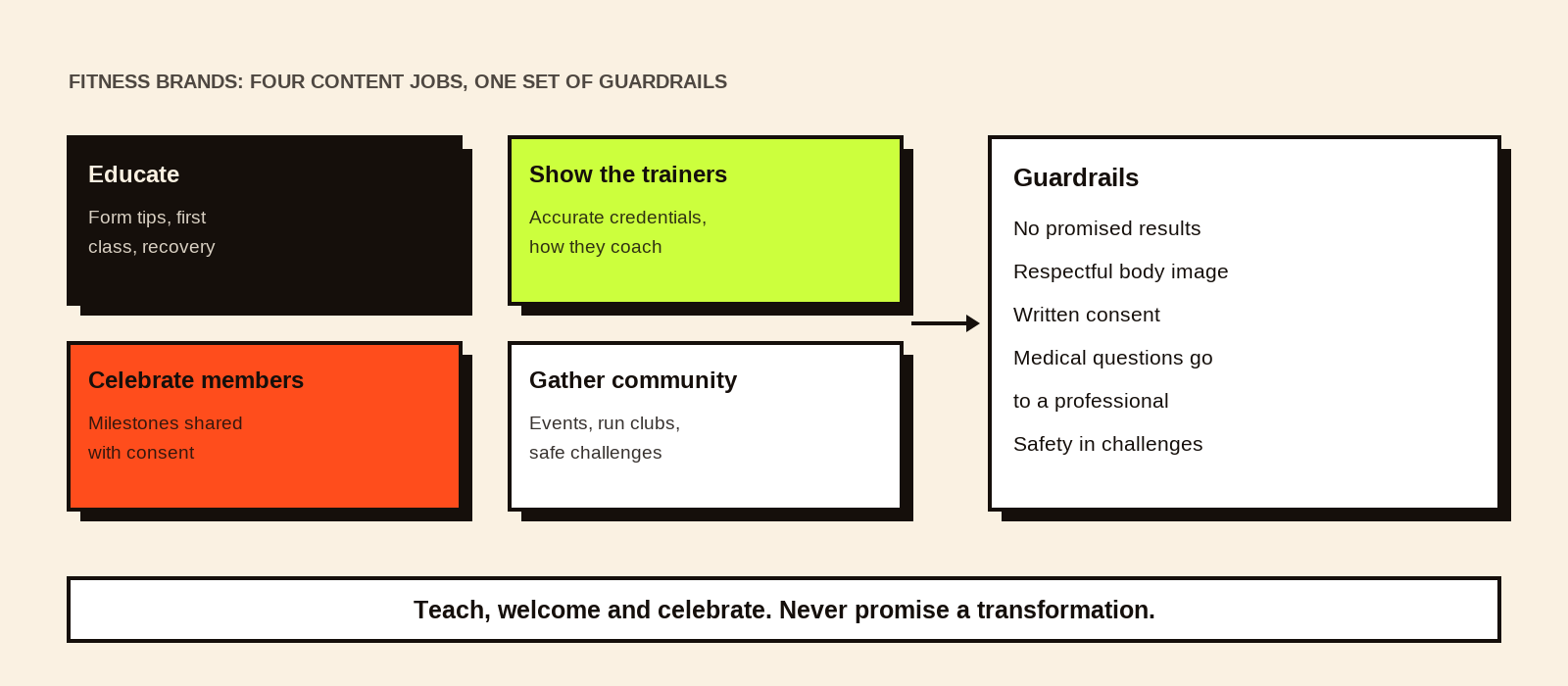
A studio posts a member's dramatic 90-day transformation with the caption 'You could be next'. It gets more likes than anything else that month. It also gets a DM from someone with a knee injury asking which class will fix it, a comment calling the 'before' photo humiliating, and a question from the member's colleague who didn't know she'd agreed to be featured. Fitness content wins attention easily. The work is making it responsible.
Quick answer
A social media strategy for fitness brands should centre on education, trainer expertise, class and facility content, member stories told with consent, and community. Avoid before-and-after transformations that promise results, keep body-image messaging respectful, state trainers' qualifications accurately, and plan challenges with safety in mind. Comment and DM questions about injuries or medical conditions should be directed to a qualified professional, not answered on social media.
What your feed is for
Whether you run a single gym, a chain of studios, a fitness app or an equipment brand, people come to your feed to judge three things: do these people know what they're doing, would I feel comfortable there, and is there a community I'd want to join. The feed should answer all three. Promotions and membership offers still matter, but they work better when the feed has already earned trust.
- Education: form tips, how to start, recovery basics, what a class involves.
- Trainer expertise: who your coaches are, what they specialise in and how they coach.
- Classes and facilities: what a session actually looks like, the equipment, the space at different times.
- Members and community: milestones, events, run clubs, member-led moments, shared with consent.
- Offers and updates: timetables, new classes, membership information, stated clearly.
Ground rules: claims, body image and qualifications
This is the section to agree with your owner or compliance lead before anything else, because it decides what your team and any agency can publish. A social media manager can flag risks, but the brand owns these decisions.
Results and claims
Under the ASCI Code, factual claims must be capable of substantiation. 'Lose 5 kg in 30 days' or 'guaranteed toned abs' are claims about results, and results vary with the person, diet, health and consistency. ASCI's guidelines on disclaimers use a weight-loss claim as an example of a disclaimer that can't be used to contradict the main claim. The safest course is to avoid promising weight loss, inches, transformations or health outcomes in your content at all.
Body image
ASCI's guidelines on harmful gender stereotypes say ads must not suggest that a person's happiness or emotional wellbeing depends on conforming to idealised body shapes, and must not imply that physique, for example being overweight, is why someone fails socially or professionally. Fitness content that frames a 'before' body as a problem to be fixed sits close to that line. Focus on strength, energy, skills, consistency and enjoyment rather than appearance.
Trainers' qualifications
State each trainer's qualifications exactly as they hold them: the certification name, the issuing body and any specialism. Don't upgrade 'certified personal trainer' to 'expert' or 'physio' to 'doctor'. ASCI's influencer guidelines, in an addendum on health and financial influencers, expect anyone giving health or nutrition advice in paid content to hold relevant qualifications and state them upfront. If a trainer's post moves into diet plans, rehabilitation or medical conditions, check that a suitably qualified professional is involved.
The resource: a monthly content plan
This plan assumes three or four feed posts a week plus Stories. Scale it up or down to what your team can sustain. Each week has a theme so planning is quick and the feed stays varied.
| Week | Theme | Example posts | Formats |
|---|---|---|---|
| 1 | Start here | What to expect at your first class; how to warm up; a trainer's tip on one common form mistake | Reel, carousel, Stories Q&A |
| 2 | Meet the team | Trainer profile with accurate credentials; 'why I coach'; a class from the coach's view | Reel, carousel |
| 3 | Community | Member milestone with consent (a first pull-up, a first 10K); a community run or event; member questions answered | Carousel, Reel, Stories |
| 4 | Inside the space | Timetable highlights; a new class explained; facility tour at a quiet hour; next month's event | Reel, Stories, static post |
Use the comments and DMs you receive as your idea bank. Questions such as 'Is this class okay for beginners?' or 'What should I eat before a morning session?' can become posts, with the second answered generally and a suggestion to consult a qualified nutritionist. Our guide to turning customer questions into content shows how to build these into recurring series, and our guide to an Instagram Reels strategy covers short-form planning.
Member stories, with consent
Member stories are the most believable content a fitness brand can share, and the most personal. Health, weight and body images are sensitive, and India's Digital Personal Data Protection Act, 2023, with the DPDP Rules notified in November 2025 and compliance being phased in, requires consent to be clear and informed and allows it to be withdrawn. For children, the PIB backgrounder on the Rules says verifiable consent from a parent or guardian is required. Check your exact obligations with a lawyer.
- Get written consent that names the specific post, the platforms and how long it will stay up.
- Let members review the final caption and visuals, and remove content promptly if they change their mind.
- Tell the story in the member's words, focused on what they can do, how they feel and what kept them going.
- No before-and-after body comparisons presented as typical or promised results.
- Never mention medical conditions, weight figures or health history unless the member has explicitly agreed, and even then think twice.
- For anyone under 18, get verifiable parental or guardian consent and keep identifying details out.
- Don't film members in changing areas or without their knowledge, and check that class footage doesn't capture people who haven't agreed.
For permission records and how to use customer content as evidence responsibly, see our guide to customer testimonials and UGC.
Challenges and events, planned safely
Challenges, such as a 30-day movement habit or a community 5K, build participation and give a month of natural content. Design them around consistency and participation, not extreme outcomes. State clearly that participants should check with a doctor if they have a health condition, offer scaled options, and avoid prizes for the most weight lost or the most dramatic change, which reward unsafe behaviour.
For in-person events, tell participants if you will be filming, give them a way to opt out (a coloured wristband works well), and get consent before featuring anyone individually. If you run a challenge as a structured campaign with creators or partners, our social campaigns service covers planning and coordination.
Platforms: where each kind of content fits
For most gyms and studios, Instagram does the heavy lifting: Reels for form tips and class energy, Stories for timetables and daily community moments, carousels for education. YouTube suits longer workouts or programme explainers if you have the production capacity. Local businesses should also keep their Facebook Page and Google listing current, because many people still check timings and reviews there. Fitness equipment and app brands may add LinkedIn for corporate wellness partnerships. Choose two platforms you can run well before adding more.
Creators are a separate channel. If you work with fitness creators, influencer marketing for sports and fitness brands covers creator selection, briefing and disclosure; this guide is about your own accounts.
Community management: when a question is medical
Fitness accounts receive a steady stream of personal questions: 'I have a slipped disc, which class should I take?', 'Is it safe to train while pregnant?', 'How much should I eat to lose weight?'. Your social team should never give individual medical or nutritional advice in comments or DMs, however well meant.
Thanks for asking, and we're glad you're thinking about training safely. Because this depends on your health history, please check with your doctor or a qualified physiotherapist first. Once you have their go-ahead, our coaches can talk you through suitable classes. Message us your number and the studio you'd like to visit, and our team will arrange a call.
Set up an escalation path: billing disputes, injury reports and complaints go to the studio manager, not the content team. Our guide to community management versus customer support explains where to draw the line, and community management within an agreed scope is part of our social media service.
Common mistakes
- Leading with transformation photos and 'results in 30 days' promises.
- Inflating trainers' credentials, or letting trainers give diet or rehab advice outside their qualifications.
- Featuring members, or filming classes, without clear written consent.
- Running challenges that reward extreme weight loss or ignore safety.
- Answering injury and medical questions in DMs.
- Posting only offers and promotions, with nothing that teaches or welcomes.
Where to start
Agree the ground rules first: no result promises, respectful body-image language, accurate credentials and a consent process for members. Then run the four-week plan above for a month, collect the questions people ask, and let those questions shape the next month.
If you need support with planning, short-form editing and community replies, our social media management service works within these guardrails, with medical, legal and membership decisions staying with your team.