How Professional Services Firms Can Use LinkedIn to Build Authority and Generate Enquiries
How consulting, legal, accounting and advisory firms can use LinkedIn: partner profiles vs the firm page, expertise-led posts, anonymised client questions, confidentiality, a four-week calendar and professional body rules.
A tax partner at a mid-sized firm writes a clear two-page note for clients the day a new notification comes out. It gets forwarded around WhatsApp groups and nobody remembers where it came from. The firm's LinkedIn page, meanwhile, has a logo, a hiring post from last year and very little else.
Quick answer
Professional services firms build authority on LinkedIn by publishing expertise, not promotion. Partners share explainers, commentary on regulatory and market changes, and answers to anonymised client questions on their own profiles, while the firm page acts as the consistent official record. Client confidentiality comes first, and law and CA firms must follow their professional body's rules on advertising and solicitation. Measure relevant enquiries and conversations, not follower counts.
Start with your professional body's rules
Before planning any calendar, check what your profession allows. What follows summarises official documents as we found them in November 2026. It isn't legal or ethics advice, and rules and their interpretation change, so confirm the current position with your professional body and your own counsel or ethics adviser.
Advocates and law firms
Rule 36 in Chapter II, Part VI of the Bar Council of India Rules says an advocate 'shall not solicit work or advertise, either directly or indirectly', and lists methods including circulars, advertisements, touts, personal communications and interviews not warranted by personal relations, newspaper comments, and photographs published in connection with cases they have been engaged in.
In a press release dated 17 March 2025, the Bar Council of India condemned advocates advertising legal services through social media, promotional videos and influencer endorsements. It called for the withdrawal of advertisements violating Rule 36, prohibited using celebrities or influencers to promote legal practice, and stated an 'absolute prohibition' on using social media or digital platforms to directly or indirectly solicit legal work. It also referred to its earlier directions to State Bar Councils in July 2024, following a Madras High Court judgment.
For law firms, that sets a much higher bar than for other businesses: no promotional posts, no publicity about your own cases or clients, no testimonials and no paid promotion by influencers. Whether a particular educational or commentary post is acceptable is a professional conduct question for the firm's partners, not for a marketing team or an agency.
Chartered accountants and CA firms
ICAI's advisory of 28 April 2020 explains that advertising of services is generally prohibited under Clauses (6) and (7) of Part I of the First Schedule to the Chartered Accountants Act, 1949, and that the proviso to Clause (7) permits a 'write-up' only within the Council's Advertisement Guidelines of May 2008. The same advisory says fees, including 'free of charge', should not be mentioned in any advertisement of services.
ICAI's website advisory of 14 October 2020 lists content members' and firms' websites must not carry, including client names and logos, testimonials with client names, awards given to the firm and videos other than educational videos. Its advisory of 22 October 2022 says members in practice may have social networking accounts, that a firm's account must follow the Advertisement Guidelines, 2008, and that members should use the 'CA' designation with 'utmost dignity'. Read these with ICAI's current Code of Ethics and the Ethical Standards Board's guidance.
Consultants and advisory firms
Management and strategy consultants usually aren't governed by a single professional body in the same way, but marketing communication still falls under advertising standards such as the ASCI Code, which expects claims about facts to be capable of substantiation. If your firm or partners hold a regulatory registration, for example as an investment adviser or with another sector regulator, that regulator's communication rules apply too. Check them with your compliance owner.
Partner profiles and the firm page do different jobs
| Partner profiles | Firm page | |
|---|---|---|
| Who owns it | The individual; it stays with them if they leave | The firm, with admin roles held by staff |
| Main job | Expert point of view, relationships, professional reputation | The official, consistent record of the firm's work and people |
| Typical content | Commentary, explainers, lessons, talks, anonymised questions | Explainers, publications, events, team news, hiring |
| Voice | First person, in the partner's own words | Clear, measured, consistent firm voice |
| Who writes | The partner, often with help drafting from their notes | Marketing team or agency, reviewed by a partner |
| Approval | The partner, plus a risk or ethics check on sensitive topics | Designated partner, against professional body rules |
In most firms, partners' profiles carry more trust than the page, because clients hire people. The page gives that trust a home: someone who reads a partner's post and checks the firm should find an accurate, active page. Page setup and admin roles are covered in LinkedIn company page management. For the wider idea of building authority through experts, see LinkedIn thought leadership marketing, which also covers working with external creators and specialists; executive influencer marketing on LinkedIn covers leaders building their own presence.
What to post: expertise without promotion
- Explainers on new laws, rules, notifications and standards, with the source and date.
- 'What changed' summaries that say who is affected and what to check.
- Common misconceptions in your area, explained calmly.
- Checklists, such as documents a business typically needs for a recurring filing or review.
- Commentary on published judgments, policy papers or market developments (for advocates, not on matters they are engaged in).
- Lessons and slides from talks partners have given.
- Firm news that isn't promotional: new publications, internal knowledge sessions, campus hiring.
Make general information obviously general. A short line such as 'This is general information, not advice on your situation' helps, but the content itself should avoid telling a reader what to do in their specific case.
Turning client questions into anonymised posts
The questions clients ask are the best guide to what other people want to know. To use them safely: strip out every identifying detail, generalise the facts, combine similar questions from several clients, never post about live matters, and have the responsible partner review the result. If anyone involved could recognise the situation, don't publish it. Our guide on turning customer questions into content covers formats.
Confidentiality checklist
- No client names, logos, transaction details or matter descriptions without written consent, and not at all where your professional rules prohibit it.
- No details that could identify a client through industry, location, size and timing combined.
- No photos from client sites or meetings, or of documents, screens or whiteboards.
- No comment on live matters, disputes or engagements, including your own wins.
- Team posts checked for anything visible in the background.
- A named partner reviews every post before it's published.
A four-week LinkedIn content calendar
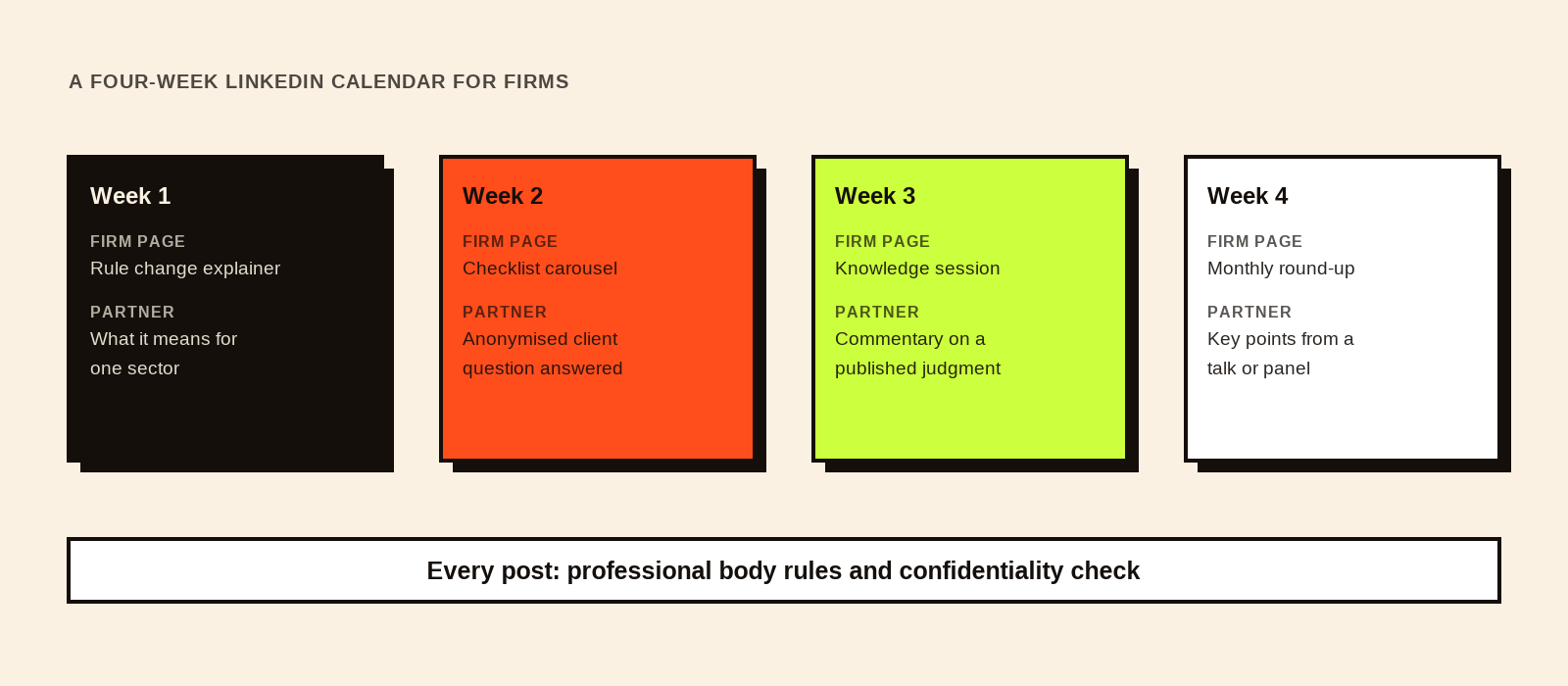
Here's a sample month for a hypothetical mid-sized firm with two partners willing to post. Adjust the volume to what your partners can genuinely review; law firms should remove anything that could read as promotion.
| Week | Firm page | Partner profiles | Check before publishing |
|---|---|---|---|
| 1 | Explainer on a recent regulatory change, with source and date | Partner A: what the change means in practice for one sector | Partner who owns the subject area |
| 2 | Checklist carousel or document post | Partner B: answer to a common, anonymised client question | Confidentiality check |
| 3 | Firm news: a publication, knowledge session or campus hiring | Partner A: commentary on a published judgment, notification or report | Risk or ethics partner for anything near a live matter |
| 4 | Longer article or newsletter summarising the month's topics | Partner B: key points from a talk or panel they joined | Final check against professional body rules |
Plan the firm page and partner posts in the same calendar so they support each other rather than repeat. Our approval process guide explains how to set review stages and turnaround times, which matters when partners are the bottleneck.
Measuring relevant enquiries, not applause
A post with modest engagement that the right general counsel or CFO reads can matter more than a viral one. Track whether the right people are noticing: comments and messages from your target sectors and roles, enquiries that mention a post or article, invitations to speak or write, referrals from other professionals, and interest from candidates.
| Measure | How to track it |
|---|---|
| Members reached and engagements | LinkedIn post analytics; LinkedIn's Help Centre counts reactions, comments, saves, sends and reposts as engagements |
| Relevant enquiries | A 'how did you hear about us' question at intake, logged in your CRM or a simple sheet |
| Speaking and writing invitations | A monthly note from partners |
| Candidate interest | Applications and questions that mention your content |
LinkedIn's definitions are in its Help Centre article on combined post analytics, current at the time of writing. For law firms, be careful how you frame this: treat LinkedIn as reputation and knowledge sharing, and keep any intake process within your professional rules.
Common mistakes
- Planning content before checking professional body rules.
- Posting about wins, clients or cases where your rules restrict it.
- Anonymised stories that are still recognisable to the people involved.
- Ghostwritten partner posts the partner hasn't read.
- Generic motivational posts that show no expertise.
- Treating follower growth as the goal.
An agency can help with planning, drafting from partner notes, design and publishing on the firm page. Kudozz's LinkedIn and social media support works on that basis: partners keep their own voice, and every professional conduct and confidentiality decision stays with the firm.
Where to start
Read your professional body's current guidance and agree in writing what the firm will and won't post. Then pick two willing partners, list the ten questions clients ask them most, and plan the first four weeks from that list, with a named reviewer for every post.