11 Influencer Marketing Ideas for Brands With Limited Budgets
Eleven influencer marketing ideas for Indian brands with limited budgets: focused seeding, barter, affiliates, UGC without posting, creator series, hyperlocal and regional creators, boosting proven posts, and a pilot first.
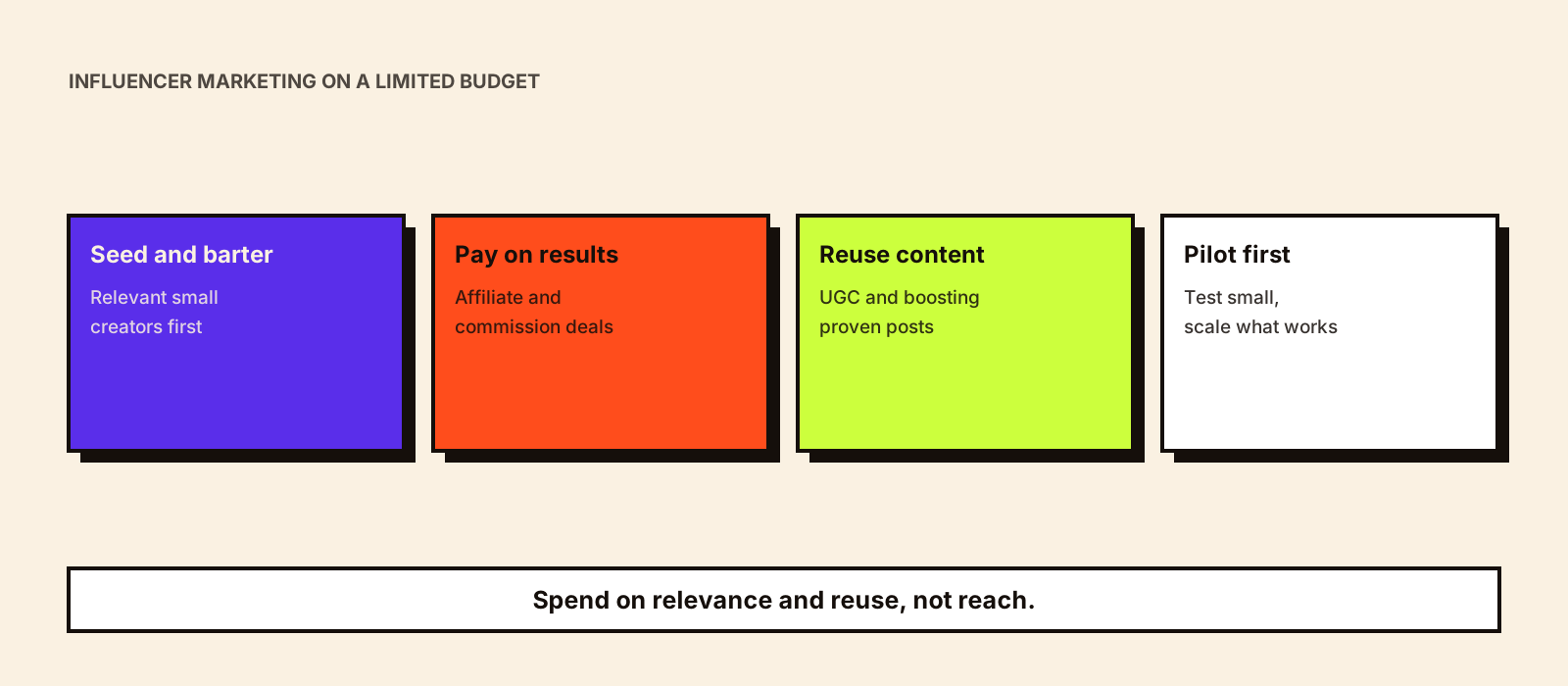
A small budget doesn't rule out influencer marketing, but it changes what you buy. You can't pay for a lot of reach, so the money has to go into relevance, content you can reuse and arrangements where creators earn when you do. These ideas are for Indian brands spending modestly, from a first campaign to a lean monthly programme.
Quick answer
The most budget-efficient influencer marketing ideas are product seeding to a tight shortlist of relevant nano and micro creators, written barter deals, commission-based affiliate partnerships, UGC you run on your own channels, a short series with one creator instead of many one-off posts, hyperlocal and regional-language creators, and putting ad spend behind one post that's already working. Run a small pilot first, track every creator with its own code or link, and disclose gifted and barter posts as clearly as paid ones.
All 11 ideas at a glance
| Idea | Where the money goes | Best for |
|---|---|---|
| Focused product seeding | Product and shipping | Awareness, feedback, finding creators to pay later |
| Written barter deals | Product or service | Small creators, services, restaurants and experiences |
| Commission-led affiliates | A share of sales | Online sales with clear tracking |
| UGC without posting | Content fee, not reach | Ads, product pages and email |
| One creator, a short series | A package fee | Building familiarity and trust |
| Hyperlocal creators | Small fees or visits | Stores, clinics, gyms, restaurants |
| Regional-language creators | Small to mid fees | Audiences outside the big metros |
| Boosting one proven post | Ad spend | Scaling what already works |
| Customers and employees as creators | Time and incentives | Proof and trust |
| Co-hosted Live or Q&A | A session fee | Questions before purchase |
| A pilot before committing | A fixed test budget | Learning what works first |
1. Focused product seeding
Send the product to a short list of nano and micro creators whose audiences match your customer, with no obligation to post. It costs product and shipping, and it tells you who genuinely likes the product before you pay anyone.
- How to run it: shortlist 15 to 30 creators by audience fit, send a short note about why you chose them, and follow up once. Note who posts, what they say and what their audience asks.
- Creators: nano and micro creators in your category or your customer's adjacent interests.
- Objective: awareness, product feedback and finding creators worth a paid deal.
Watch for: don't ask for a guaranteed post in exchange for a 'gift'; that turns it into barter. Creators who do post about a free product still need to disclose it. Running it as a programme is covered in influencer product seeding.
2. Written barter deals
Offer your product or service in exchange for agreed content. Barter suits restaurants, salons, hotels, experiences and higher-value products, where the item is worth something real to the creator.
- How to run it: agree in writing what will be posted, when, whether you can reuse it and how it will be disclosed. Value the product honestly so both sides understand the deal.
- Creators: nano and micro creators, local creators.
- Objective: content and local awareness without cash fees.
Watch for: barter is still a commercial arrangement. It has tax consequences in India and needs the same disclosure as a paid post; see barter influencer collaborations.
3. Commission-led affiliate partnerships
Pay creators a share of the sales they drive instead of, or on top of, a small fixed fee. You pay mostly when it works.
- How to run it: give each creator a unique code and link, set a clear commission and cookie window, pay on time and share a simple monthly statement.
- Creators: creators whose audiences already buy from their recommendations: deal, review and niche hobby creators.
- Objective: online sales.
Watch for: established creators rarely work on commission alone; offer a small fee plus commission. Tracking gaps (marketplaces, quick commerce) need planning; see influencer affiliate programmes.
4. UGC you run on your own channels
Pay creators to make content for your ads, website and emails without posting it on their own accounts. You pay for the content, not their audience.
- How to run it: brief two or three angles, ask for several hooks per video, and agree usage rights for the channels you'll use. Test the videos as ads with a small budget.
- Creators: UGC creators with strong portfolios; follower count matters less.
- Objective: conversion content for paid social and product pages.
Watch for: you need some ad budget for UGC to be seen. How fees are usually structured is covered in UGC content costs in India.
5. One creator, a short series
Instead of five creators posting once, work with one well-matched creator on three or four connected posts over a month. Repetition builds familiarity, and a package is often cheaper per post.
- How to run it: plan a simple arc (first impression, a week in, an honest verdict), agree the package and dates, and keep the brief light so it stays in their voice.
- Creators: a micro creator whose audience strongly overlaps your customer.
- Objective: trust and consideration.
Watch for: pick carefully; with one creator, a poor fit costs the whole budget. Longer arrangements are covered in long-term influencer partnerships.
6. Hyperlocal creators
For a store, clinic, gym, café or service in one city, a creator whose followers live nearby is worth more than a bigger creator whose audience is spread across India.
- How to run it: check audience location in screenshots, invite creators for a visit, and give each one a code or booking link for that location.
- Creators: city, neighbourhood and food or things-to-do creators.
- Objective: footfall, bookings and local awareness.
Watch for: measure visits or bookings by location, not only views. See how Indian brands can work with micro-influencers.
7. Regional-language creators
If your customers watch in Hindi, Tamil, Telugu, Marathi, Bengali or another language, creators who make content in that language can reach them more convincingly than an English national campaign.
- How to run it: brief in the creator's language or with a translated summary, let them adapt the message rather than translate a script, and track by language.
- Creators: regional micro creators in your category.
- Objective: reach and trust in Tier 2 and Tier 3 markets.
Watch for: check translations of claims and product names. Planning by language is covered in regional influencer marketing in India.
8. Put spend behind one proven post
Rather than buying more posts, take the post that's already performing and run it as an ad from the creator's handle. You spend money on content with evidence behind it.
- How to run it: agree ad-authorisation rights and a time limit in the original contract, then run the best post as a partnership ad to a lookalike or interest audience.
- Creators: any creator whose organic post clearly outperformed.
- Objective: scaling reach or conversions efficiently.
Watch for: creators usually charge for ad usage; negotiate it upfront. See Instagram partnership ads.
9. Customers and employees as creators
Happy customers and willing employees can produce believable content at very low cost. A review video from a real customer, or a staff member explaining how something is made, is often more persuasive than a polished ad.
- How to run it: ask customers who've left good reviews to share a short video, with consent to reuse it, and give employees simple guidelines and freedom to say no.
- Creators: existing customers, team members, founders.
- Objective: proof, trust and website content.
Watch for: employees and incentivised customers must disclose their connection; see employee influencer marketing.
10. Co-hosted Live or Q&A
Pay one credible creator for a live session or Q&A instead of several posts. People ask the questions that stop them buying, and the recording can be cut into short clips.
- How to run it: agree the topic, a rough run order and who answers product questions. Collect questions in Stories beforehand and pin a link or code during the session.
- Creators: experts and educators in your category.
- Objective: consideration for products that need explaining.
Watch for: have someone from the brand ready for technical questions, and keep claims to what you can support. See Instagram Live influencer marketing.
11. A small pilot before committing
Spend a fixed, small part of the budget to answer one question, such as which creator type or message works, before you spend the rest.
- How to run it: choose one question, set pass marks in advance, track every creator separately and decide what to scale.
- Creators: a mix of the creator types you're unsure about.
- Objective: learning which approach deserves the rest of the budget.
Watch for: a pilot too small to read is wasted. Sizing and pass marks are covered in how to run a pilot influencer campaign.
A sample brief for a seeding wave (hypothetical)
Hi [name], we make [product] for [skin concern]. We picked you because your audience asks about [concern] and you review honestly. We'd like to send you a full-size [product], with no obligation to post. If you do share it, please mark it as gifted ('#gifted' or 'gifted by @brand') and say what you really think. Here is a code [CODE] your followers can use for 10% off; it also helps us see what's working. Thanks, [name and contact]Where small budgets get wasted
- Spreading the budget so thin that no creator has a reason to care.
- Choosing creators by follower count instead of audience fit.
- No tracking, so you can't tell what worked.
- Paying for posts but not rights, so the best content can't be reused.
- Skipping disclosure on gifted or barter posts.
Conclusion
On a limited budget, put money where it's most likely to come back: relevant small creators, content you can reuse, commission-based deals and ad spend behind posts that have already proved themselves. Test small, track every creator and scale what works. Kudozz runs seeding and gifting programmes for brands starting out through its influencer seeding and gifting service.