Organic Social Media vs Paid Social Advertising: What Should Your Business Invest In?
Organic social builds a presence people trust; paid social buys reach and speed. This guide compares the two, explains how to think about budget by stage and goal, and shows how they work together without confusing two different jobs.
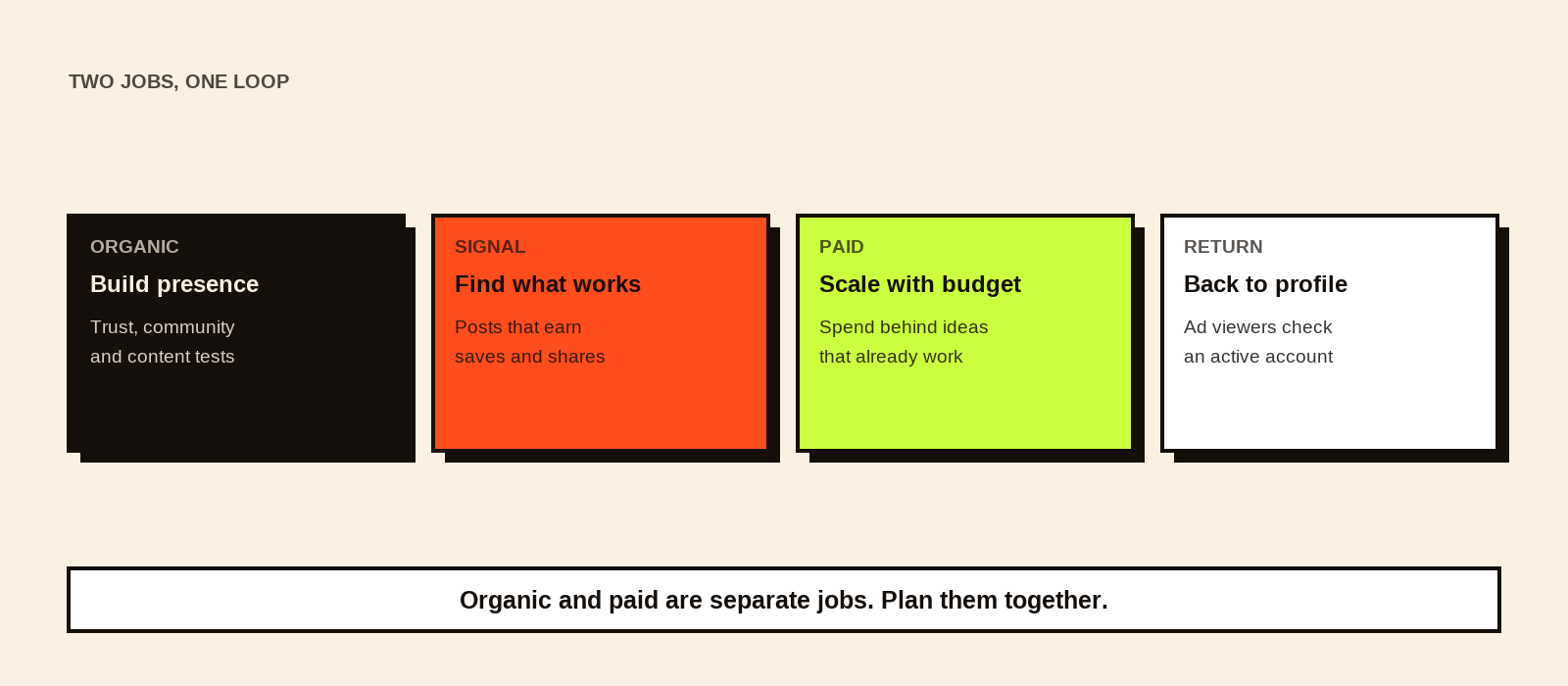
A founder boosts a post for ₹2,000 before Diwali, sees a spike in likes from accounts that look nothing like customers, and decides that ads don't work for the brand. Another brand runs ads for six months that send people to a profile with no posts since spring, and can't work out why visitors click and leave. Both are treating organic and paid social as one decision. They're two different jobs that happen to share a platform.
Quick answer
Invest in organic social first if people already look you up and you need a credible, active presence; it costs time and content rather than media spend, and compounds slowly. Invest in paid social when you need predictable reach, a specific audience or measurable conversions on a deadline. Most growing brands need both, run as separate jobs: organic builds trust and finds winning ideas, paid scales the ones that work.
What organic and paid social actually mean
Organic social is everything you publish on your own accounts without paying the platform to distribute it: posts, Reels, Stories, carousels, replies and community conversations. Who sees it depends on your followers, how people engage and how each platform's recommendation systems treat it.
Paid social is content the platform shows because you paid for delivery: ads built in a platform's ad tools, boosted posts, and creator content run as ads. You choose an objective, an audience, a budget and a schedule, and the platform's auction decides delivery and cost.
Organic vs paid social, side by side
| Factor | Organic social | Paid social |
|---|---|---|
| Main purpose | Presence, trust, community, education and content learning | Reach, targeted acquisition, retargeting and conversions |
| Cost structure | People and production time; no media spend | Media spend paid to the platform, plus people to plan, build and optimise campaigns |
| Speed | Slow and cumulative | Fast; delivery starts once ads are approved |
| Targeting | Limited to who follows, engages or is recommended your content | Chosen audiences, locations, interests, custom and lookalike audiences, within platform rules |
| Lifespan | Posts stay on your profile and can keep being found | Delivery stops when spend stops |
| Skills | Strategy, content, copy, design, video, community management | Campaign structure, audiences, bidding, creative testing, tracking and analysis |
| Measurement | Views, reach, engagement, saves, shares, profile activity, tracked clicks | Cost per result, conversions, return on ad spend, with attribution caveats |
Organic and paid are separate jobs
This is the point most budget conversations skip. Running organic social well means planning content, making it, publishing it and looking after the community. Running paid social well means setting up campaigns, choosing audiences, managing budgets daily, testing creative variations, checking tracking and reading results against cost. The skills overlap at the creative end and almost nowhere else.
When one person or one retainer is expected to do both without that being scoped, one of them usually suffers. Often the ads get run as an afterthought by whoever made the posts, or the content calendar thins out because campaign management keeps interrupting. If you're deciding how to staff this, our comparison of in-house and outsourced social media management covers the operating-model trade-offs.
How to think about budget by stage and goal
There's no correct percentage split, and anyone who gives you one without knowing your margins, category and stage is guessing. Use the questions below to decide where the next rupee and the next hour should go.
| Stage or goal | Lean towards | Reasoning |
|---|---|---|
| Pre-launch or new brand with no presence | Organic first | Ads to an empty profile waste money; people check the profile before they trust the ad |
| Launch with a fixed date | Both, with paid timed to the launch | Organic builds the story and proof; paid guarantees the launch reaches enough of the right people |
| Growth with proven unit economics | Paid gets more budget | If you know what a customer is worth and what one costs, paid can scale what already works |
| Building trust in a high-consideration category | Organic and creator content | Buyers research for weeks; depth and proof matter more than a burst of impressions |
| Retention and repeat purchase | Organic, community and owned channels | Existing customers already follow or message you; paid retargeting supports specific offers |
| Local footfall or enquiries | Organic plus small, tightly targeted local ads | A narrow radius keeps spend small; a well-kept profile and reviews do much of the persuading |
Three questions decide most cases. Can you afford to wait for organic to compound? Do you know your margin per order or lead well enough to judge ad costs? Do you have creative that has already shown it works, or would paid be testing from scratch?
When each one is the right tool
Organic is usually enough when
- Most of your sales come from referrals, repeat customers or search, and social mainly needs to reassure.
- Your audience is small and specific, and already knows where to find you.
- You're still learning what your brand should say, and testing ideas without spend is useful.
Paid is usually needed when
- You have a launch, sale or admission season with a deadline.
- You need to reach a defined audience your organic content isn't reaching, such as a new city.
- You want to retarget website visitors or people who engaged with your content.
- You have proof that a product converts and want to scale it while unit costs hold.
How organic and paid work together
Organic as a testing ground for ads
Your organic calendar is a free test lab. Posts that earn unusually high saves, shares or completion rates from your own audience are good candidates for ad creative, because they've already shown that the hook and message land. Paid then puts budget behind proven ideas rather than guesses. This isn't a guarantee, since a cold audience reacts differently from followers, but it's a better starting point than briefing ads from nothing.
Creator content in ads
Creator videos often perform as ads because they look native to the feed. On Meta, the official route is partnership ads. According to Meta's developer documentation on partnership ads, the ad shows both the brand and the partner account in its header, and the creator must give permission, either at account level or for a specific post, before the brand can run it. Instagram's creator guidance on partnership ads adds that the brand pays for the spend, and that formats like Reels, Stories, posts and carousels can run. These were the documented features at the time of writing (November 2026); check Meta's help pages before planning, as permissions and formats change.
Usage rights, duration and fees for this need to be agreed with the creator in writing. Our guides to testing and scaling UGC in paid social and to how creator whitelisting works cover the practical side.
Boosting a post vs using Ads Manager
Meta's Business Help Center has a page on the difference between boosted posts and Meta ads. In broad terms, boosting turns a post that's already on your Page or profile into an ad, with a simplified set of choices for goal, audience, budget and duration. Ads Manager is the full tool, with more control over campaign objectives, audiences, placements and creative, including running an existing post inside a properly structured campaign. Either way, it's paid advertising. The available options change, so check Meta's page before deciding.
- Boost when you want a quick, small push for a post that's already doing well, and the goal is simple, such as more people seeing it.
- Use Ads Manager when you care about a specific outcome like enquiries or purchases, need tracking, want to test variations, or plan to spend regularly.
- Either way, set the goal before spending. 'More engagement' bought from the wrong audience is how the founder in our opening ended up disappointed.
How to structure agency responsibilities
| Task | Organic social team | Paid social team |
|---|---|---|
| Content calendar, posts, Reels and captions | Owns | Gives input on ideas worth testing |
| Ad creative variations | Supplies source content and brand guidance | Briefs, versions and tests |
| Campaign setup, audiences, budgets | Not involved | Owns |
| Comments on organic posts | Owns within agreed scope | Flags comments on ads that need a reply |
| Tracking, pixels and UTMs | Uses UTMs on organic links | Owns ad tracking with your web team |
| Monthly reporting | Organic performance and content learning | Spend, cost per result and conversions |
Put both scopes in writing, even if one agency does both: who approves spend, who can change budgets, how quickly ad comments are handled, and how the two reports connect. Our guide to writing a social media agency brief has a section for this. For clarity on our own side, Kudozz's social media management covers organic work, and paid ads and ad budgets sit outside it, as our social media management scope sets out, and would be agreed separately.
Common mistakes
- Running ads to a profile that looks abandoned.
- Boosting every post by habit instead of choosing posts with a clear goal.
- Judging organic social on sales alone, or paid social on likes alone.
- Expecting the organic team to run campaigns 'on the side' without scope or skills.
- Using creator content in ads without written usage rights.
- Comparing organic reach with paid reach as if they were the same thing.
Measuring each properly starts with picking the right metrics for each job; our guide to social media KPIs by business goal sets those out.
The bottom line
Organic social earns trust and teaches you what your audience responds to. Paid social buys speed and reach for messages you already believe in. Decide by stage and goal, staff them as two jobs, and let the best organic ideas inform what you pay to scale.