In-House Social Media Team vs Outsourcing to an Agency: What Makes Sense for Your Business?
The roles a full in-house social media team needs, how it compares with an agency on control, speed, skills, cost categories and continuity, when each model fits, and how a hybrid setup works.
Your marketing executive has been running Instagram on the side for a year. Posting is patchy, Reels happen when someone remembers, and comments sit unanswered over weekends. The founder wants it fixed, and the two obvious options are to hire a proper team or hand it to an agency. Both cost real money, and both can fail for reasons that have little to do with talent.
Quick answer
Build in-house when social media is central to how you sell, you need real-time presence through the day, and you can hire and manage several specialists. Outsource when you need a full skill set quickly, your content needs are steady rather than minute-by-minute, and nobody internally can manage a creative team. Many brands settle on a hybrid: an in-house owner who knows the business, with an agency handling strategy, design, video editing and reporting.
What a full in-house team actually needs
The common mistake is to hire one 'social media manager' and expect them to cover everything. A consistent presence across two or three platforms draws on six distinct skills. In a small team some roles combine, but each one still has to be done by someone.
Strategist or social media lead
Decides platforms, content pillars, tone and posting rhythm, plans the monthly calendar against launches and offers, and owns the relationship with leadership. Without this role, the team produces content but nobody decides what it's for.
Graphic designer
Makes static posts, carousels, infographics and campaign creatives that follow brand guidelines and read well on a phone screen. Volume is high and steady, which is why design is often the first role brands hire.
Video editor
Cuts Reels and Shorts, adds captions and text overlays, and keeps a series looking consistent. Someone also has to shoot the footage, whether that's the editor, a team member with a phone, creators or a hired crew.
Copywriter
Writes captions, hooks, Reel scripts and calls to action in the brand's voice, and adapts them for each platform. If you post in Hindi, Tamil or other languages, you need someone fluent, not a translation tool.
Community manager
Replies to comments and messages, spots complaints early and passes them to support, and keeps the tone consistent. This is the role most affected by evenings, weekends and festive peaks.
Analyst
Pulls platform insights, connects them to website traffic and enquiries where tracking allows, and turns the numbers into next month's decisions. In small teams this often falls to the lead and quietly stops happening.
In-house vs agency, side by side
| Factor | In-house team | Agency |
|---|---|---|
| Control | Direct day-to-day control over priorities and output | Control through the scope, the calendar and approvals |
| Speed | Fast for reactive posts and real-time replies during working hours | Fast once the monthly cycle runs; ad hoc requests depend on scope |
| Skills breadth | Limited to the people you hire | Access to design, video, copy, strategy and reporting from one team |
| Cost categories | Salaries, hiring, tools, devices, training, management time, cover for leave | Monthly fee, plus shoots, ad spend, tools or extra platforms where scoped separately |
| Continuity | At risk when one key person leaves | The agency covers absences, but your account lead may change |
| Knowledge of the brand | Deep, built daily, close to product and customers | Built through onboarding and briefings; needs ongoing input from you |
| Scalability | Slow: more output means more hiring | Scope can be expanded for launches or festive peaks |
| Approvals | Informal and quick, but easily skipped | Formal rounds and turnaround times, which add structure and some lead time |
| Outside perspective | Can become inward-looking over time | Sees patterns across other brands and categories |
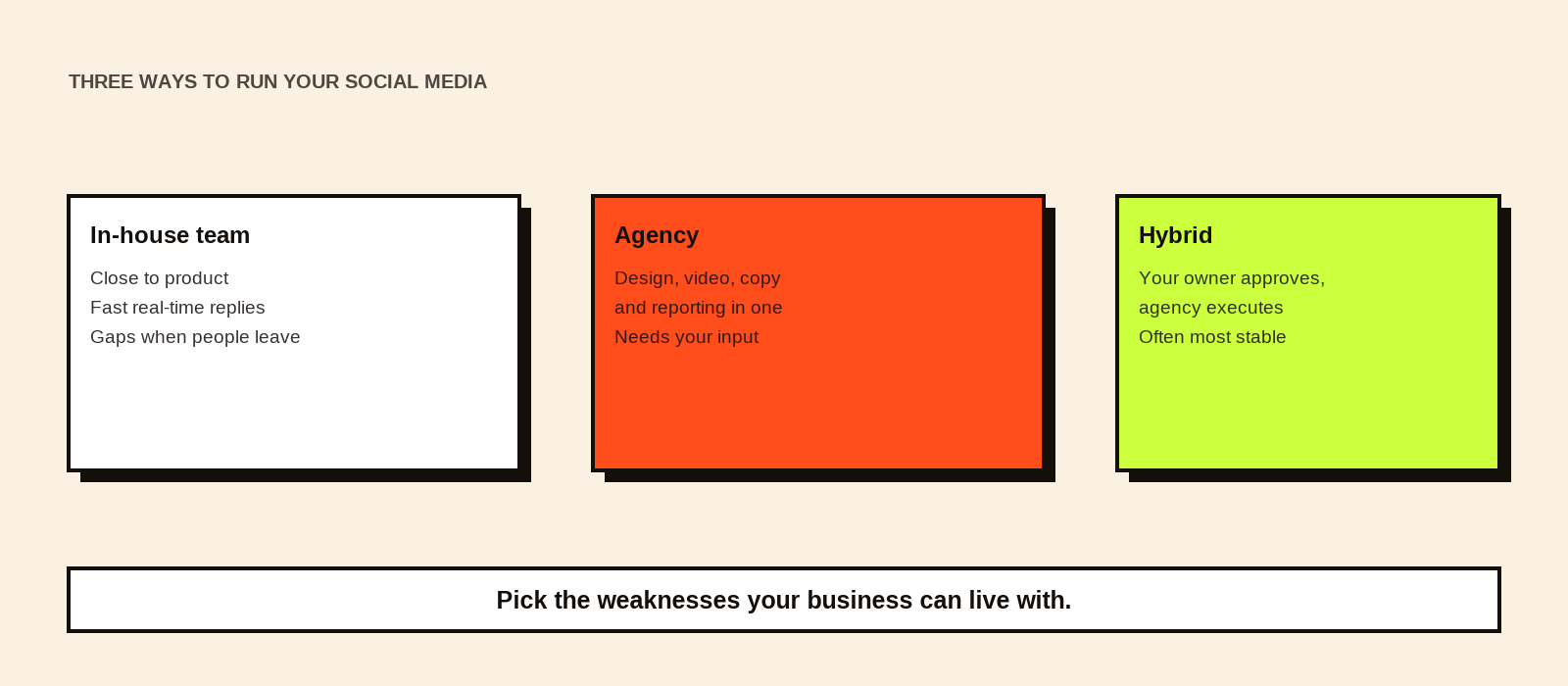
Neither column wins outright. The question is which weaknesses your business can live with. A brand that sells through live conversations on Instagram can't accept slow replies. A brand with a small marketing team can't accept six separate hires.
The costs that don't show up in a salary
Comparing one agency fee with one salary misleads in both directions. List every cost category for each model before you compare figures. The detail on what moves an agency quote is in social media management cost in India.
In-house cost categories
- Salaries and statutory benefits for each role, not just one hire
- Recruitment time and fees, plus the months before a new hire is productive
- Design, editing, scheduling and analytics software licences
- Laptops, phones, lighting and basic shooting kit
- Training as platforms change formats and features
- Your own time managing, reviewing and appraising the team
- Cover for leave, notice periods and replacement hiring
Agency cost categories
- The monthly management fee for the agreed scope
- Shoots, extra platforms, additional languages or campaign spikes outside scope
- Ad spend and ad management, which are usually separate budgets
- Your internal time for briefings, approvals and sharing product information
- Onboarding time, during which output is lower
When in-house makes more sense
- Social media is the main sales channel, for example orders taken through DMs.
- You need real-time presence: live events, news-led content, or constant customer conversation.
- Your product knowledge is hard to transfer, such as technical, medical or financial detail that needs daily expert input.
- You already have a marketing lead who can hire and manage creative people.
- You can sustain the full set of roles, or have a clear plan for which ones to combine.
When outsourcing makes more sense
- You need design, video, copy and reporting at once, and can't hire for all of them.
- Content needs are steady and plannable a month ahead.
- No one internally has the time or experience to manage a creative team.
- Your current setup depends on one person, and continuity has already been a problem.
- You want an outside view of what works across brands, not only inside your own.
- You plan to run creator campaigns alongside your own content and want them coordinated.
The hybrid model
Most brands that outsource well don't hand everything over. They keep ownership and business knowledge inside, and buy specialist capacity outside. Three common splits:
| Model | Who does what | Works when | Watch for |
|---|---|---|---|
| In-house owner, agency execution | Your marketing lead sets priorities and approves; the agency plans, creates, publishes and reports | You have one capable owner but no creative team | The owner becoming a bottleneck on approvals |
| Agency strategy, in-house creation | The agency sets strategy and calendars; your team creates and publishes | You have designers or editors but no strategist | Strategy that your team can't produce at the planned volume |
| In-house day-to-day, agency for peaks | Your team runs routine posting and replies; the agency handles launches, festive campaigns and video series | Demand spikes a few times a year | Inconsistent look between the two teams' work |
Community management is a common split too. Many brands keep complaints, orders and refunds with their own support team and let the agency handle routine comments within agreed hours. The same in-house-or-agency question for creator programmes is covered in influencer marketing agency vs in-house.
Decision checklist
- Which platforms matter, and how much content does each need per month?
- Does anyone need to reply in real time, and during which hours?
- Which of the six roles do you already have, even part-time?
- Who will own social media internally and approve content?
- Can that person manage creative hires, or only review work?
- How often do you have launches, offers or festive peaks?
- How hard is your product knowledge to transfer to outsiders?
- What happens today when your social media person is on leave?
- Do you plan creator or influencer campaigns that should connect with your own content?
- Have you listed every cost category for both models, not just one salary against one fee?
Common mistakes
- Hiring one junior generalist and expecting strategy, design, video and analytics.
- Outsourcing without naming an internal owner, so nobody approves or shares context.
- Comparing an agency fee with one salary and ignoring tools, management time and cover.
- Expecting an agency to handle customer support when it was hired for content.
- Switching models every few months before either has had time to settle.
- Running an in-house team and an agency without a shared calendar or style guide.
Practical recommendations
- Whichever model you choose, keep account ownership and admin access with the business.
- Name one internal owner with authority to approve content and set priorities.
- Write down the scope, even for an in-house team: platforms, volume, reply hours.
- If you outsource, keep a monthly review with the agency and someone senior on your side.
- If you build in-house, hire the strategist or lead first, then the roles they need.
- Review the model after two quarters, using the decision checklist again.
If you decide to outsource, the next steps are choosing a social media management agency and getting your side ready with the outsourcing social media management checklist. You can also see how social media management works at Kudozz, including which parts sit with the brand.
Making the call
In-house buys you closeness and speed; an agency buys you breadth and continuity. Work out which of those your business can least afford to lack, list the real cost categories for both, and remember that a hybrid with a strong internal owner is often the most stable answer.