How to Choose the Right Social Media Management Agency for Your Business in 2027
A practical way to compare social media management agencies: a scorecard with the evidence to ask for, 15 questions to ask before hiring, warning signs, and how to compare proposals like-for-like.
You've had three agency calls this week. Each showed a polished deck, a reel of other brands' work and a monthly fee. One offered 'twelve posts and eight Reels', another 'complete social media management', and the third wants a paid strategy phase before quoting anything. On paper they look similar. In practice they're offering three different jobs, and the one you pick will decide how your brand looks online for the next year.
Quick answer
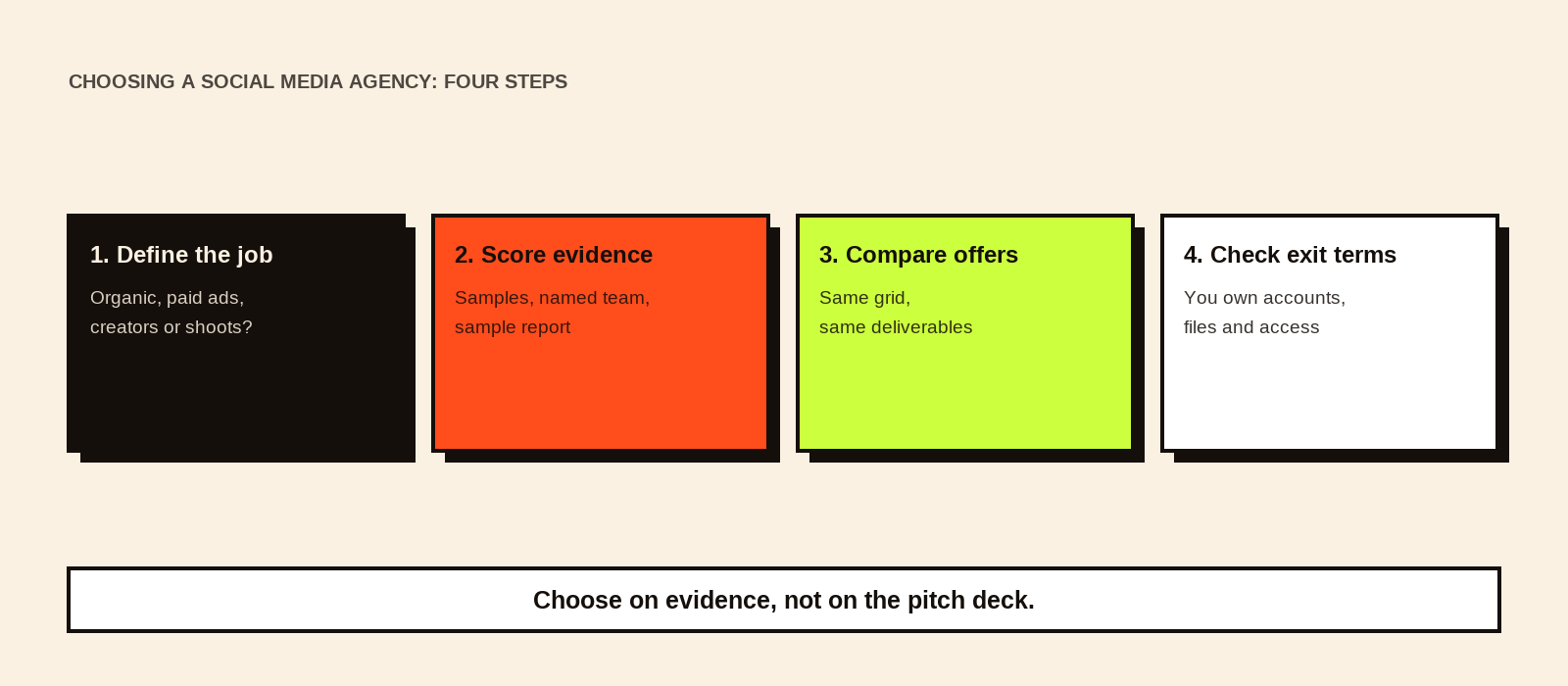
Choose a social media management agency on evidence, not the pitch deck. Define the job first: organic content, community management, paid ads, influencer work or a mix. Then score each agency on strategy, creative quality, video, copy, community handling, reporting, team and contract terms, using real samples, a named team and a written scope. Compare proposals on identical deliverables, confirm you keep ownership of accounts and content, and walk away from anyone promising follower numbers.
Define the job before you meet anyone
Most bad agency matches start with a vague brief. 'Handle our social media' can mean a few designed posts a week, or a full content operation with video, daily comment replies and monthly strategy reviews. Agencies quote what they think you mean, so you end up comparing different services at different prices.
Before the first call, write down which platforms matter, roughly how much content you expect each month, who on your side will approve it, and what the business needs social to do: build trust before purchase, support launches, generate enquiries, or recruit. If you haven't yet decided whether an agency is the right model at all, settle that first with our guide to in-house vs outsourced social media management. Turning these answers into a document agencies can respond to is covered in how to write a social media agency brief.
Organic, paid and influencer: know which capability you're buying
Three different skills often get sold under the label 'social media'. Some agencies do all three well, many do one well and outsource or improvise the rest. Ask directly which of these they do with their own team.
| Capability | What it involves | What to check | Usually in a management retainer? |
|---|---|---|---|
| Organic social management | Strategy, calendars, design, Reels editing, copy, publishing, community management, monthly reporting | Samples, monthly workflow, named team | Yes, this is the core |
| Paid social advertising | Campaign setup, audiences, budgets, ad creative testing, ad reporting | Who runs ads day to day, whose ad account is used, how budget is billed | Often scoped separately, with its own fee; ad spend is paid to the platform |
| Influencer marketing | Creator discovery, outreach, negotiation, contracts, disclosure checks, content approvals | Whether creators are sourced in-house, how creator fees are shown | Usually separate, with creator fees on top |
| Shoots | Photo and video production, crew, locations, talent | In-house team or vendors, who owns raw footage | Usually quoted per shoot |
None of these is better than the others. The point is to know what you're paying for: an agency strong in organic content may be the wrong choice if your real need is performance ads. If creators are part of your plan, check that capability with the same care you'd use when you choose an influencer marketing agency in India.
An agency evaluation scorecard
Score each agency from 1 to 5 on the criteria below, and ask for the evidence in the third column. Weight the criteria to your situation: a brand that runs on short video should weight video heavily, while a B2B company may care more about LinkedIn copy and reporting.
| Criterion | What good looks like | Evidence to ask for |
|---|---|---|
| Understanding of your business | They ask about customers, margins, sales cycle and approvals before talking about posts | A short written read-back of your brief after the first call |
| Strategy | Platform choices and content pillars tied to a business goal, with reasons for what they'd drop | An anonymised strategy document from a past client |
| Creative quality | Work that looks different from brand to brand and reads well on a phone | Recent posts and carousels they made, with the brief behind them |
| Short-form video | Reels planned as series, with scripts, hooks and clean edits | Raw footage next to the final edit; who scripts and who edits |
| Copywriting | Captions that sound like the brand, adapted per platform and language | Captions written for two different brands; regional language samples if you need them |
| Community management | Agreed hours, response times and clear escalation rules | A sample response guideline or escalation matrix |
| Reporting | Explains what worked and what changes next month, not only numbers | An anonymised monthly report |
| Process and approvals | A fixed monthly cycle with calendar dates, revision rounds and turnaround times | Their workflow calendar for a typical month |
| Team | Named people, with a clear day-to-day lead and realistic time on your account | Names, roles and how many other accounts each person handles |
| Compliance awareness | Checks claims, disclosures, music and image rights before publishing | How they review a post in a regulated category, such as health or finance |
| Contract and exit | You own accounts and content; fair notice period; clean handover | Their standard contract terms |
If you've used a scorecard for influencer agencies before, the logic is the same as in our influencer marketing agency checklist, but the evidence differs. Social media management is judged on consistency month after month, so the workflow and the team matter as much as the best piece in the portfolio.
15 questions to ask before hiring
- What would you need to know about our business before recommending anything?
- Which platforms would you recommend for us, and which would you leave out? Why?
- Who exactly will work on our account, and roughly how much of their time do we get?
- Can we see three pieces of work for a brand like ours, along with the brief behind each?
- How does a month run: when do we see the calendar, how many revision rounds are included, and what turnaround do you need from us?
- What is in the monthly scope, line by line, and what is charged extra?
- For video, do you edit our footage, run shoots, or work with creators? Which of these is in the fee?
- What are the community management hours and response times, and what gets escalated to our team?
- What does the monthly report contain? Can we see an anonymised sample?
- What do you do when a post draws an unexpected wave of negative comments?
- How do you check product claims, disclosures and music or image rights?
- Who owns the accounts, designs, raw files and templates if we part ways?
- What access do you need, and how will you get it without our passwords?
- What is the notice period, and what does a handover include?
- How would you work with our ads agency, influencer partners or in-house team?
Listen for specifics. 'We'll post consistently and grow your engagement' is not an answer to any of these. 'Calendar by the 20th, two rounds of revisions, you approve within three working days' is.
Warning signs
- Guaranteed follower counts, engagement rates or sales. Nobody controls platform distribution, and promises like these sometimes lead to bought followers or engagement groups.
- Asking for your account passwords instead of role-based access.
- Offering to create or hold your pages in the agency's own name.
- Portfolio pieces that all look alike across brands, which suggests templates rather than thinking.
- A pitch team you never see again, or no named team at all.
- 'Unlimited' posts or revisions with no definition of what a post or a revision is.
- A sample report that is a set of follower-count screenshots.
- Ad budgets bundled into the management fee, so you can't see what went to the platform.
- A long lock-in with no review point, or vague answers about what is out of scope.
How to compare proposals like-for-like
Proposals arrive in different formats, which makes them hard to compare. Rewrite each one into the same grid before you look at the fee. Where a proposal is silent on a line, ask. Silence usually means 'not included' or 'charged extra'.
| Line to fill for each agency | What to watch for |
|---|---|
| Platforms covered | Whether a 'cross-post' to a second platform counts as managing it |
| Static posts and carousels per month | Carousel slide counts; whether resized versions count as separate posts |
| Reels or short videos per month | Edited from your footage, from stock, or shot by them |
| Stories per month | Often left vague; ask for a number |
| Strategy deliverable | One-time document vs quarterly review |
| Copy and languages | Extra languages, transcreation, Reel scripts |
| Community management | Hours, days, response times, DMs vs comments only |
| Reporting | Monthly report, review call, what metrics |
| Revision rounds and approval turnaround | What happens when you exceed them |
| Shoots, ads management, influencer work | In scope, quoted separately, or not offered |
| Tools | Scheduling, design or listening tools billed to you |
| Term, notice period and GST | Minimum term; whether the fee includes GST or adds it |
Avoid dividing the fee by the number of posts. A cheaper cost per post often means less strategy, fewer revisions or no community management. What actually drives the difference between quotes is explained in social media management cost in India.
Access, ownership and exit terms
Your brand should own every account, page and ad account, and the agency should work inside them through role-based access. On Meta, a business portfolio lets you give a partner business access to your assets, as described in Meta's Business Help Centre, so nobody needs your login. LinkedIn Pages have separate admin roles, at the time of writing (November 2026) Super admin, Content admin and Analyst, so an agency can post without being able to remove your admins. Keep the highest role with someone on your payroll.
In the contract, check that final designs, edited videos, captions and editable source files transfer to you, that any stock music or images were licensed for your use, and that the agency hands back access and files within a set period after notice.
Common mistakes
- Choosing on the best portfolio piece instead of the work produced month after month.
- Letting each agency define the scope, then comparing fees that cover different jobs.
- Hiring an organic content team and expecting it to run paid ads well, or the reverse.
- Not naming one approver on your side, then blaming the agency for slow publishing.
- Judging the first month on follower growth rather than on whether the system works.
Practical recommendations
- Shortlist three or four agencies, not ten. You can't do proper diligence on more.
- Send all of them the same brief and the same deadline.
- Score them on the scorecard above before anyone discusses price.
- Meet the person who will lead your account day to day, not only the founder.
- Start with a defined term and a review point, such as the end of month three.
Once you've signed, prepare your side with the outsourcing social media management checklist. For a reference point, here is what a managed social media service from Kudozz includes and scopes separately, and how we work with brands more generally.
Where to start
Write down the job before you talk to anyone, then ask every agency for evidence rather than promises. A good social media management company will be specific about scope, team, process and ownership, and comfortable telling you what it doesn't do. If two agencies score close, pick the one whose monthly process you understand best.