How to Write a Social Media Management Agency Brief: A Checklist for Brands
A copy-ready social media agency brief template, the questions to answer before you write it, a scope and deliverables checklist, what to share before and after an NDA, and how to run a fair agency process.
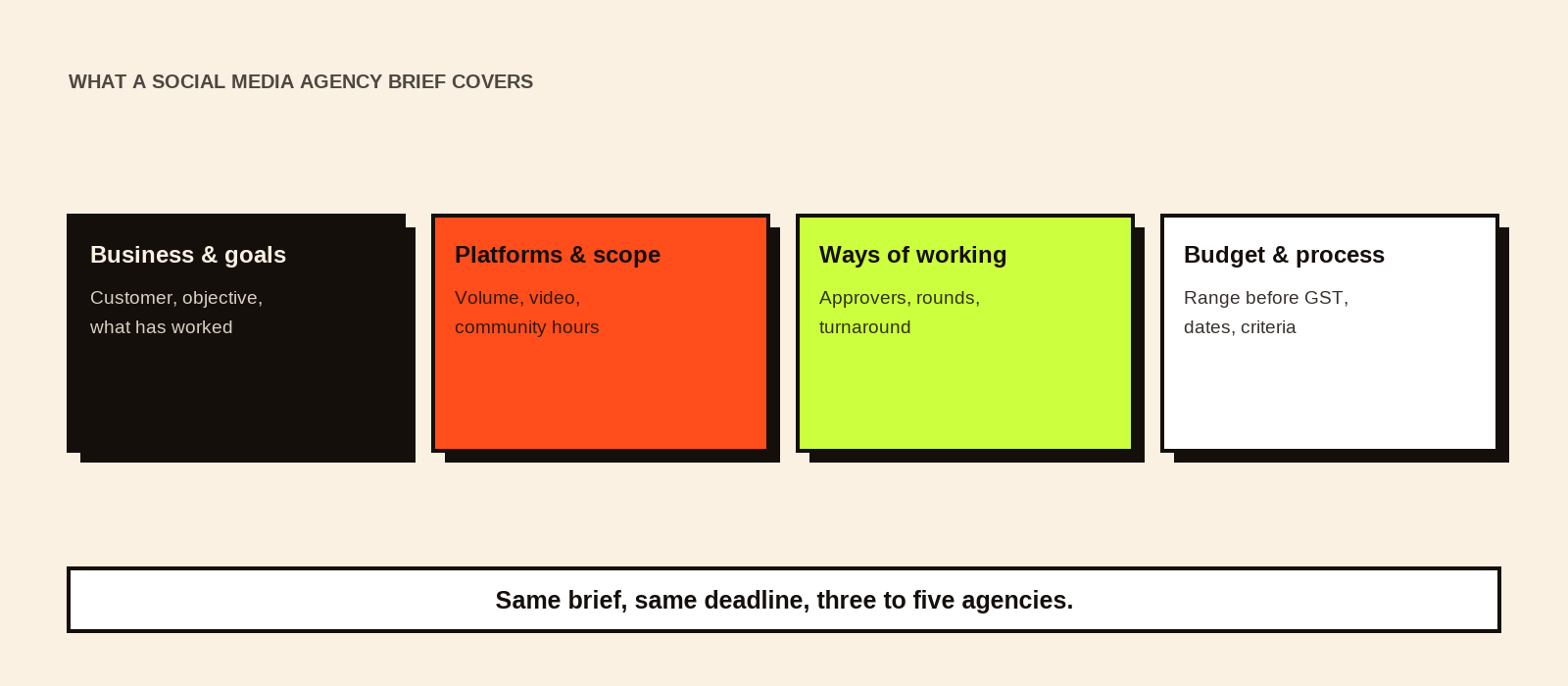
A founder sends a two-line WhatsApp message to five agencies: 'Need someone to handle our Instagram and LinkedIn. Please share your packages.' Five PDFs come back, each describing a different service at a different price, and none of them mentions the product launch in March. The problem wasn't the agencies. It was the brief.
Quick answer
A good social media agency brief tells agencies what your business does, what social media should achieve, which platforms and how much content you need, how approvals and community management will work, your budget range, timelines and how you'll decide. Answer the key questions internally first, use a fixed template so proposals are comparable, keep sensitive data for after an NDA, and send it to three to five agencies at the same time.
Answer these questions before you write
Most weak briefs are weak because the brand hasn't agreed internally on what it wants. Get the founder, marketing lead and whoever approves content to answer these together:
- What should social media do for the business in the next 6 to 12 months: trust before purchase, launches, enquiries, hiring, community?
- Who is the customer, and where do they actually spend time online?
- Which platforms are non-negotiable, and which are you unsure about?
- What has worked and not worked on your accounts so far?
- How much content can you realistically review and approve each month?
- Who approves content, and how fast can they turn it around?
- Can you supply footage and product photos, or will content need shoots?
- Who handles complaints, orders and refunds that arrive through social media?
- Are paid ads, creator campaigns or shoots part of this brief, or separate?
- What budget range is realistic, and for what term?
If you can't answer the last two, read how the monthly cost is built in social media management cost in India first. If your accounts have history, a quick social media audit gives agencies far better context than a description from memory.
Scope and deliverables checklist
These are the social media management requirements agencies need in order to quote accurately. Tick each one as 'in scope', 'out of scope' or 'please advise'.
- Strategy: audit, platform recommendations, content pillars, brand voice guidelines
- Monthly content calendar and planning call
- Static posts and carousels: number per platform per month
- Reels or Shorts: number per month, and whether footage comes from you, creators or shoots
- Stories: number per week
- Copy: captions, hooks, Reel scripts, languages
- Scheduling and publishing
- Community management: platforms, days, hours, response time, comments and DMs
- Escalation route for complaints, orders and sensitive questions
- Monthly reporting and review meeting
- Festive, sale and launch campaigns in the period
- Paid ads management (state if this is a separate brief)
- Influencer or UGC content (state if this is a separate brief)
- Photo or video shoots
- Tools the agency should use or that you already pay for
Social media agency brief template
Copy this into a document, fill in every bracket, and send the same version to every agency.
1. ABOUT US
Company, what we sell, price range, where we sell (website, marketplaces, stores, B2B)
Who our customer is: [age, city tier, language, what they care about]
Competitors or brands we admire on social, and why: [ ]

2. WHAT SOCIAL MEDIA SHOULD DO FOR US
Main objective for the next [6/12] months: [ ]
How we'll judge progress: [e.g. reach, engagement on Reels, profile visits, website clicks, enquiries]
What we will not judge it on: [ ]

3. CURRENT STATE
Accounts and handles: [ ]
What has worked / not worked: [ ]
Who runs it today: [ ]
Brand guidelines available: [yes/no]  Past content library: [yes/no]

4. SCOPE
Platforms: [ ]
Content per month, per platform: static [ ] carousels [ ] Reels/Shorts [ ] Stories [ ]
Video source: [our footage / creators / shoots needed]
Languages: [ ]
Community management: days [ ] hours [ ] response time [ ] DMs [yes/no]
Reporting: [monthly report / review call]
Known campaigns and dates: [launches, sales, festive periods]
NOT in this brief: [paid ads / influencer campaigns / shoots / customer support]

5. HOW WE WORK
Approvers: [names/roles]  Revision rounds expected: [ ]  Our turnaround: [ ] working days
Other agencies or teams you'll work with: [ads, PR, website]
Category rules: [claims we can't make, regulated topics]

6. BUDGET AND TERM
Monthly budget range for management, before GST: [ ]
Separate budgets (not to be included in your fee): [ad spend, creator fees, shoots]
Preferred term: [ ] with review after [ ] months

7. WHAT WE'D LIKE IN YOUR RESPONSE (max [ ] pages)
a) Your read of our objective and audience
b) Recommended platforms and what you'd leave out
c) Sample content approach for one month (no full creative needed)
d) Monthly deliverables, line by line
e) Team: names, roles, who leads day to day
f) Process: calendar dates, approvals, community management, reporting
g) Fee before GST, what's included, what's extra
h) Two relevant work samples and one anonymised monthly report
i) Standard contract terms: term, notice, ownership of accounts and files

8. HOW WE'LL DECIDE
[Criteria and weights, e.g. understanding of our business 25%, creative quality 25%, process and team 20%, reporting 10%, fee 20%]

9. PROCESS AND DATES
Questions by [date] to [email]; answers shared with all agencies
Responses by [date]; meetings [dates]; decision by [date]; start [date]
Unpaid response, no spec creative expected. Ideas in responses remain the agency's unless we hire or pay for them.
If you've briefed an influencer agency before, the structure will feel familiar, but the emphasis is different. An influencer marketing agency brief centres on a campaign and its creators; a social media brief centres on an ongoing monthly operation, so the scope, approvals and community management sections carry more weight.
What to share now and what to keep for after an NDA
| Share in the brief | Share after shortlisting and an NDA | Share only after signing |
|---|---|---|
| Business overview, customer description, goals | Sales figures, margins and channel mix | Account access, through role-based permissions |
| Public account handles and what's worked | Unannounced launches and pricing plans | Full content library and raw footage |
| Brand guidelines (public parts) | Internal performance dashboards | Approver contact details and escalation numbers |
| Budget range and term | Detailed competitive strategy | Customer service processes and templates |
| Timelines and decision criteria | Category legal guidance you've received | Login-free shared folders for assets |
Never send passwords or customer lists at the brief stage. Customer personal data shouldn't go to a pitching agency at all, and after signing, account access should be given through each platform's admin or partner roles rather than shared logins.
How many agencies, and how to run a fair process
Three to five agencies is usually the right number. Fewer gives you little to compare; more makes it hard to give each response proper attention, and good agencies are less likely to invest in a pitch they see as a lottery.
- Send the same brief to everyone on the same day, with the same deadline.
- Set one window for questions and share all answers with every agency.
- Tell agencies how you'll decide, including criteria and weights.
- Don't ask for full creative campaigns unpaid. A one-month content approach is enough to judge thinking.
- Meet the people who would actually run your account.
- Score responses with the same scorecard, ideally with two people scoring separately.
- Tell every agency the outcome, including the ones you didn't choose.
- Don't use an agency's ideas from a pitch unless you hire or pay them.
For a larger organisation that needs procurement sign-off, the more formal structure in our influencer marketing RFP guide adapts well to social media management. To score responses, use the scorecard in how to choose a social media management agency.
Common mistakes
- Asking for 'packages' instead of describing the work, then comparing prices for different scopes.
- Leaving out launch and festive dates, so proposals ignore your busiest months.
- Hiding the budget entirely, which produces proposals at every price level.
- Mixing paid ads, influencer campaigns and organic management in one vague scope.
- Not saying who approves content or how quickly, so agencies can't plan a workflow.
- Asking for unpaid spec creative, which favours agencies with time to spare over careful ones.
- Changing the brief for one agency mid-process without telling the others.
Practical recommendations
- Keep the brief to three or four pages. Agencies should spend time thinking, not decoding.
- Share a budget range before GST, with ad spend and creator fees clearly outside it.
- Attach two or three posts you like and two you don't, with one line on why.
- Name what's out of scope as clearly as what's in.
- Hold a 30-minute briefing call for shortlisted agencies to ask questions.
- Once you've chosen, prepare your side with the outsourcing social media management checklist.
If you'd like to see how one agency structures this work, what an agency like Kudozz includes in social media management sets out the standard scope and what sits outside it, and how we work with brands covers the wider service mix.
Where to start
Spend an hour with your approvers answering the questions above, then fill in the template. The brief does most of the work in an agency search: a clear one produces comparable proposals, honest pricing and a realistic first month.
Keep the final brief. It becomes the starting point for the scope annexe in your contract and the benchmark for your first quarterly review.