Social Media Management for Car Dealerships: Content That Supports Local Discovery and Test-Drive Enquiries
A practical guide to running a car dealership's own social accounts: content for each stage of the buyer journey, OEM guidelines, fair comparisons, offers with terms, test-drive enquiry handling and lead tracking.
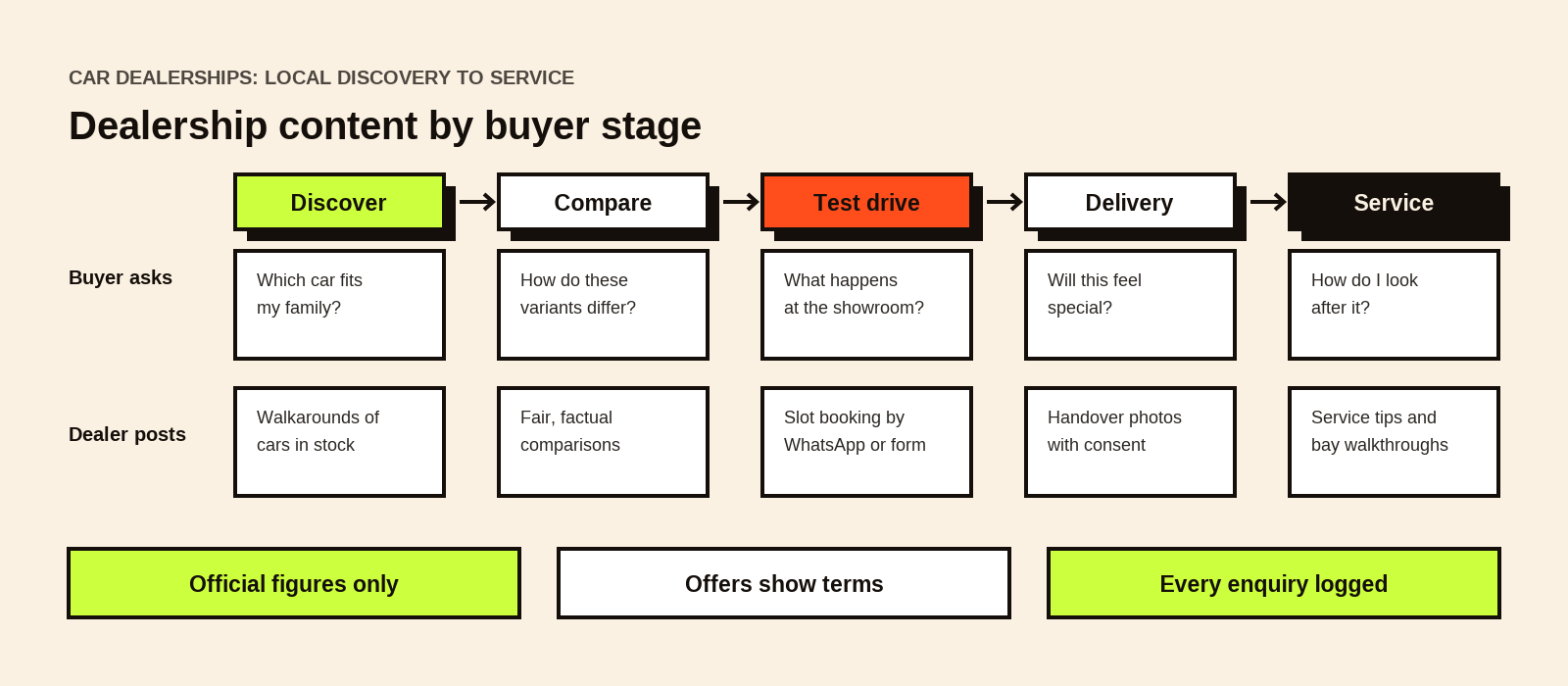
A buyer in your city has narrowed it down to two SUVs. They have watched the national launch film, read the brochure and seen a dozen reviews. What they still want to know is local: is the colour they like in stock nearby, how long does a test drive take, what does the first service cost, and are the people at your showroom easy to deal with? Most dealership feeds answer none of this, because they repost the brand's ads.
Quick answer
Social media management for car dealerships should make the showroom and service centre feel known before the visit. Post vehicle walkarounds, feature explanations, fair comparisons, service education, team and delivery content (with consent) and local updates, all inside OEM brand guidelines. Use only official figures for mileage and safety, show offer terms, and route every enquiry into a tracked test-drive journey so you can see which content brings real visits.
What the dealership's own accounts are for
The manufacturer runs national brand marketing. Your accounts do a different job: local discovery, trust in your people, and getting enquiries into the showroom. That means content the OEM can't make, filmed at your premises, by your team, about your stock, your service bay and your city.
Most manufacturers give dealers brand guidelines covering logos, model names, approved images, how offers are worded and, often, which posts need approval or qualify for co-operative marketing support. Treat those guidelines as part of your brief. New model announcements are a particular risk: never post leaked images, specifications or prices ahead of an OEM embargo, and use only the launch assets and wording the manufacturer approves.
This guide covers the dealership's own pages. Paid local creator campaigns are a separate job, explained in influencer marketing for automotive dealerships.
A buyer-journey content matrix
Plan content around the questions buyers ask at each stage, not around the models you most want to push. This matrix is a practical starting point.
| Stage | Buyer's question | Dealership content | Next step offered |
|---|---|---|---|
| Discover | Which cars fit my budget and family? | Walkarounds, 'who this model suits' explainers, variant overviews | Save, follow, ask a question |
| Compare | How do these two models or variants differ? | Fair, factual comparisons using official specifications | Book a test drive of both |
| Test drive | What happens at the showroom? | Test-drive process, showroom tour, team introductions | Pick a slot by WhatsApp or form |
| Purchase | What is the process and paperwork? | Booking-to-delivery steps, document lists, finance explained generally | Talk to a sales consultant |
| Delivery | Will this feel special? | Delivery moments shared with the customer's consent | Share, tag, refer |
| Ownership | How do I look after the car? | Service schedules, maintenance tips, service bay walkthroughs | Book a service |
Content ideas that work for dealerships
- Walkarounds of a model in stock, filmed in your showroom, with the colour and variant named.
- One-feature explainers: how a feature works, shown in the car, in under a minute.
- Variant explainers: what you get as you move up the range, using the OEM's specification sheet.
- 'First 10 minutes in the car': seat, mirrors, infotainment pairing and key controls.
- Service education: what happens at a periodic service, why tyre pressure matters, warning lights explained.
- Service bay walkthroughs that show your technicians and process.
- Team introductions: sales consultants, service advisers, the person who hands over the keys.
- Customer delivery moments, with written consent.
- Local updates: showroom hours, holiday timings, events, test-drive days.
- Accessory and care content, with prices only when current and confirmed.
- FAQs from your enquiry desk, answered generally.
- Safe-driving reminders, especially around festivals and monsoon.
Comparisons must be fair and factual
Comparison posts are popular, and they are where dealerships can slip. Chapter IV of the ASCI Code allows comparisons only if it is clear what is being compared, the comparisons are factual, accurate and capable of substantiation, they don't mislead about either product, and they don't unfairly denigrate competitors. Compare like with like (variant against variant), take every figure from the official specification sheet, and date the comparison. Many dealers only compare models within their own brand's range, which avoids most of the risk.
Mileage, safety, price and availability claims
Quote fuel efficiency, range or safety ratings only from the manufacturer's official figures or the official test or rating body, state the source, and use the exact wording, for example 'certified fuel efficiency' rather than 'real-world mileage'. Never imply a safety rating that belongs to another variant or model year. Say 'available' or 'in stock' only when it's true today, and remove outdated posts. ASCI's guideline on disclaimers, dated 13 July 2023, sets expectations for how conditions supporting a claim are shown; in practice, every offer post should state the validity period, eligible variants and where full terms can be read.
ASCI's self-regulation guidelines for advertisements depicting automotive vehicles (1 April 2008) say ads shouldn't show traffic violations, speed or manoeuvrability that encourages unsafe driving, or stunts needing professional skills in normal traffic. Apply that to every Reel your team films: seat belts on, phones down, no speeding shots on public roads.
The test-drive enquiry journey
Content only matters if enquiries are handled well. Decide in advance where enquiries go, who answers them and how fast. A simple journey:
- One clear action in the bio and on each post: 'Book a test drive' leading to WhatsApp or a short form.
- A first reply that asks only what you need: model, preferred date and time, and location.
- WhatsApp Business away messages for out-of-hours enquiries and quick replies for common questions, both available in the WhatsApp Business app.
- Confirmation of the slot with the consultant's name and the showroom's map link.
- A reminder the day before, and a follow-up after the drive.
- Every enquiry logged with its source, so you know which content brought it.
Google Business Profile is a related channel that often drives more local visits than social posts do. Google's help pages describe Updates, Offers and Events posts on a profile; keep hours, photos and offers consistent with your social pages. If you run several showrooms or a separate service centre, our guide to social media management for multiple locations covers local pages and governance.
Customer stories and delivery photos
Delivery photos are some of the most liked dealership posts, and they involve real people, their families and sometimes their registration plates. Ask before you shoot, explain where the photo will appear, and get written consent (a simple form at handover works). Offer to blur number plates and avoid children's faces unless a parent has consented. If a customer later asks you to remove a post, do it promptly. India's Digital Personal Data Protection Act, 2023 governs how personal data is used, and the DPDP Rules were notified in November 2025 with an 18-month phased compliance period, according to the Press Information Bureau; check your obligations with counsel.
A local content calendar
A dealership calendar mixes fixed beats (new stock, service reminders) with local moments. Use this weekly rhythm as a template and adjust it to your OEM's launch schedule and your city's festivals.
Monday: Walkaround of a model in stock (Reel)
Tuesday: One-feature explainer or variant guide (carousel)
Wednesday: Service education tip or service bay walkthrough
Thursday: Team introduction or 'what happens at a test drive'
Friday: Offer post with validity and terms, if an OEM-approved offer is running
Saturday: Delivery moment (consent on file)
Sunday: Local update, community event or safe-driving reminder

Monthly additions: OEM launch assets (after embargo), festival booking reminders, monsoon or winter car-care series
Before publishing: OEM guideline check, figures checked against official specification sheet, offer terms attached
If you want a full monthly planning format, see our monthly social media content calendar guide.
Lead tracking
Dealerships already track walk-ins and bookings. Add social as a source with enough detail to learn from it.
| Field | Why it matters |
|---|---|
| Source and post or theme | Shows which content types start real conversations |
| Model and variant of interest | Guides which walkarounds and explainers to make next |
| Response time | Slow replies lose test drives; track it weekly |
| Test drive booked and completed | The clearest sign that social is doing its job |
| Booking or service appointment | Links content to revenue without over-claiming |
| Reason lost, if known | Feeds back into FAQ and comparison content |
Report trends monthly, not single viral posts. A walkaround with modest reach that leads to five completed test drives is worth more than a trending Reel with none. If enquiries also reach you through Facebook, keep that page's details, messaging settings and reviews in order too; our guide to Facebook Page management for businesses covers the basics.
Common mistakes
- Reposting national OEM ads instead of making local content.
- Posting a competitor comparison built from brochure screenshots and opinions.
- Quoting mileage or safety figures from forums, reviews or a different variant.
- Offer posts without validity dates or terms, left up after the offer ends.
- Delivery photos posted without the customer's consent.
- Leaking a new model before the OEM's embargo lifts.
- Enquiries arriving in DMs with no one assigned to answer them.
Where to start
Start with the enquiry journey, because good content wasted on slow replies helps no one. Then build a four-week calendar from the buyer-journey matrix, gather your OEM guidelines and official specification sheets in one shared folder, and introduce your team on camera.
If you'd rather hand over planning, editing and publishing, a managed social media team like Kudozz's can run the calendar inside your OEM's rules while your sales and service teams handle the enquiries.