Social Media Management for Doctors: How to Build a Professional and Consistent Online Presence
How an individual doctor in India can run a professional social media presence under the NMC's October 2026 guidelines: profile details, what to post in your own name, patient DMs, misinformation, a monthly publishing framework and what help is safe to take.
You finish OPD at 8 pm, open Instagram and find twenty follow requests, two patients asking about their reports in DMs, and a relative's forwarded Reel claiming a kitchen remedy replaces insulin. You'd like to post something useful, but you have twenty minutes and no idea which of your ideas the new NMC rules allow. This guide is for the individual doctor's own professional presence, not a clinic or hospital account.
Quick answer
Social media management for doctors in India means running your profile as a professional record and an outlet for general health education, not a marketing channel. Under the NMC's guidelines of 6 October 2026, your posts should disclose your name, qualifications, registration status and SMR or NMR number, must not solicit patients or promote your practice, and can include education and talks in your own name. A short monthly framework and firm DM boundaries keep it sustainable.
Personal profile, clinic account or both?
Most doctors end up with more than one presence, and mixing them causes problems. Decide what each account is for before you post anything:
| Account | What it's for | Who runs it | Guide |
|---|---|---|---|
| Your professional profile as a doctor | Education within your specialty, talks and articles in your own name, formal announcements | You, with any help working under your review | This article |
| Clinic or practice account | Timings, booking, team, facilities, process FAQs | The clinic, with the doctor approving | Our clinic guide |
| Hospital account | Departments, services, public health, governance | Hospital communications team | Our hospital guide |
| Private personal account | Family and friends | You | Keep it private and patient-free |
If you run a practice, see our guide to social media management for clinics; if you work in a multi-department hospital, the hospital social media strategy guide covers the institution's accounts. Clause 8.2(iii) of the guidelines lets you give public health talks on electronic media in your own name and designation, but without promoting your employer, so keep the professional profile about education rather than about where you work.
Set up the profile as a professional record
Explanation III to clause 3.2 of the NMC's Guidelines on Ethical Advertising and Public Communication (No. R-13014/01/2024-Ethics, 6 October 2026) says a registered medical practitioner publishing any electronic media post should transparently disclose their name, qualifications, registration status and SMR or NMR registration number. The simplest way to meet that consistently is to put the details in the bio and repeat a short version on education posts. Clause 1.4.2 of the 2002 Regulations allows only recognised degrees and qualifying certificates as suffixes, and clause 7.20 bars claiming to be a specialist without a special qualification in that branch.
Dr [Full name], [recognised qualifications exactly as registered]
[Specialty, only if you hold the qualification]
Registered with [State Medical Council / NMC], Reg. No. [number]
General health education only. Not medical advice. I can't answer personal medical questions here.
- No 'best', 'top', 'No.1', 'leading' or 'most trusted' in the bio or handle (clause 8.1(ix)).
- No booking link or 'DM for appointments' if the profile is meant for education; a link to an official practice page with timings is a judgement call to check with your State Medical Council.
- Profile photo: plain and professional. Clause 9.2 bars using a doctor's photograph where it amounts to self-advertisement or promotional publicity.
What you can post in your own name
The guidelines are restrictive about promotion but explicitly make room for education. Clause 5.1 allows medical practitioners to take part in health awareness programmes, public health campaigns, academic discussions and educational content, provided these don't promote personal practice, don't solicit patients and aren't monetised through promotional marketing.
| Content | Basis | Keep in mind |
|---|---|---|
| General education within your specialty | Clause 5.1 | Written for a general reader; no diagnosis; a 'not medical advice' line |
| Talks, interviews and articles in your own name | Clause 8.2(iii) | Your name and designation, without promoting your employer |
| Research you've published in a reputed journal | Clause 8.2(i) | Share the paper and its findings, not a promotional case story |
| Formal announcements: starting practice, change of address or type of practice, temporary absence, resumption, succession, declaration of charges | Clause 8.2(ii); IMC 6.1.1 | Factual and limited in scope (clause 9.3) |
| Greetings on national days or medical observances | Clause 8.2(v) | No advertisement of professional gain |
| Government health campaigns | Explanation to clause 7.3 | Campaigns on Government of India and state programmes are exempt |
Where the line is
Clause 8.1 lists what registered practitioners shall not do. For a personal profile, these are the ones that come up:
- Soliciting patients directly or indirectly, or self-promotion of professional services (8.1(ii)).
- Advertising personal achievements, success rates or the number of patients treated (8.1(iii)).
- Endorsing any drug, device, health product or commercial product, paid or not (8.1(iv)).
- Case posts for promotion, surgical results, before-and-after photos, celebrity patients or success stories (8.1(v)).
- Requesting or sharing patient testimonials or reviews for promotion on social media (Explanation V to 3.2).
- Fear-based content or creating unnecessary demand for procedures or tests (8.1(i)).
- Buying followers, likes, comments or views, or manipulating rankings (8.1(xii)).
- AI-generated promotional campaigns; any AI-generated content must carry a source mark saying so (7.2).
- Sharing any patient data, such as names, faces or anomalies, that could identify someone (7.4).
Common mistakes
- Posting an 'interesting case' from today's OPD with the face blurred but the story recognisable.
- Sharing a grateful patient's message as a screenshot.
- Celebrating a milestone number of procedures.
- Accepting a gifted product and showing it in a Story.
- Using a hashtag like #bestcardiologistdelhi.
A monthly publishing framework for a busy doctor
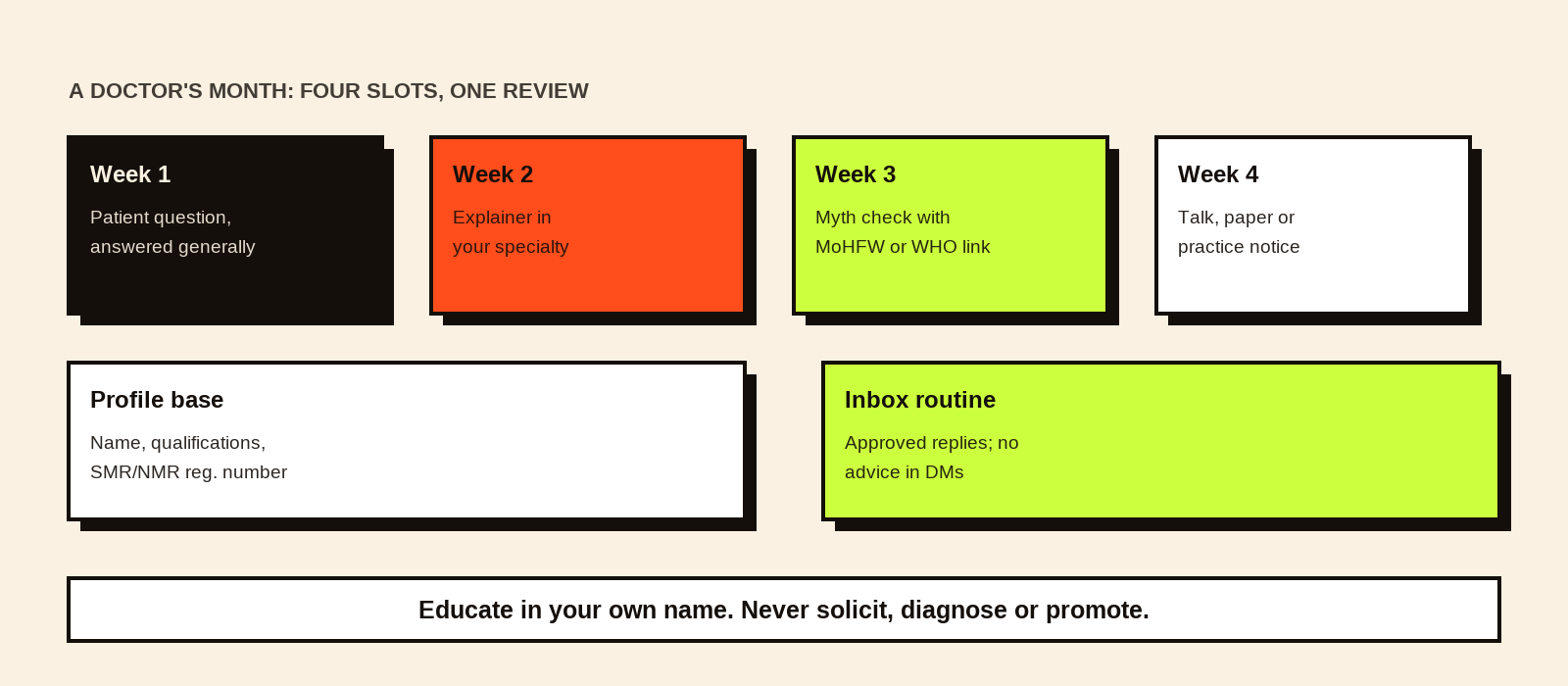
Consistency matters more than volume. Four planned posts a month, one per weekly slot, is a realistic starting point for a doctor in full-time practice; increase only if you can still review everything yourself. This framework is a suggestion, not a benchmark, and works on Instagram, LinkedIn or YouTube Shorts.
| Week | Slot | Example (general, hypothetical) | Your review |
|---|---|---|---|
| 1 | A question patients often ask, answered generally | 'Why does my doctor ask me to fast before some blood tests?' | Check every sentence; add the not-advice line |
| 2 | Explainer within your specialty | A carousel on how a common condition is usually diagnosed, in plain language | Source health facts; avoid anything that reads like individual advice |
| 3 | Misinformation check, sourced | A forwarded claim, why it's misleading, and what MoHFW or WHO actually say | Link the primary source; correct the claim, not the person |
| 4 | Professional notice or talk | A talk you gave, a published paper, a change in consultation days, or a national health day | Announcements stay factual (clause 9.3) |
Budgeting the time
- One 90-minute monthly session: pick four topics from questions you heard in OPD, outline them, and record any video in one sitting.
- If someone helps you, they turn the outlines into drafts; you review the final versions in one 30-minute block.
- Ten minutes, two or three times a week, for comments and DMs, using approved replies.
- A 'parking list' in your phone for questions worth answering next month.
If you post on LinkedIn for peers and institutions as well, our guide to LinkedIn thought leadership covers the professional-audience side; a doctor's version should still follow every rule above. For turning recurring patient questions into posts, see our guide to content from customer questions, and keep every example general.
Patients in your DMs and follow requests
A DM is not a consultation. You don't have the history, the examination or a record, and replying with advice creates a clinical interaction you can't document properly. The 2002 Regulations require you to keep patients' confidences (clause 7.14), so never discuss anyone's care in comments or confirm that someone is your patient. If you offer teleconsultation, run it through a proper channel under the rules that apply to it, not through Instagram messages.
Thank you for writing. I'm not able to give personal medical advice over social media, because I'd need your history and an examination. Please consult a doctor in person, or call [clinic number] if you'd like an appointment with me. If your symptoms are severe or sudden, please go to the nearest emergency department now.
- Decide your follow-back policy once (for example: you don't follow patients back) and apply it to everyone.
- Turn off message requests from people you don't follow if the volume becomes unmanageable; check the current setting in the platform's help centre.
- Never ask patients to follow, review or tag you.
- Screenshot and escalate threats or harassment to the platform and, where needed, the police.
Correcting misinformation without a fight
Correcting viral health myths is among the most useful things a doctor can do online, and it is squarely education. Quote the claim without naming or mocking the person who shared it, explain what is wrong in two or three sentences, and link the primary source, such as the Ministry of Health and Family Welfare or the World Health Organization. Don't speculate beyond your specialty, don't use the post to point people to your practice, and if a claim concerns a specific medicine or product, keep to what the official source says.
What help is safe to take
Clause 4.4 says publishing through an agency or other third party does not absolve a practitioner of responsibility for content they authorised or knowingly permitted. Clause 8.1(ii) lists engaging 'any third party for marketing medical services' among the practices to avoid, while clause 8.1(viii) says the engagement of advertising and digital marketing agencies must not be structured so that payment is linked to the procurement or referral of individual patients. How these apply to help with factual and educational posting is a question for your State Medical Council or legal adviser before you engage anyone.
- Lower-risk help: editing your own recorded video, designing carousels from your outline, scheduling, and flagging comments for your reply.
- Needs your full review: anyone drafting captions or scripts in your voice. You publish only what you've read and agree with.
- Avoid: anyone 'growing' the account through paid engagement, posting without your approval, replying to patients as you, or charging per enquiry or appointment.
- AI drafting tools: never paste patient information in (clause 7.2(d)), check every fact, and mark AI-generated content as clause 7.2 requires.
Your first month
Fix the bio with your registration details, write your DM reply and follow-back policy, then publish four posts using the weekly slots above. Review what people actually asked during the month and feed those questions into the next one.
If you decide, after checking with your State Medical Council, that support with editing, design and scheduling is appropriate, a social media management service such as Kudozz's content planning support can work only inside your review, with fees never tied to patients or appointments.