Social Media Management for Personal Trainers: Building Credibility and Attracting the Right Clients
A content framework for personal trainers: choosing a niche, showing real qualifications, safe demonstrations, client stories with consent and no promises, and screening enquiries before the first session.
A personal trainer with eight years on the gym floor posts what everyone posts: workout clips, a mirror selfie, a client's side-by-side photo. The DMs that arrive are mostly 'diet plan?' and 'how much for abs in a month?'. The clients they'd actually like to coach, say people returning to exercise after years off, or professionals who can only train at 6 am, never see anything that speaks to them.
Quick answer
Social media management for personal trainers starts with a clear niche and honest credentials, then a repeatable content framework: demonstrations with safety cues, your coaching point of view, how you work, and client stories told with consent and without promises. Screen enquiries with a few questions, and ask anyone with a health concern to get their doctor's go-ahead first. The goal is better-matched enquiries, not more followers.
Pick a niche you can actually serve
A niche tells the right people the account is for them, and tells everyone else politely that it isn't. Choose one or two you have the training and experience for. These are examples, not a menu you must pick from:
| Niche | Who it's for | What they need to see | Watch out for |
|---|---|---|---|
| Returning to exercise | Adults restarting after years off | Patience, basics, how you scale movements | Implying rehab skills you don't hold |
| Early-morning professionals | People with fixed work hours | Efficient sessions, scheduling, consistency | 'Results in 20 minutes a day' promises |
| Strength training for women | Women new to lifting | Technique, a comfortable setting, progress in skills | Body-shape language |
| Older adults | People in their 60s and beyond | Supported movements, slow progression | Fall-prevention or medical claims |
| Sport conditioning | Amateur runners, cricketers, footballers | Conditioning, technique, warm-ups | Answering injury questions yourself |
| Home or online training | People who can't travel to a gym | Equipment-light sessions, how video form checks work | Privacy of clients' homes on camera |
Say your niche in the first line of your bio, then make your first nine posts prove it. A visitor should be able to tell who you coach in a few seconds.
Be transparent about qualifications
List what you hold, exactly: the certificate's name, the body that issued it, the year and any specialism. If a credential has lapsed, say so or leave it off. Don't describe a certificate as 'government-certified', 'international' or 'mandatory' unless the issuing body itself uses those words, and don't imply your training covers injury treatment or diet prescription if it doesn't.
Brand deals add rules. If you're paid, or given free products, to promote supplements, apparel or apps, ASCI's guidelines for influencer advertising require a clear disclosure label, such as 'Ad' or 'Collaboration', placed where it's hard to miss. Their addendum for health and financial influencers (dated March 2025 on ASCI's page) expects people giving health and nutrition information in such content to hold relevant qualifications, such as a medical degree or certification as a nutritionist, dietician or physiotherapist depending on the advice, and to state them upfront. A personal training certificate alone may not cover nutrition advice.
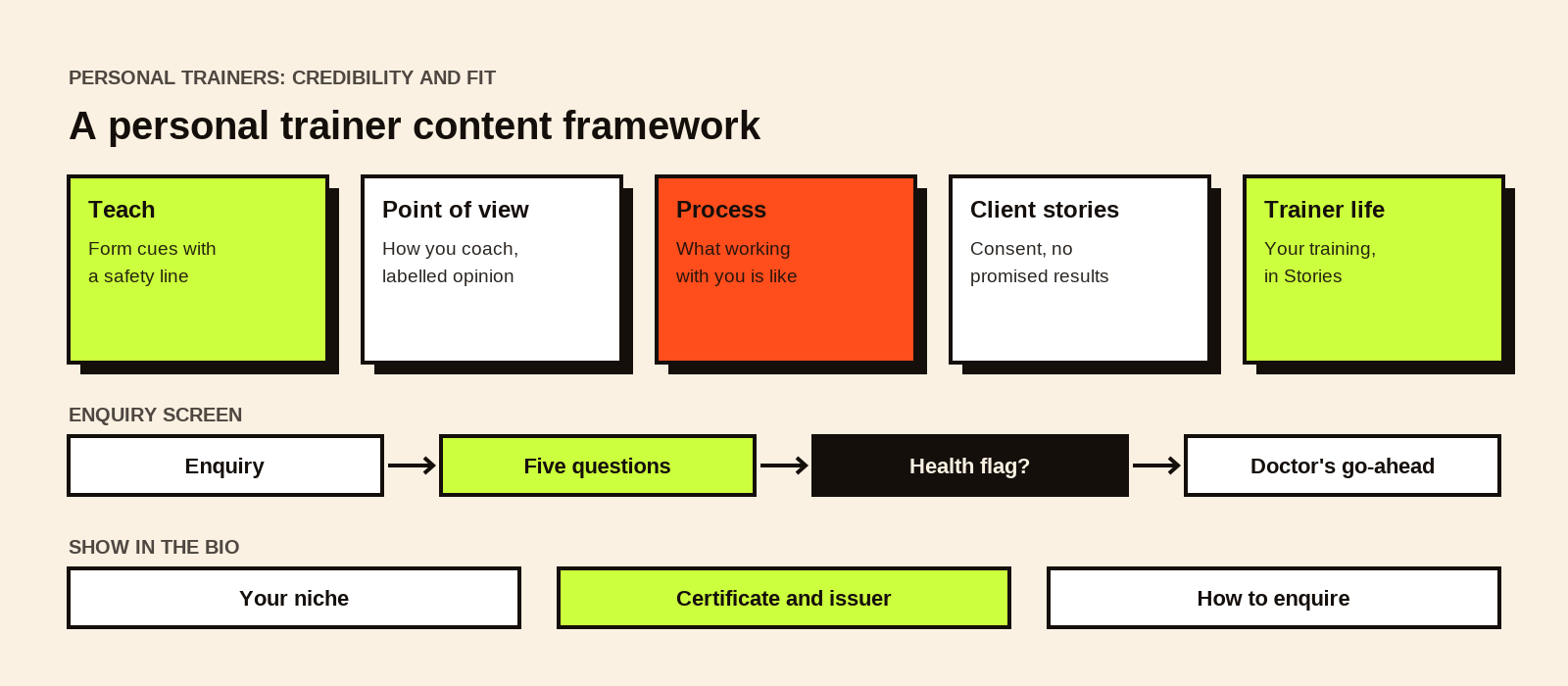
- Bio: your niche, certification name and issuer, where you train (a gym's name only with its permission, or the areas you cover) and one way to enquire.
- Pinned post: 'How I coach', with your credentials, session format and who you're not the right fit for.
- Highlights: 'Start here', 'Client stories', 'FAQs', 'Sessions and fees'.
The personal trainer content framework
Five pillars cover everything a solo trainer needs. Rotate through them so the feed never becomes only workouts or only selling.
| Pillar | Purpose | Example posts | Guardrail | Suggested rhythm |
|---|---|---|---|---|
| 1. Teach | Show you understand movement | One cue for a better squat; choosing a starting weight; scaling a push-up three ways | General information with a safety line | Weekly |
| 2. Point of view | Show how you think | 'Why I don't sell 30-day plans'; what I ask in a first session | Your opinion, labelled as such; no attacks on other trainers | Fortnightly |
| 3. Process | Show what working with you involves | First-session walkthrough; how weekly check-ins work; a blank session-plan template | No client data or screenshots of chats | Fortnightly |
| 4. Client stories | Proof, with consent | A milestone in the client's words, such as a first unassisted pull-up or a habit kept for six months | Written consent; no before-and-after or promised outcomes | Once or twice a month |
| 5. Trainer life | Personality and trust | Your own training, a course you're taking, a day on the floor | Gym's filming rules; other members out of frame | Stories, most days |
Monday: Teach (Reel)
Wednesday: Point of view or Process (alternate weeks; carousel or talking-head Reel)
Friday: Client story if one is consented and approved, otherwise Teach
Daily Stories: trainer life, available slots (real ones only), a question box
Month end: note which pillar brought enquiries from your niche, and adjust
Demonstrations with safety framing
Demonstrations build credibility fastest, and carry the most risk if someone copies them badly. Chapter III of the ASCI Code says ads must not, without justifiable reason, show dangerous practices or manifest a disregard for safety. Use this checklist before you post any exercise:
- Show the easier version first, then the progression.
- Film the whole body with the set-up visible; avoid speed edits that hide technique.
- Keep maximal lifts, extreme stretches and stunts out of content aimed at beginners.
- Name who should check with a doctor or physiotherapist first.
- Avoid calorie, fat-loss or 'spot reduction' claims in captions.
- Add the safety line below to every exercise post.
General information, not a programme for you. If you have pain, an injury or a medical condition, or are pregnant, check with your doctor or physiotherapist before trying this. Stop if anything hurts.
Client stories without transformation promises
Our fitness brands guide covers member-story consent in detail. For individual trainers the extra risk is pressure: clients like you and may find it hard to say no. Ask in writing, never mid-session, and make 'no' easy. Tell the story through what the client can now do and how they describe it, not through weight, measurements or side-by-side photos. Under the DPDP Act, 2023, consent should be clear and informed and can be withdrawn, so keep a record and act quickly on requests. For using client content as evidence responsibly, see our guide to customer testimonials and UGC.
CLIENT STORY CONSENT
I, [name], agree that [trainer] may share the post described below.
Post: [description; final caption attached]
Shows my face: yes / no     Uses my name: first name / full name / none
Platforms: [ ]     Stays up until: [date], or until I withdraw
I can withdraw this consent at any time by messaging [number]; the post will be removed within [x] days.
I have / have not received anything in return for this: [state what, if anything]
Signed: ________     Date: ________
Qualifying enquiries before the first session
Screening protects both of you. It filters out people looking for a crash diet, and it flags anyone who needs medical clearance before training. Send a short set of questions in reply to every serious enquiry:
Thanks for your message! A few quick questions so I can tell you honestly whether I'm the right trainer for you:

1. What would you like to be able to do in six months?
2. How much exercise have you done in the past year?
3. Which days and times can you train, and where (gym, home, online)?
4. Do you have any injury, pain or medical condition, or are you pregnant? You don't need to share details here. If yes, I'll ask you to get your doctor's go-ahead before we start.
5. What monthly budget are you working with?
Before training starts, many trainers use a written pre-activity health questionnaire in the style of the PAR-Q. Its job is to flag who needs medical clearance; the clearance comes from a doctor, not from you. If an answer raises a concern, refer rather than reassure. If someone isn't a good fit for your niche, say so and point them to a better option. Diet-plan requests go to a qualified dietician or nutritionist.
If you train clients inside someone else's gym
Many trainers work from a gym they don't own. Before you build an account around it, agree with the gym whether you can film on the floor, how other members are kept out of frame, whether you may name the gym, and what happens to your client relationships if you leave. Collaborative posts with the gym's account can help both sides. The gym's own content, from local awareness to renewals, is covered in our guide to social media marketing for gyms.
Where trainers go wrong
- Trying to coach everyone, so the feed convinces no one.
- Vague credentials ('certified coach') with no issuer or year.
- Before-and-after photos and 'transform in 12 weeks' captions.
- Giving diet plans or injury advice in DMs.
- Promoting supplements or apparel without a disclosure label.
- Posting slot scarcity that isn't real.
Start with your bio and five posts
Rewrite your bio with your niche and exact credentials, pin a 'How I coach' post, and publish one post from each pillar over two weeks. Send the screening message to every enquiry and note which posts brought people who matched your niche. That note is your plan for next month.
Kudozz's social media management is built for businesses with ongoing content needs; a solo trainer may find this framework enough to run alone, and bring in help with planning, copywriting and editing only when content starts taking hours that should go to coaching. If brands approach you for paid content, our guide to influencer marketing for sports and fitness brands explains how those partnerships usually work from the brand's side.