How Architects Can Build a Strong Social Media Presence Without Sharing Only Project Photographs
Eighteen post ideas for architecture firms beyond finished photographs, how to split Instagram, LinkedIn and Pinterest, and what to check against the Council of Architecture's professional conduct rules before you publish.
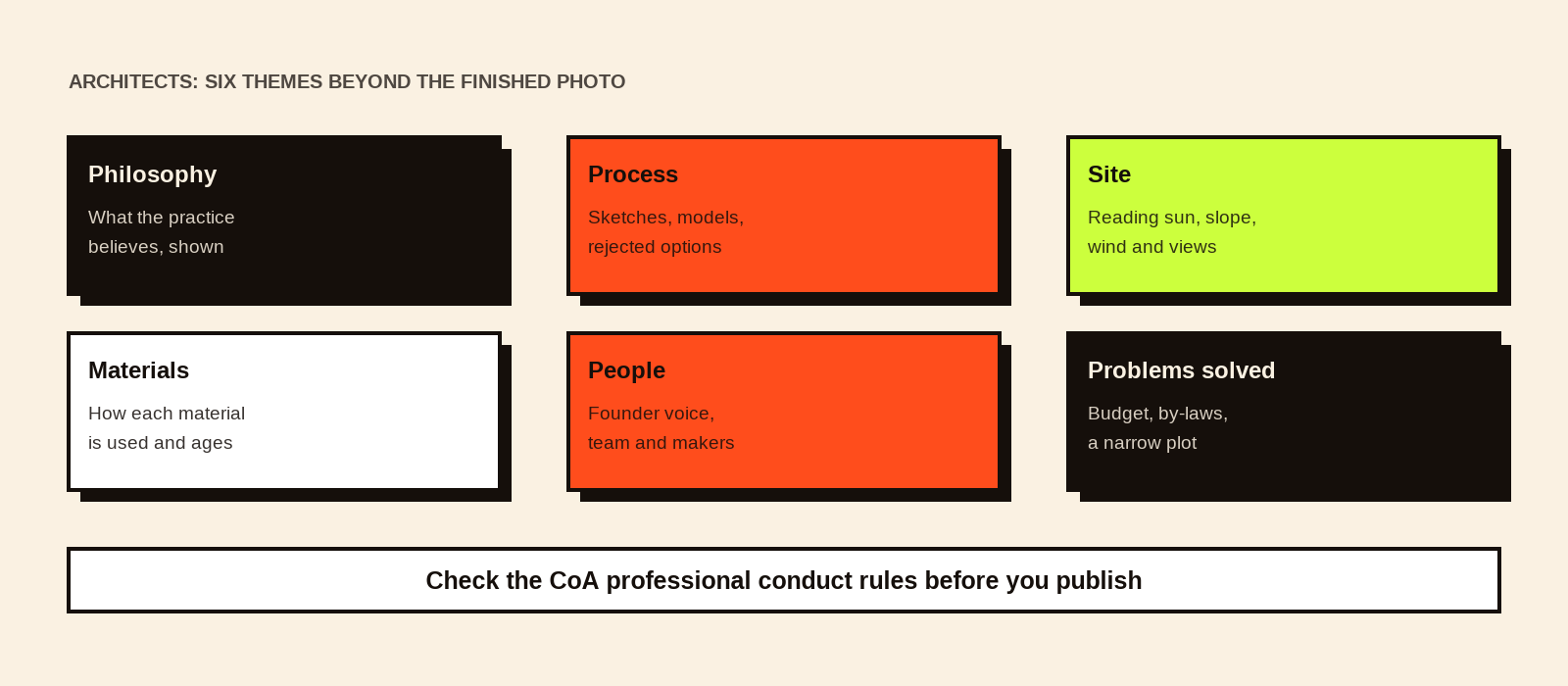
An architecture practice has a finished house it can't photograph yet because the landscaping isn't done, a hospital project under a confidentiality clause and an office building still on paper. The Instagram grid hasn't changed in two months. Meanwhile the partners spend every week solving problems that would make excellent content: a difficult slope, a tight budget, a heritage facade. The practice isn't short of material, only of a way to see it as content.
Quick answer
Architects build a strong social presence by sharing how they think, not only what they've built: design philosophy, sketches and concept development, site visits, material choices and problems solved. Give Instagram, LinkedIn and Pinterest different jobs, turn the practice's expertise into a weekly rhythm, and keep sustainability claims to what is verified. In India, check the Council of Architecture's professional conduct rules on advertising before you publish or promote anything.
Check the professional rules first
Architects in India work under rules that most brands don't. The Architects (Professional Conduct) Regulations, 1989, published by the Council of Architecture (CoA) and amended in 2003, say in regulation 2(1)(xxv) that an architect shall not advertise their professional services or allow their name to be used for publicity, except in listed situations. Breaching the regulation is treated as professional misconduct.
The listed exceptions, as published on the CoA website at the time of writing (November 2026), include allowing your name to be associated with illustrations and descriptions of your work in the press or other public media, provided you don't give or take any payment for those appearances; brochures describing your experience for named potential clients; and listings in directories or on a website. The regulations predate social media and don't mention it directly, so how they apply to a firm's Instagram or LinkedIn activity is a question of interpretation.
- Before you post, promote or boost anything, check the current regulations and any later CoA guidance on the CoA website, and ask the CoA or a lawyer familiar with the Architects Act if you're unsure.
- Content that describes and explains your work is closer to what the exceptions allow than content that sells your services.
- Be cautious with paid promotion of your services, paid features and paid creator content about your practice. Check before you spend.
- Don't make claims about other architects' work or fees, and don't solicit their clients. The regulations also cover fair competition.
- Only registered architects (and firms of architects) may use the title 'architect' under section 37 of the Architects Act, 1972, so make sure team bios are accurate.
Everything in the rest of this guide is written with that in mind: it focuses on explaining your work and sharing knowledge rather than advertising. Your partners, not your social media team or agency, are responsible for the practice's professional compliance.
Give each platform a job
| Platform | Its job for an architecture practice | Content that suits it |
|---|---|---|
| Show the work and the thinking visually | Sketch-to-built Reels, site visits, material close-ups, carousels on a single decision | |
| Professional credibility with developers, institutions, consultants and future hires | Problem-solving write-ups, founder perspectives, awards and publications, hiring, events | |
| A long-life library of finished spaces and details | Completed projects, details, material palettes, organised into searchable boards |
LinkedIn deserves particular thought, because many commissions for larger projects begin with people rather than pages. The firm's page should be the official record; partners' own profiles carry opinion and voice. Our guides to LinkedIn company page management and LinkedIn thought leadership cover each side. For Pinterest set-up and board structure, see Pinterest marketing for business.
18 post ideas beyond the finished photograph
Each idea below can become a recurring series rather than a single post. All of them depend on client permission where a real project is shown, and on keeping confidential details, such as unpublished plans or security-sensitive layouts, off social media.
| # | Post idea | Format | Best platform |
|---|---|---|---|
| 1 | The design philosophy in one sentence, then three projects that show it | Carousel | Instagram, LinkedIn |
| 2 | Sketch to built: the first napkin sketch next to the finished space | Reel or carousel | |
| 3 | The brief problem: what the site or client needed, before any design | Carousel | |
| 4 | Three options we rejected, and why | Carousel | Instagram, LinkedIn |
| 5 | Site visit diary: what we check on a site and why | Reel | |
| 6 | Reading a site: sun path, wind, slope, neighbours and views | Annotated photo set | |
| 7 | Model-making or massing studies at the concept stage | Reel | |
| 8 | Material focus: one material, where we used it and how it ages | Carousel | Instagram, Pinterest |
| 9 | Detail of the week: a junction, stair, window or joint explained | Photo with caption | Instagram, Pinterest |
| 10 | Plans explained simply: how to read the drawing of one project | Carousel | LinkedIn, Instagram |
| 11 | Working with constraints: budget, by-laws or a narrow plot | Write-up | |
| 12 | Climate response: shading, ventilation or daylight decisions with the reasoning | Carousel | Instagram, LinkedIn |
| 13 | Before the architect: what clients should prepare for a first meeting | Carousel | |
| 14 | A day in the studio: pin-ups, reviews and the people behind the work | Reel or Stories | |
| 15 | Founder's view on a city or industry issue | Text post or short video | |
| 16 | Revisiting a building years later: what worked and what we'd change | Carousel | LinkedIn, Instagram |
| 17 | Collaborators: engineers, craftspeople and consultants who made it work | Carousel | |
| 18 | Answering a common question: approvals, timelines in general terms or the design process stages | Short video |
Ideas 13 and 18 are useful because they answer the questions clients ask in first meetings, which means they also help the right people self-select. Keep these general and educational. Avoid promising approval outcomes or timelines, since those depend on authorities and conditions outside your control.
Sustainability content without greenwashing
Sustainability is a natural subject for architects, and an easy one to overstate. Words such as 'green', 'eco-friendly', 'net zero' or 'sustainable building' are claims. If a project holds a green building rating, name the rating system and the level exactly as certified, and check the certifying body's rules on using its name or logo. If it doesn't, describe the specific measures instead: 'deep overhangs on the west facade', 'rainwater harvesting tank sized for the roof area', 'locally quarried stone'.
- No certification, rating or award mentioned unless the project actually holds it.
- No performance figures (energy, water, temperature) unless they come from measured data you can share.
- Design intent is labelled as intent: 'designed to reduce heat gain', not 'reduces heat gain by X'.
- No implied comparison with other buildings or architects that you can't support.
Founder-led and team-led content
In most practices, the founder or principal is the most recognisable voice. Short videos of the principal explaining a decision on site, or a LinkedIn post on a design question, often carry more conviction than a polished firm post. They don't need to be produced; they need to be clear and specific.
Bring the team in too. Credit the project architects and designers by name on posts about their work, with their agreement, and let them present their own details or sketches. It is fair to the people who did the work, and it shows prospective hires what working at the practice is like.
Turning expertise into a repeatable calendar
The practices that stay consistent set a simple weekly rhythm and fill it from work already happening. Give one person, in-house or at an agency, the job of collecting material from site visits, reviews and partner conversations every week. Our guide to building a monthly social media content calendar explains how to run the planning meeting and keep a backlog.
Monday: Detail of the week (Instagram, Pinterest)
Wednesday: Process post: sketch, model, site visit or rejected options (Instagram)
Thursday: Problem-solving write-up or founder perspective (LinkedIn)
Friday: Studio life or collaborator credit (Instagram Stories, LinkedIn)
Monthly: One project story told across a carousel, a Reel and a LinkedIn post
Standing check: client permission confirmed, no confidential details, wording reviewed against the professional conduct rules
Planning and approvals are where an outside team helps most. An agency can run content planning and turn partners' voice notes and site footage into posts, while the partners keep final sign-off on anything that touches professional conduct.
Common mistakes
- Posting only completed projects, so the feed stalls between handovers.
- Treating social media like advertising without checking the professional conduct rules.
- Sharing client projects, plans or interiors without written permission.
- Using sustainability language or certifications the project doesn't hold.
- Letting team members call themselves architects when they aren't registered.
- Posting the same file on every platform instead of giving each one a job.
Interior design studios share many of these challenges, especially around client homes and photography rights. Our companion guide on social media marketing for interior designers sets out a stage-by-stage capture framework that works for residential architecture projects too.
Where to start
Read the current professional conduct regulations with your partners and agree what the practice is comfortable publishing. Then pick five ideas from the list above, assign one person to collect material each week, and run that rhythm for a quarter before judging it.
If the practice needs help with planning, editing and publishing, what a social media management agency like Kudozz includes is set out on our service page, with the partners remaining responsible for professional and client approvals.